
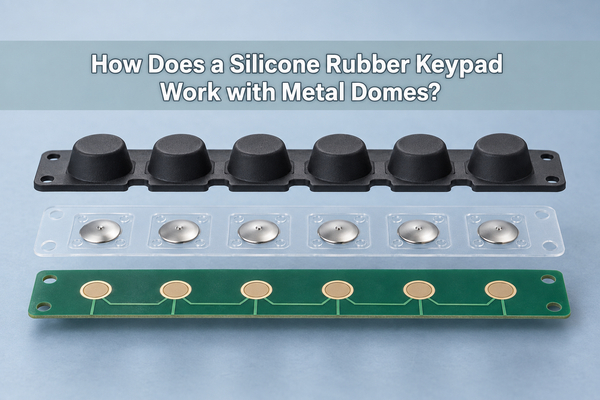
A silicone rubber keypad is a molded elastomer layer that forms the visible keys and flexible return webs above an electrical contact system. The contact may be a conductive carbon pill, but it can also be a metal dome or dome array when the product needs a sharper snap, a controlled force curve and a low-profile momentary switch. A reliable design therefore depends on the complete stack, not the silicone part alone.
What Is a Silicone Rubber Keypad?
A silicone keypad, rubber keypad or elastomeric keypad is a single molded sheet with individual key tops connected by flexible webs. Pressing a key deforms its web, moves an actuator toward the circuit and then allows the key to return after release. The silicone layer can provide the user surface, key spacing, legends, light control and part of the environmental seal.
The silicone rubber keypad is not automatically the electrical switch. Electrical closure occurs at the interface below it. That distinction is important because the keypad manufacturer, circuit supplier and metal-dome supplier must agree on travel, force, datums and contact geometry before tooling is fixed.
Should the Keypad Use Carbon Pills or Metal Domes?
A conductive silicone rubber keypad normally uses carbon pills molded or bonded beneath the key actuators. The pill bridges printed PCB contacts when the key collapses. This route can be economical for broad key areas and soft feel. A metal-dome route places a formed stainless spring contact over a center pad and outer contact. The dome snaps through at a defined load, closes the circuit and recovers when the load is removed.
| Contact system | Main tactile source | Key design concern | Typical reason to choose it |
|---|---|---|---|
| Conductive carbon pill | Silicone web and pill compression | Pill alignment, resistance and contact cleanliness | Softer response and integrated molded contact |
| Metal dome | Elastic snap-through of the dome | Center loading, over-travel, pad support and venting | Crisp tactile confirmation and controlled switching point |
| Polydome | Formed polyester dome | Film geometry and environmental window | Low-profile alternative with different tactile behavior |
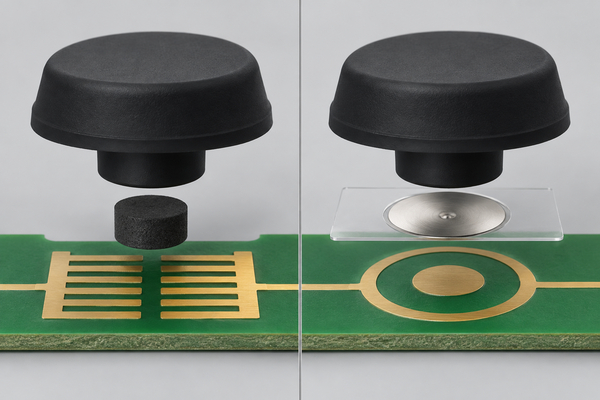
Neither option is universally better. Select the contact system from the required feel, resistance, environmental exposure, life target, available height and assembly process. When metal domes are chosen, a rubber-glue metal dome array can retain the contacts on a registered carrier for installation beneath the silicone keys.
How Does the Complete Keypad Stack Work?
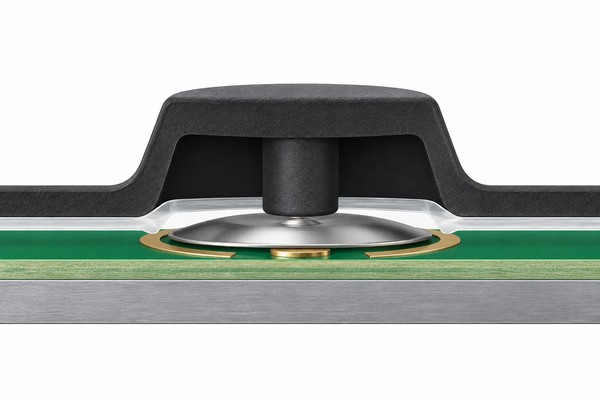
The full stack usually includes the silicone key and web, a molded actuator or separate plunger, a spacer or carrier, adhesive, the contact element, PCB or FPC pads and a rigid housing support. The key web supplies return motion, while the metal dome supplies the electrical event and much of the snap sensation.
The nominal heights must add up without unintended preload. If the actuator rests too heavily on the dome, the key can feel stiff or remain near collapse. Too much free space creates lost motion, rattle and a delayed click. A housing stop should limit movement after actuation so the silicone key does not flatten or overload the dome.
How Do Web Geometry and Dome Force Shape the Tactile Feel?
The silicone web has its own force-displacement curve. Wall angle, web thickness, key area, silicone hardness and molded travel affect the load before the actuator reaches the dome. The dome adds trip force, return force, travel and click ratio. The user feels the combined curve through the keycap, not either component in isolation.
- Define the target key force at the visible key surface, not only at the loose dome.
- Keep actuator contact centered so the dome does not collapse from one edge.
- Control preload and free travel across key-to-key stack tolerances.
- Use a mechanical stop to limit over-travel after electrical closure.
- Approve the force curve on production-intent keypad, carrier and PCB samples.
When Does a Plunger Dome Array Improve the Design?
A molded silicone actuator can contact the dome directly when its diameter, height and alignment are suitable. A separate plunger can be useful when the key needs additional height, a smaller force-transfer point or tighter alignment control. Our plunger dome array integrates the actuator with the registered carrier so the force path is controlled at the array level.
The plunger should not contact the unsupported dome edge or become a substitute for proper housing guidance. Its diameter, flatness, height and tolerance must match the selected dome and silicone key. An oversized plunger can suppress the snap; an undersized or offset plunger can concentrate stress and produce inconsistent feel.
How Should PCB or FPC Contacts Be Designed?
For a silicone rubber keypad PCB interface with a metal dome, the circuit normally uses an isolated center pad and an outer contact region. The dome perimeter rests on the outer contact and bridges to the center only after snap-through. Solder mask, vias, raised copper, residue and uneven support must stay out of the active contact area.
- Match pad geometry to the released dome drawing instead of a generic footprint.
- Use common datums for the silicone keypad, array carrier, circuit and housing.
- Support an FPC contact region so it does not flex excessively during actuation.
- Control surface finish, cleanliness and flatness in the electrical contact area.
- Keep a vent path open without routing contamination toward the contacts.
How Do Sealing, Adhesive and Venting Work Together?
The silicone sheet can help seal the front surface, but the finished environmental rating belongs to the entire enclosure. Perimeter compression, screw spacing, gasket design, keypad flange, housing stiffness and cable exits all matter. The dome cavity also changes volume as the key is pressed, so trapped air needs a controlled route.
Adhesive openings should retain the dome and seal the intended area without blocking the vent. A custom dome array can register dome positions, adhesive windows, tail geometry and vent channels to the customer layout. The drawing should state the surface material and temperature range because adhesive behavior depends on the mating surface and environment.
How Can a Silicone Rubber Keypad with LED Backlighting Be Built?
A silicone rubber keypad with LED lighting may use translucent silicone, molded light pipes, laser-etched legends, a white reflective coating or a separate light guide. The mechanical stack must prevent the light-control layer from changing the actuator height or interfering with dome movement.
For thin, distributed illumination, an LGF dome array can combine a light guide film with the dome carrier. LED position, optical dots, opaque masks, legend location and key-to-key brightness must be reviewed together. A lighting concept should be checked in the actual housing because internal ribs, dark silicone and PCB components can create hot spots or shadows.
When Is EMI Shielding Needed?
Silicone rubber keypad EMI shielding may be required when the control surface is near sensitive circuits, long flex tails, RF modules or electrostatic discharge paths. The keypad itself does not create an automatic shield. The design may need conductive printing, grounded films, gasket features or a defined chassis connection.
An EMI metal dome array can add a shielding or grounding feature to the array construction, but it must be tied into the product grounding strategy. Confirm the grounding points, clearance from signal contacts and durability through the expected environmental and actuation cycles.
What Happens During Silicone Rubber Keypad Manufacturing and Assembly?
Silicone rubber keypad manufacturing typically molds the elastomer first, followed by trimming, color or coating operations, legend printing or laser processing and inspection. That is a different process from producing the metal dome and registered dome array. The two parts meet during assembly, so their datum scheme and tolerance stack must be defined before production tooling is approved.
EBest Circuit(Best Technology) focuses on metal domes, dome arrays and related tactile interface components. We can review a custom silicone rubber keypad layout and develop the matching dome-array geometry from CAD, PDF, Gerber, PCB/CAM files or customer drawings. Depending on the key layout, the supply format may be a full custom dome array or separate single-key dome array units.
Which Tests Find Keypad Failures Before Production?
Testing must use the complete keypad stack. EBest Circuit(Best Technology) can evaluate trip force, rebound force and life-cycle behavior for the selected metal dome or array, while finished-product validation should also include the customer housing, silicone part, circuit support and environment.
| Test | What it reveals | Typical failure to investigate |
|---|---|---|
| Force-displacement and electrical timing | Combined feel and switching point | Preload, off-center actuator or excessive over-travel |
| Key-to-key comparison | Consistency across the keypad | Stack-height, web or carrier variation |
| Life cycling | Mechanical and electrical drift | Dome fatigue, adhesive shift or contact wear |
| Temperature and humidity exposure | Material and adhesive stability | Slow return, bond loss or resistance change |
| Dust, liquid and chemical checks | System-level sealing performance | Ingress path, contamination or coating damage |

Prototype failures such as weak click, edge-only operation, slow return, double actuation or intermittent closure should be traced to the responsible layer. Replacing the dome without checking actuator alignment and circuit support can hide the symptom without fixing the stack.
What Should You Send to a Silicone Keypad and Dome Array Supplier?
For an OEM silicone rubber keypad project, send the key layout, 2D and 3D stack dimensions, circuit pad drawing, target key force and travel, silicone hardness, actuator diameter, key legends, lighting method, sealing level, operating environment, life target, packaging preference and forecast quantity. Identify whether the silicone supplier is already selected and which component controls the final datum.
A silicone rubber keypad manufacturer may focus on molding and legends, while our engineering review covers the metal contact and array interface. EBest Circuit(Best Technology) can compare round dome, custom dome, dome array and plunger-array routes without claiming to replace the silicone molding supplier. Send the production-intent files and project requirements to sales@metal-domes.com.
When every layer is reviewed as one system, the silicone rubber keypad can deliver a consistent tactile response, stable electrical closure and an assembly path that is practical for repeated production.