
Automotive soft-touch button materials are getting renewed attention because many drivers still need physical controls they can locate by touch, press confidently and use without navigating multiple screen menus. The return of physical buttons is not simply a styling choice; it depends on surface materials, actuator geometry, metal dome force behavior, contact stability and the way the button stack survives heat, humidity and repeated use.
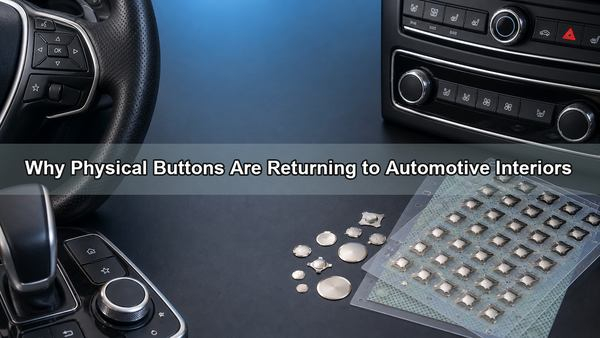
For automotive interiors, a useful button design must combine a pleasant surface feel with a clear electrical and mechanical response. That is where metal domes, custom dome arrays, SMD dome switches, PET spacers and PCB or FPC contacts become important inside the larger HMI design.

Why Are Physical Buttons Returning to Automotive Interiors?
Physical buttons are returning because some vehicle functions are faster and safer to operate when the driver can identify them by position, shape and click feel. Climate control, defrost, hazard lights, volume and steering-wheel commands are common examples because they are used repeatedly and often need immediate confirmation.
Touchscreens are effective for navigation, media browsing and configurable menus, but they often require visual attention. A well-designed physical button gives the driver three signals at once: location, resistance and click confirmation. That combination is difficult to replace with a flat surface alone.
What Do Automotive Soft-Touch Button Materials Need to Do?
Automotive soft-touch button materials must provide surface comfort, wear resistance, stable color, chemical tolerance and controlled feel across the vehicle life cycle. A soft surface that feels premium in the showroom can still fail the project if it becomes sticky, glossy, cracked or inconsistent after temperature cycling and repeated pressing.
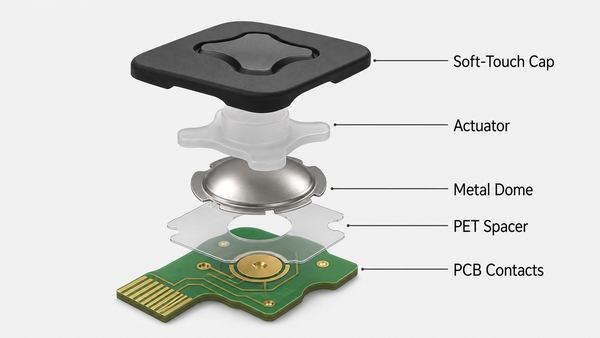
The visible material is only one part of the stack. The final feel also depends on actuator height, button cap stiffness, dome diameter, dome force, spacer thickness, venting, PCB pad geometry and assembly tolerance. If any of these elements changes, the same exterior material can feel softer, harder, mushier or louder.
| Layer or Feature | Engineering Role | RFQ Check |
|---|---|---|
| Soft-touch cap | Defines surface texture, perceived quality and finger comfort | Material, coating, color, texture, cleaning exposure |
| Actuator or plunger | Transfers finger force to the dome and controls travel path | Height, diameter, alignment, interference risk |
| Metal dome | Creates snap feel and closes the circuit | Shape, size, trip force, travel, click ratio, plating |
| PET spacer or adhesive | Maintains air gap, location and contamination protection | Thickness, adhesive type, vent holes, alignment holes |
| PCB or FPC contacts | Provides fixed contact pads for electrical closure | Pad diameter, finish, gap, solder mask clearance |
How Do Physical Buttons Improve Blind Operation?
Physical buttons improve blind operation by giving the finger a fixed target and a mechanical response before the driver needs to check the screen. Shape, spacing and force curve all matter. A button that is easy to locate but too light can cause accidental activation; a button that is too stiff can feel slow or tiring in repeated use.
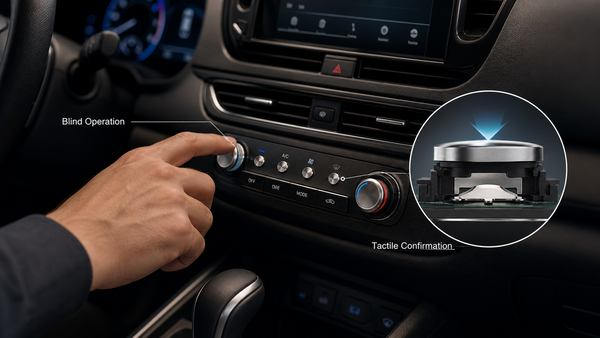
Metal dome selection helps control this balance. Trip force determines how much pressure is needed to actuate the button. Travel and click ratio shape the snap feel. Return force affects how quickly the button resets. For an automotive panel with several keys, matching these values helps each button feel intentional rather than random.
Where Do Metal Domes Fit in Automotive Button Design?
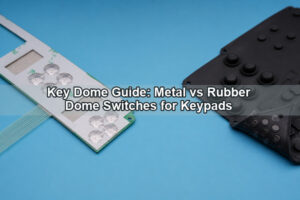
Metal domes fit between the visible button mechanism and the circuit contacts. They act as both spring and contact element: the dome resists finger pressure, snaps through at a defined force and completes the circuit when it touches the pad below.
EBest Circuit(Best Technology) supports circle, four-leg, triangle, oblong and custom metal dome options. For automotive controls, the engineering conversation should include force value, plating, dome size, working temperature, contact resistance, expected life cycle and how the dome will be retained in the keypad stack.
How Do Dome Arrays Support Consistent Tactile Confirmation?
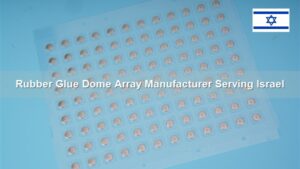
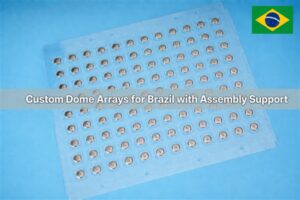
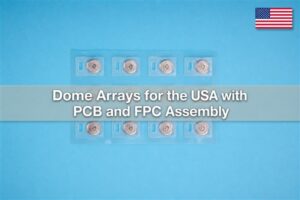
Dome arrays support consistent tactile confirmation by fixing multiple metal domes on a PET or Mylar carrier sheet. Instead of manually placing individual domes, the assembly team aligns one sheet to the PCB, FPC or membrane circuit. This reduces placement variation and helps each key maintain its intended feel.
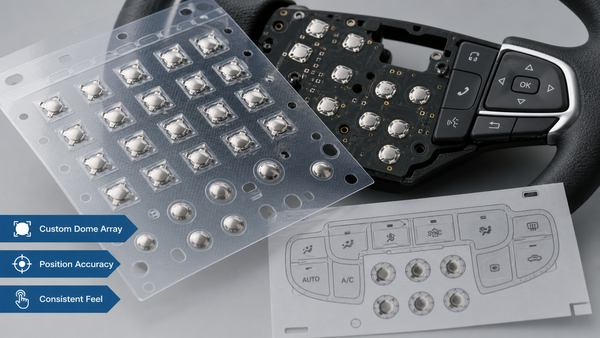
A custom dome array can include different dome sizes, shapes and force values on the same sheet. It can also include vent holes, alignment holes, spacer layers, rubber glue, EMI printing or light guide film when the keypad structure requires them.
For automotive interior panels, dome arrays are especially useful in steering wheel switches, climate panels, seat controls, console controls and other multi-key layouts where position accuracy and force consistency are more important than the lowest individual component cost.
Which Materials Are Commonly Used Around Soft-Touch Buttons?
Common material choices include ABS, PC/ABS, silicone rubber, TPU, TPE, coated plastic, painted plastic, laser-etched caps, PET adhesive layers and stainless steel metal domes. Each material solves a different part of the interface problem, so the design should be reviewed as a stack rather than as a single material decision.
- Use silicone or elastomeric surfaces when sealing, soft feel or complex geometry is required.
- Use molded plastic caps when the button needs sharper edges, stable lettering or tight dimensional control.
- Use PET or Mylar spacer layers when the dome needs controlled air gap, alignment and clean retention.
- Use stainless steel metal domes when the interface needs a crisp snap, repeatable force and compact height.
- Use an SMD dome switch when SMT placement and low-profile PCB assembly are more important than a laminated dome array.
What Durability Tests Matter for Automotive Button Feel?
Durability testing should verify that the button still feels and functions correctly after mechanical, environmental and handling stress. The test plan depends on the vehicle program, but the metal dome portion should not be evaluated only by appearance.
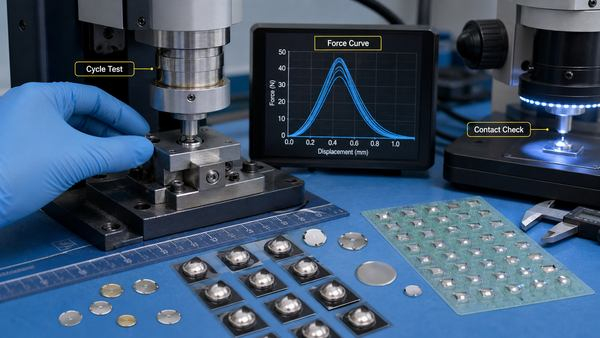
Useful checks include force-displacement curve, actuation force drift, contact resistance, contact bounce, life-cycle pressing, temperature exposure, humidity exposure, salt or contamination risk and visual inspection for deformation or burrs. EBest Circuit(Best Technology) provides Metal Dome Test Criteria references that can support specification review before prototype or mass production.
When Should Designers Use Custom Metal Domes or SMD Dome Switches?
Use custom metal domes when the project has a special force target, unusual button geometry, limited height, custom pad layout or a tactile feel that cannot be achieved with a standard dome. Use an SMD dome switch when the design is closer to a PCB-mounted component and needs tape-and-reel SMT assembly.
The decision usually depends on the full interface structure. A steering-wheel switch module may need a custom dome array because many keys must be aligned together. A compact PCB control board may use SMD dome switches for automated placement. A membrane-style control panel may use single-layer or double-layer dome arrays with adhesive and vent holes.
What RFQ Information Should Be Confirmed Before Prototype?
Before requesting a prototype, confirm the structure and performance targets instead of sending only a button name. For automotive soft-touch button materials, the supplier needs enough data to review both the surface material and the tactile contact system.
- Button function, layout drawing and number of keys
- PCB, FPC or membrane contact drawing, preferably with Gerber or CAD files
- Target trip force, travel, click ratio and operating life
- Button cap or actuator height, diameter and tolerance
- Required dome shape, plating, size or sample reference
- Operating environment, cleaning exposure and temperature range
- Prototype quantity, validation schedule and expected mass production volume
- Preferred assembly method: loose dome, peel-and-place array, custom dome array or SMD dome switch
If the design is still open, contact EBest Circuit(Best Technology) with the panel layout, target feel and expected production volume. The engineering review can narrow the choice between loose metal domes, dome arrays and SMD dome switches before tooling or pilot production.
FAQ About Automotive Physical Buttons?
1. Why are physical buttons returning to car interiors?
They are returning because certain functions are easier to operate by touch when the driver needs quick confirmation. A physical button provides location, resistance and click feedback without forcing every action through a screen menu.
2. Are soft-touch button materials only about the surface?
No. The surface material affects comfort and appearance, but the final feel also depends on the actuator, metal dome, spacer, contact pad and assembly tolerance.
3. How does a metal dome create tactile feedback?
A metal dome stores force as it is pressed, then snaps through at a defined trip force. That snap creates the click feel and closes the electrical contact.
4. When is a custom dome array better than loose metal domes?
A custom dome array is better when multiple keys need accurate placement, consistent feel and faster assembly. It is especially useful for steering wheel controls, climate panels and membrane-style keypads.
5. What should be sent for an automotive button RFQ?
Send the layout drawing, circuit files, target force, dome or button samples, environmental requirements, prototype quantity and expected production volume.
Conclusion
The return of physical controls in automotive interiors is a practical HMI decision, not a rejection of screens. The strongest designs use the right surface materials for comfort, the right metal dome or dome array for tactile confirmation and the right test criteria for long-term consistency.
If your project needs metal domes, dome arrays or SMD dome switches for automotive physical buttons, send drawings and target specifications to sales@metal-domes.com, or contact EBest Circuit(Best Technology) for engineering and quotation support.