
We supply custom dome arrays for Brazil, from adhesive dome carriers to arrays assembled onto PCB or FPC and coordinated membrane-switch projects. At EBest Circuit(Best Technology), we manufacture in China and work directly with Brazilian OEM, EMS and electronics teams. Our aim is to provide the tactile component in the form your production process needs.

Choose how your dome arrays arrive
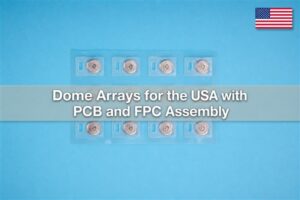
A dome array holds metal domes in defined positions on an adhesive film, allowing them to be placed over the circuit contacts together. You can receive that tactile layer alone or include related assembly work. The useful distinction is how much interface assembly remains at your facility.
| Supply scope | What is included | Work retained by your team |
|---|---|---|
| Custom dome array | Selected domes on a carrier cut to the agreed layout | Array alignment and application to your circuit, followed by product integration |
| Dome array with circuit assembly | Array assembled onto the agreed PCB or FPC | Connection to the electronics and installation in the equipment |
| Coordinated keypad or membrane-switch project | Array, circuit and related interface work within the approved scope | Final equipment integration and product-level validation |
The third option is defined by the individual project; it does not automatically include a complete electronic device or enclosure. Agreeing the assembly boundary early keeps the delivered interface and your remaining production steps clear.
Custom geometry for Brazilian electronics projects
We build the array around the contact pattern and key mechanism. Our custom dome arrays can include different dome sizes, shapes and forces on one carrier, with the outline and cutouts adapted to the circuit.

This is useful when an interface combines several small navigation keys with larger function keys, or when the circuit contains openings that the carrier must avoid. Dome centers, actuator positions and electrical contact geometry must remain aligned; changing only the film outline is not enough.
Where a key needs an added actuator feature, our plunger dome arrays can be evaluated against the available height and travel. For backlit interfaces, our LGF dome arrays combine the tactile layer with light guide film. Both options require review of the finished keypad stack rather than an assumption that they fit every existing enclosure.
Selecting tactile force and actuator travel
Select the dome force for the assembled key, including the effect of the overlay and actuator. The component’s trip force describes its snap point; the finished control may feel different when its mechanical layers are added.
Check that the actuator reaches the intended contact area and allows the dome to return fully. Limit travel to the selected dome specification rather than assuming every series stops at the same position. For Brazilian industrial or handheld projects, this makes the chosen tactile response part of the interface design instead of a force value considered on its own.
Aligning the carrier during local assembly
When the array is supplied separately, align the complete carrier to the circuit before bonding it. Use the agreed reference features to check dome centers and cutouts together; a correct outer edge does not by itself prove that every dome sits over its contact pattern.
Peel the release liner only when ready to apply the array. During placement, follow the approved bonding method and avoid a roller or rigid tool pressing across the dome crowns. Keeping this step controlled lets your Brazilian assembly team use the pre-positioned pattern without damaging its tactile elements.
Applications in industrial and electronic interfaces
Dome arrays provide a compact tactile interface for industrial controls, payment equipment and handheld electronics. These are design applications that Brazilian teams can discuss with us, not named customer installations.
Industrial keyboards and operator controls
A multi-key carrier places the tactile contacts in one defined pattern beneath the keypad. The important check is the feel and release of each assembled key, including the effect of its overlay and actuator. A consistent dome part cannot compensate for an unsupported circuit or an off-center key mechanism.
Payment terminals and compact electronic keypads
The array can keep several switching positions organized in a small area. Contact-pad alignment, carrier cutouts and the connection between the keypad circuit and the main electronics need to be designed together. Supplying the tactile interface does not imply certification of the complete payment device.
Handheld instruments
PCB-mounted arrays suit rigid button areas, while FPC can help route the connection within a compact housing. The switching area of an FPC still needs firm mechanical support. Where illumination is required, evaluate the light guide through the actual legends and overlay.

Prototype validation before repeat production
A representative prototype should reproduce the supplied assembly boundary and the finished key mechanism. If we supply an array on a circuit, evaluate that assembly with the intended overlay and housing support, rather than approving only the loose tactile sheet.
Confirm key response, electrical closure and release, and physical fit. Use a consistent test method when comparing samples, then record the approved configuration and acceptance conditions. Recheck the relevant functions after a change to dome type, carrier, circuit support or actuator; an earlier sample approval does not automatically cover a revised stack.
Bringing PCB, FPC and membrane-switch work together
Coordinating the array and related circuit work through one project can reduce repeated communication between separate suppliers. We can review the dome layout alongside PCB or FPC drawings and the membrane-switch structure, so an interface change is considered across the connected parts.

Keeping revisions consistent across the assembly
Keep the array, circuit and overlay on one controlled interface revision. This gives our team and your production team a shared definition of the assembly, particularly when related parts are released at different times.
For example, moving a key affects more than one drawing: it may change the dome position, circuit contact, overlay legend and actuator. Handling those interfaces together helps avoid approving each part in isolation. The final assembly still needs checks for tactile response, electrical switching and fit in the intended equipment.
Identify which version is approved for the next build and keep superseded samples separate from that reference. Coordinated supply is most useful when the drawing change is communicated across the complete interface, not only to the supplier of the visibly changed part.
Our experience manufacturing metal dome arrays and individual domes dates to 2006. For your project, this means being able to discuss the tactile layer and its related assembly scope with the same team.
Packaging and delivery to Brazil
We plan packaging around the supplied form of the product. An adhesive array should remain protected on its release liner until placement, while an array mounted on a circuit needs protection against movement and unintended key loading during handling.
If your line places individual domes, our tape-and-reel metal domes offer another handling format for suitable dome types. Confirm the part orientation and placement method. A dome supplied on a reel is not automatically a solderable switch.
Combining related items in one delivery may reduce separate parcels and coordination when their schedules align. We assess freight and import-related arrangements for the actual shipment and do not promise a fixed reduction in Brazilian duties or total delivery cost. Direct supply from China should not be confused with a factory or stock location in Brazil.
For dome arrays for Brazil, email sales@metal-domes.com. Tell us about the interface and whether you want the dome array alone or related PCB, FPC and membrane-switch assembly support. We can review a practical supply scope with your team.