
We manufacture dome arrays for the USA and offer PCB, flexible printed circuit (FPC) and membrane-switch integration support for OEM and EMS projects. At EBest Circuit(Best Technology), our focus is the tactile interface: metal domes held in a custom adhesive carrier, aligned with the circuit and matched to the finished keypad. We manufacture in China and supply US customers directly.

Custom dome arrays built around your circuit
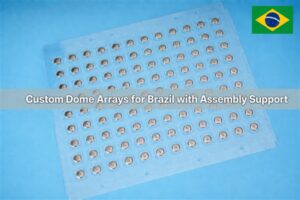
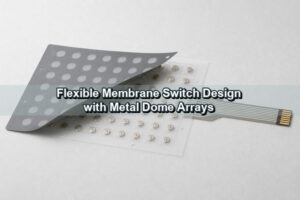
A dome array positions one or more metal domes on an adhesive film so they can be applied together to the contact circuit. The metal dome provides the snap action and electrical contact; the PET carrier holds its position. The carrier is not a replacement for the PCB or FPC conductors beneath it.
Our custom dome arrays can combine different dome sizes, shapes and operating forces on the same carrier. We can adapt the outline, dome locations and cutouts to your interface, allowing the array to follow the circuit layout instead of forcing your enclosure around a standard sheet.

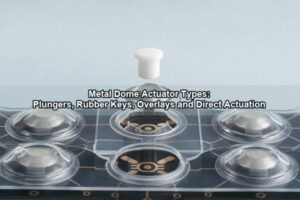
For a keypad with a gap between its actuator and the tactile layer, our plunger dome arrays add an actuator feature. The plunger height and contact area must be matched to the available travel; simply adding height can preload a dome or prevent it from releasing.
Choosing rigid PCB or supported FPC
Use rigid PCB where the keypad needs a firm, fixed contact area. Use FPC where the connection must follow the enclosure layout, while providing a stable backing beneath the dome positions. Flexibility in the cable area is useful; movement beneath an actuated dome is not.
For a US EMS assembly, distinguish the supported switching zone from the flexible tail on the interface drawing. This helps the circuit, enclosure and array work together without treating a flexible circuit as a self-supporting keypad.
One coordinated build from dome array to keypad
We can provide the dome array separately or assembled onto a PCB or flex circuit. For projects needing a broader interface assembly, we also coordinate the dome array, circuit and membrane-switch work within the agreed project scope. PCB and FPC are circuit options—not layers that every keypad needs together.

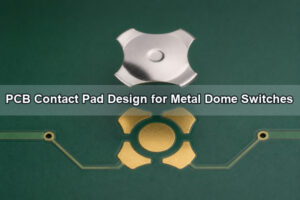
This approach puts dome centers, contact-pad geometry, film cutouts and keypad actuation points into the same design discussion. A revision to the circuit can then be reviewed alongside the array drawing, rather than reaching the assembly line as a mismatch between separately approved parts.
Matching dome force to the finished key
The complete stack still needs evaluation. Dome force measured on its own is not the same as the force a user feels through a graphic overlay or rubber key. Vent paths, adhesive placement, actuator alignment and circuit support all influence the assembled response. We use the intended interface configuration to guide the project review.
Compare candidate forces through the intended key surface, and check both pressing and release. Use the selected dome’s permitted travel when setting the actuator stop. A larger force is not automatically a better industrial key, and extra travel should not be used to compensate for poor alignment.
Applications for US OEM and EMS teams
Dome arrays suit electronic interfaces that need distinct tactile feedback in a compact space. These application examples show how the array contributes to the product; they are not claims of specific customer installations.
| Interface | Role of the dome array | Integration priority |
|---|---|---|
| Industrial keyboards and control panels | Repeatable tactile points across a multi-key layout | Align the key mechanism, domes and contact pads; check the assembled key force |
| Handheld instruments and electronic controls | A low-profile button interface on a compact circuit | Provide firm support beneath the switching area, including when using FPC |
| Illuminated keypads and equipment interfaces | Tactile switching combined with a light-distribution layer | Review LED location, legend illumination and available stack height together |

For illuminated interfaces, our LGF dome arrays incorporate light guide film to distribute light through the keypad. The LED arrangement and optical pattern remain design-specific; an LGF layer does not guarantee the same brightness or LED count in every product.
Array placement or tape-and-reel domes?
Choose a pre-positioned array when several domes should be transferred to the circuit as one aligned group. Choose individual tape-and-reel domes when your existing placement process handles each dome separately. The distinction is the assembly route, not a change in the function of the metal contact.
Our tape-and-reel metal dome packaging supports suitable round, four-leg and triangle domes. Reel orientation and equipment compatibility must be agreed for the selected part. Tape-and-reel packaging alone does not make a conventional metal dome solderable; these domes use the intended mechanical or adhesive retention method.
Validating dome array samples before production
Validate the array in a representative interface, not only as a loose sheet. Our dome test methods distinguish trip force from release behavior; your finished-keypad checks should also confirm that the electrical contact closes when pressed and opens when released.
Include the actual overlay, actuator and circuit support in the sample build. Compare equivalent key positions using the same test setup, record any force or return differences, and agree the acceptance criteria for the selected configuration before releasing the design for repeat production.
Protecting arrays during handling and placement
Keep the release liner on the array until the circuit is ready for placement. Align the carrier before bonding it, and follow the agreed application method so pressure is applied where intended rather than rolling across the dome crowns.
Avoid testing loose domes between fingers or pressing them with sharp tools. Excess travel, uneven support or an oversized rigid actuator can damage the return mechanism. For US production teams receiving the array separately, these handling controls remain important after the carrier arrives at the assembly line.
Direct support for your US production program
We have manufactured metal dome arrays and individual domes since 2006. US teams can work with us on the array and its related circuit assembly through one coordinated project, with the agreed drawings and revisions defining what is supplied. That can reduce repeated explanations between separate component and interface suppliers.
Where the production schedule allows, supplying related parts together can also reduce separate shipments. Freight and import costs still need to be assessed for the actual delivery arrangement; we do not promise fixed duty savings or US-local manufacturing. Our team works from China, so clear written revision records help keep engineering discussions moving across time zones.
Discuss dome arrays for the USA with our team at sales@metal-domes.com. Share your keypad layout and tell us whether you need an array alone, an array mounted on a circuit, or membrane-switch integration. We can then review the configuration around your actual product.