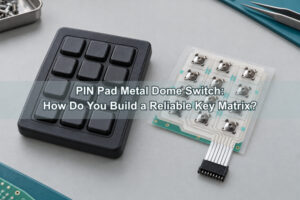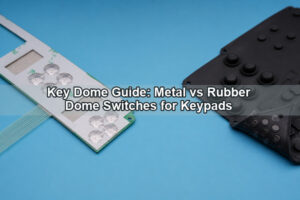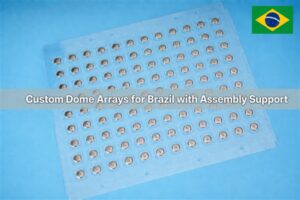

Our dome arrays for Canada support industrial keypads, handheld controls and electronic interfaces that need a clear tactile response. At EBest Circuit(Best Technology), we manufacture custom metal dome arrays in China and supply Canadian OEM and EMS teams directly, with PCB/FPC assembly and membrane-switch integration available for the agreed design.

Matching the dome array to an industrial keypad
The dome array is the tactile contact layer, not the complete industrial keyboard. Metal domes are held at defined positions in an adhesive carrier over the circuit contacts. Pressing a correctly aligned key deflects the dome and closes the contact; releasing it allows the dome to return.

The key mechanism, overlay, array and circuit must work as a stack. A heavier graphic overlay or a different actuator can change the assembled key force even when the dome itself is unchanged. For a Canadian equipment project, we therefore start with the interface layout and actuation requirements, rather than assuming that a particular dome force suits every industrial use.
Choose the array structure for the interface
The required tactile layout, actuator geometry and illumination determine which array construction is useful. These options solve different interface problems and can be reviewed as part of the same custom design.
Custom layouts for multiple key functions
Our custom dome arrays support different dome sizes, shapes and forces on one carrier. This is useful when navigation keys and a separate function key need different physical layouts. Carrier cutouts can also accommodate features that must remain accessible on the circuit.
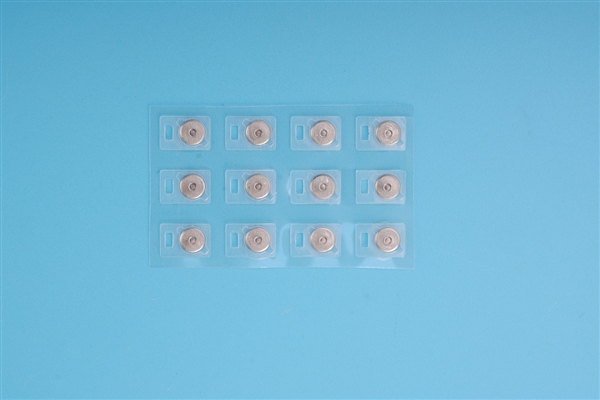
Plunger arrays for actuator contact
A plunger dome array adds a feature above the dome carrier to meet the key actuator. This can help where the enclosure leaves a gap, but plunger height must be checked against the rest position and permitted travel. The dome must not remain partially pressed when the key is released.
LGF arrays for backlit keys
Our LGF dome arrays add light guide film for keypad illumination. The film pattern and LED positions are designed together to distribute light to the intended legends. Illumination performance should be checked through the finished overlay, not just by viewing the uncovered film.
Carrier handling and adhesive placement
The adhesive carrier needs an agreed placement process as well as the correct outline. Keep its release liner in place until assembly, align the array with the circuit references, and ensure the specified bonding areas are seated without damaging the domes.
A visible wrinkle or lifted edge calls for inspection before the overlay hides it. Do not add adhesive across contact areas or vent openings to compensate for a placement problem. The adhesive material and application conditions should match the selected carrier and circuit surface, rather than being treated as universal for every Canadian equipment project.
Integrating the array with PCB, FPC and membrane switches
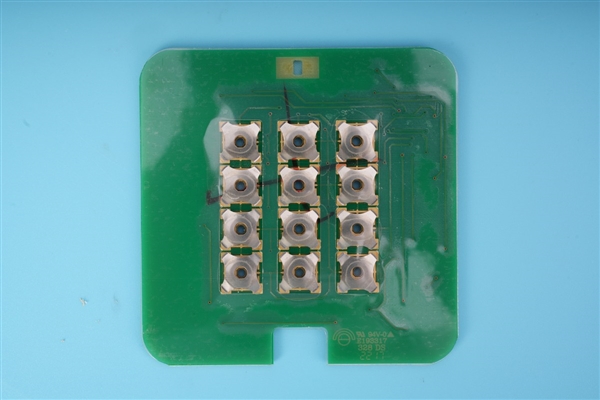
We can supply dome arrays assembled onto a rigid PCB or a flex circuit, and coordinate membrane-switch integration where required. Defining these connected parts in one project helps keep dome locations, pad locations, mechanical cutouts and drawing revisions consistent.
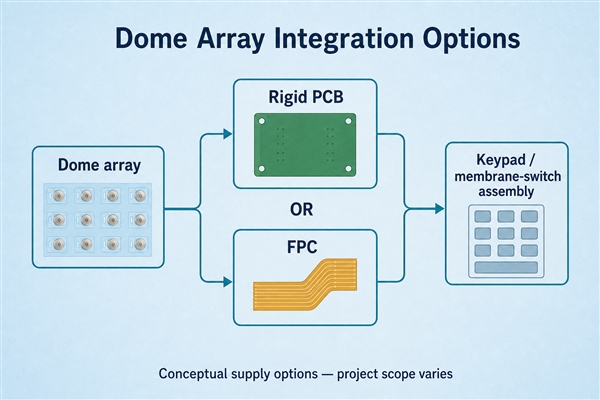
Rigid PCB provides support directly beneath a key area. FPC can route the electrical connection through a compact enclosure, but its switching area still needs suitable backing. Neither circuit choice removes the need to align the dome with its contact pattern or provide the intended vent path.
As one configuration example, our double-layer array using 4 mm or 5 mm C-series domes has approximately 0.27–0.30 mm total thickness, with ±0.03 mm tolerance and variation by force. That is not a universal keypad clearance. A plunger, LGF, overlay or different dome series changes the stack and must be included in the project drawing.
Checking the finished keypad before production
Check tactile response on the assembled industrial keypad, using the intended overlay, actuator and supported circuit. Pressing feel, return action and electrical switching are separate observations; a noticeable click alone does not confirm a reliable electrical connection.
For each key position, confirm contact closure and reopening, freedom from unintended preload, and consistent behavior across repeated operations. Where keys are illuminated, inspect the legends with the final overlay installed. Define any durability or environmental validation around the equipment’s actual use conditions; a component result does not qualify the complete instrument.
Applications for Canadian electronics projects
Industrial panels, portable instruments and compact electronic controls need different interface checks. The following are application examples, not customer case studies or claims of product certification.
| Application | What the array contributes | What to verify in the finished interface |
|---|---|---|
| Industrial operator panels | Defined tactile positions beneath a durable keypad surface | Key alignment, return action and feel through the actual overlay |
| Handheld test and control instruments | Compact switching on a small PCB or supported FPC | Actuator contact area, circuit support and clearance inside the enclosure |
| Backlit equipment keypads | Tactile feedback with an optional light guide layer | Legend brightness, light distribution and total interface thickness |
Venting and environmental protection
Environmental requirements belong to the complete product. For a keypad exposed to moisture, cleaning agents or temperature changes, the overlay, adhesive, enclosure and vent design require assessment together. A metal dome array alone does not establish a sealing rating for the equipment.
The vent path lets air move as a dome is pressed. Depending on the array construction, it may run through a spacer, carrier or circuit. That path must remain functional after assembly; its presence is not evidence that the housing is protected against liquids. Plan internal air movement and the external sealing boundary as different parts of the interface design.
Array placement and tape-and-reel options
A pre-positioned dome array is useful when the key pattern should transfer to the circuit as one group. An individual-dome placement line uses a different handling format, so the assembly method should be settled before the final carrier design is released.
For production lines that place individual domes, we also offer tape-and-reel dome packaging for suitable dome types. It is an alternative placement format, not a substitute for a pre-positioned array or proof that a dome can be soldered.
For a Canadian EMS project, identify whether the incoming item will be an adhesive array, individual domes, or an array already mounted on its circuit. This keeps placement work and the receiving inspection aligned with what our team actually supplies.
Working with our team from Canada
We have made metal domes and dome arrays since 2006. Our direct-supply model lets Canadian teams discuss the tactile layer and related assembly with the same manufacturing partner. Keeping one approved interface drawing reduces the chance that separate revisions reach different suppliers.
Related items may be shipped together when their schedules and packing requirements align. Any freight benefit depends on the actual shipment; Canadian import charges and delivery arrangements are reviewed separately, with no blanket savings promise. We supply from China and do not claim a Canadian factory.
For dome arrays for Canada, contact sales@metal-domes.com with your keypad layout, intended key feel and assembly scope. We will discuss an array configuration that fits the interface you are building.