
A tact switch is a momentary switch that gives a clear tactile response when pressed. In many electronic interfaces, that response comes from a small spring contact, a metal dome, an SMD dome switch or a dome array working with PCB pads, FPC contacts or membrane switch layers.
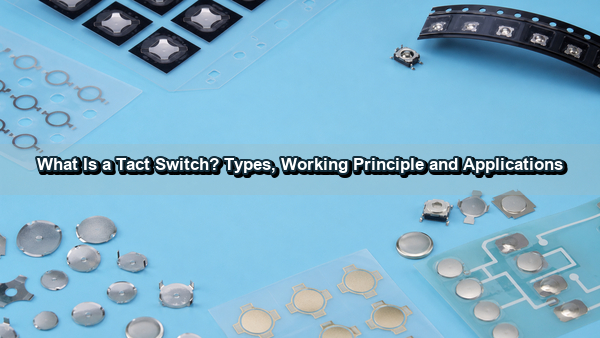
This article explains the basic working principle, common interface types and selection checks. It also clarifies an important boundary: EBest Circuit(Best Technology) focuses on metal domes, dome arrays, SMD dome switches and related tactile interface components, not every finished tact switch category on the market.
What Is a Tact Switch?
A tact switch, also called a tactile switch or tactile button switch, is usually a normally-open momentary contact. It closes the circuit only while the user presses the actuator, then returns to the open state after release.
In a finished tact switch, the housing, actuator, fixed contacts and movable contact are supplied as one component. In a custom keypad or membrane switch, the tactile function may instead be built from a custom metal dome, adhesive film, spacer, actuator and printed circuit contacts.
How Does a Tact Switch Work?
A tact switch works by converting a short mechanical press into temporary electrical contact. The user presses the actuator, the internal spring or metal dome deflects, and the movable contact touches the fixed contact. When pressure is removed, the spring element returns and opens the circuit.

The “click” feel comes from the force curve. A metal dome stores energy as it is pressed, then snaps through at a defined trip force. Useful specifications include trip force, rebound force, travel, click ratio, contact resistance, operating life and contact bounce.
What Are the Main Types of Tact Switch Interfaces?
The main types differ by how much of the switch is supplied as a finished component and how much is built into the customer’s interface stack. The table below keeps the terms separate for purchasing and design discussions.
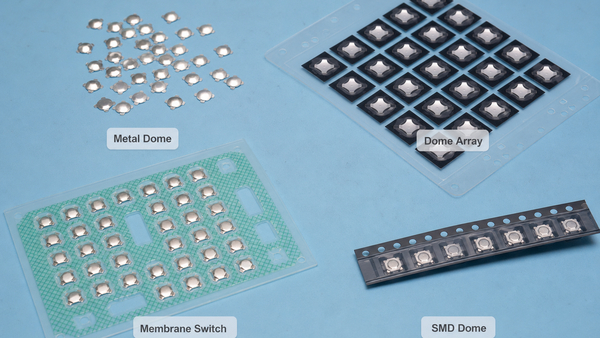
| Term | What It Usually Means | When It Is Used |
|---|---|---|
| Tact switch | Finished momentary tactile switch component | Standard PCB-mounted buttons and compact electronic controls |
| Metal dome | Spring contact that creates click feel and electrical closure | Custom keypads, PCB contacts, FPC contacts and membrane switches |
| Dome array | Adhesive sheet holding one or more metal domes in fixed positions | Multi-key panels, membrane switch assemblies and fast placement |
| Membrane switch | Layered user interface with printed circuits, spacer and overlay | Industrial, medical, appliance and control-panel keypads |
| SMD dome switch | Surface-mount dome-based switch supplied for SMT assembly | Low-profile PCB designs requiring reflow-compatible placement |
How Is a Metal Dome Different from a Complete Tact Switch?
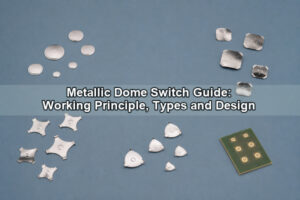
A metal dome is usually the tactile and conductive element inside a custom interface, while a complete tact switch is a packaged component with its own housing and terminals. The metal dome still needs a circuit pattern, actuator or overlay, spacing control and retention method before it becomes a usable button.
This distinction matters when requesting a quotation. If the product already has a PCB, FPC or membrane circuit, a loose dome or dome array may provide the right feel with less height than a finished switch. If the product needs a standard soldered button with a housing, a catalog tact switch may be more suitable.
When Should You Use a Dome Array Instead of Loose Metal Domes?
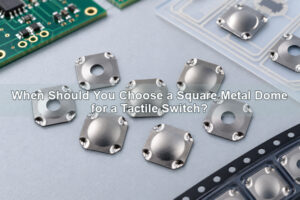
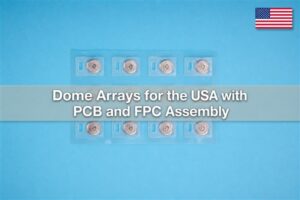
Use a dome array when several keys need controlled position, repeatable placement and faster assembly. The domes are pre-positioned on adhesive PET or Mylar film so the sheet can be aligned to the circuit instead of placing each dome one by one.
A custom dome array can combine different dome shapes, force values, vent holes, alignment holes, spacers, EMI printing, rubber glue or LGF layers. For a keypad with many buttons, the array format reduces double-dome risk, placement error and handling contamination.
Where Does an SMD Dome Switch Fit?
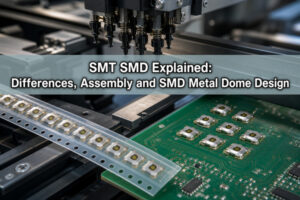
An SMD dome switch fits when the design needs a low-profile tactile switch that can be handled by SMT equipment. It is closer to a finished component than a loose metal dome, but it still uses a dome structure to provide vertical actuation and tactile feedback.
EBest Circuit(Best Technology) provides SMD dome switch options for PCB, FPC and compact electronic devices. Typical checks include tape width, reel quantity, operating direction, soldering compatibility, height limit, rating, life cycle and whether the top actuator or film structure matches the product housing.
What Applications Use Tact Switch Components?
Tact switch components are used wherever a user needs a reliable short-press input with physical feedback. Metal domes and dome arrays are especially useful when the device needs a thin interface, custom force feel or a multi-key layout.
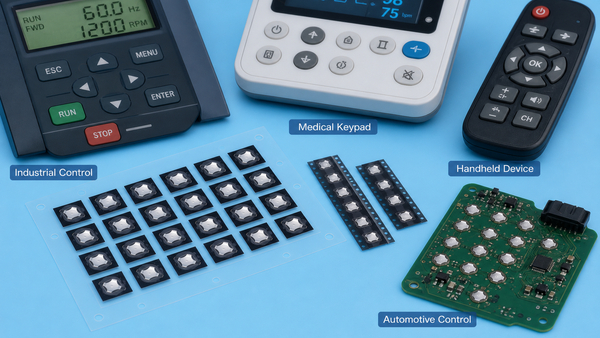
- Industrial control panels that need clear feedback with gloves or frequent operation
- Medical keypads where force consistency, cleaning tolerance and reliability matter
- Handheld devices and remote controls with compact button layouts
- Automotive controls where tactile confirmation helps reduce accidental operation
- Membrane switch panels using metal dome arrays under a graphic overlay
- PCB and FPC keypads that need a low-profile dome-based tactile response
What Specifications Should Be Checked Before Ordering?
Before ordering a tact switch component, confirm the actual interface structure rather than only the button name. The same “tactile button” description may require a finished tact switch, a loose metal dome, a dome array or an SMD dome switch.
- Dome shape, size, material and plating
- Trip force, rebound force, travel and click ratio
- Required operating life and expected press frequency
- PCB, FPC or membrane contact layout
- Actuator shape, overlay thickness and total height limit
- Assembly method: manual placement, peel-and-place, SMT or custom lamination
- Environmental needs such as humidity, cleaning, dust protection or temperature range
- Packaging method: bulk, tube, tape and reel or peel-and-place sheet
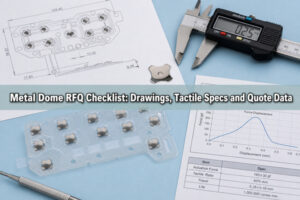
For custom tactile interfaces, send drawings, Gerber files, keypad layout, target force, sample quantity and expected production volume. EBest Circuit(Best Technology) can review whether a metal dome, dome array or SMD dome switch is the practical route.
FAQ About Tact Switches?
1. What is a tact switch?
A tact switch is a momentary tactile switch that closes a circuit only while it is pressed and gives the user a noticeable click or force change.
2. Is a tact switch the same as a metal dome?
No. A metal dome is often the tactile contact element. A complete tact switch may include a housing, actuator, terminals and internal contacts. A metal dome needs the correct circuit and mechanical stack to work as a switch.
3. Are tact switches momentary?
Most tact switches are momentary and normally open. They turn on during the press and turn off after release.
4. When should I choose a dome array?
Choose a dome array when several keys must be placed accurately on a PCB, FPC or membrane circuit. It improves positioning and reduces manual handling compared with loose domes.
5. What should I send for a tactile interface RFQ?
Send the drawing, target force, dome shape or switch type, circuit layout, height limit, assembly method, sample quantity and production quantity.
Conclusion
A tact switch is best understood as a tactile momentary input, but the real product form can vary. A finished tact switch, metal dome, dome array, membrane switch and SMD dome switch solve different design and assembly problems.
If your project needs metal domes, dome arrays or SMD dome switches for a custom tactile interface, send your drawing and target specifications to sales@metal-domes.com, or contact EBest Circuit(Best Technology) for quotation support.