
Loose metal domes vs dome array is an assembly-format decision, not a contest between two kinds of switch. Loose domes are placed and retained at individual contact positions; an array holds multiple domes in a pre-spaced adhesive carrier that is aligned to the PCB as one part. The better choice depends on key count, placement method, design stability, rework plan and the cost of installing a good assembly, not just the price per dome.
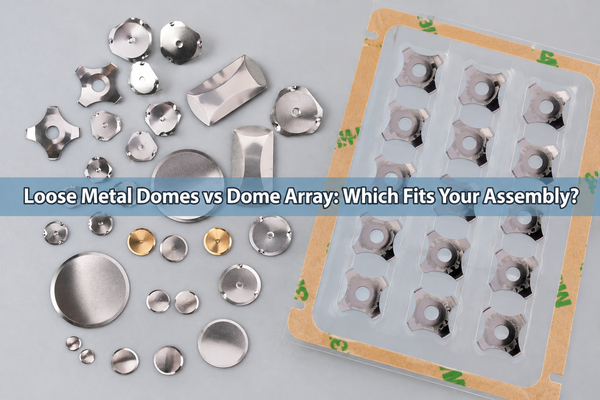
What Is the Difference Between Loose Metal Domes and a Dome Array?
Both formats can use the same specified metal dome. What changes is how the domes reach their final PCB positions and how they stay there before the overlay or actuator is assembled. A loose dome needs its own placement and retention method. In an array, the carrier defines the relative positions and usually includes adhesive for fixing the sheet to the board.
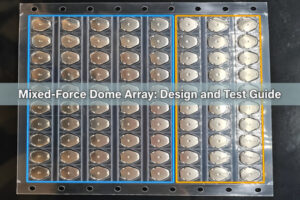
| Decision point | Loose metal domes | Dome array |
|---|---|---|
| Placement unit | One dome at a time, unless a compatible feeder and placement process are qualified | One pre-spaced carrier for a group of keys |
| Position control | Placement tool, fixture or local retention feature | Carrier die-cut, registration features and sheet-to-PCB alignment |
| Engineering change | Individual key locations can be changed without replacing a full carrier design | Key-layout changes may require a new carrier drawing or tooling |
| Rework | A single dome may be replaceable if the retention method permits | Lifting the sheet can disturb neighboring positions or adhesive |
| Main cost question | Handling and inspection time per key | Carrier preparation, application yield and cost per finished keypad |
When Do Loose Domes Make More Sense?
Loose domes are a practical starting point for one or two keys, early prototypes, serviceable assemblies or designs whose key spacing is still changing. They also suit production when an existing fixture or qualified automated process already places and retains the domes reliably. The condition is that the dome must stay centered over its PCB contacts through subsequent handling, overlay assembly and use.
Choose the dome specification separately from the supply format. A custom metal dome still needs the required diameter or outline, actuation force, travel and contact footprint, whether it arrives loose or on a carrier.

When Does an Array Save Assembly Work?
An array becomes attractive when several fixed-position keys can be aligned as one sheet. It moves the repeated dome-positioning operation upstream and gives the assembler one registration task instead of many independent placement tasks. That advantage only counts if the PCB, carrier and overlay stack can be aligned repeatably and the adhesive survives the intended process.
Ask for a custom dome array when the key layout is sufficiently stable to define the center coordinates, carrier outline and adhesive keep-outs. For a first design, compare a carrier prototype with loose-dome builds before committing to production tooling.
How Are Loose Domes Positioned and Retained?
The PCB contact pattern must support the dome without letting its rim bridge unintended conductors. A placement fixture can reference board edges or tooling holes; the assembler then checks dome center, orientation where applicable, and whether the dome rocks on the pad finish. Retention may come from a dedicated adhesive feature, cover film or the final mechanical stack. Do not assume the dome will remain centered simply because it sits correctly during a bench test.
Define the retention method on the assembly drawing. If adhesive is used, specify its location so it does not enter the active contact area or restrict snap motion.
How Is a Dome Array Aligned and Applied?
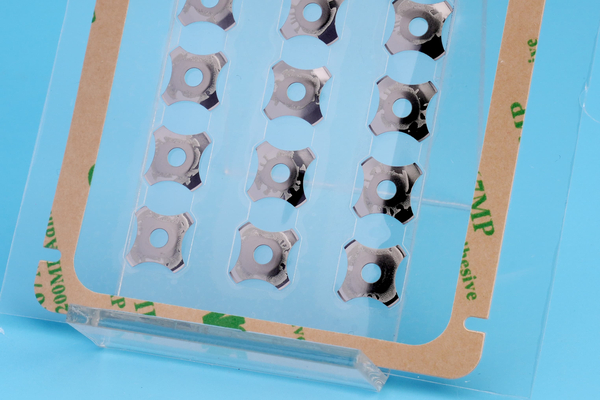
An array needs a datum strategy, not just a dome-center drawing. Match the carrier’s registration holes or edges to PCB tooling features, check the first-to-last key position across the full sheet, and apply pressure to the adhesive regions without crushing the domes. Protect release liners until placement; contamination or premature contact can make the sheet difficult to reposition.
Inspect the installed array for skew, bubbles or lifted edges, and dome centers relative to the contact pads. A single alignment error can affect several keys, so acceptance should be based on the assembled keypad rather than a loose-sheet visual check.
How Do the Formats Affect PCB and Overlay Design?
The electrical pad geometry is driven by the chosen dome, but the mechanical stack changes with the carrier. For an array, reserve space for adhesive, registration features and any vent path required by the key design. For loose domes, show how each position is held before the overlay goes on. In both cases, verify that the actuator presses near the intended dome center and that its travel does not bottom out against the PCB.
If the overlay is already designed, provide its thickness and key-actuator geometry before choosing the carrier. A thicker film stack can alter the assembled key feel even when the bare dome force is unchanged.
What Defects Should Be Checked During Placement?
Check defects at the stage where they can still be corrected. Incoming visual inspection alone will not expose a shifted dome after cover-film lamination.
| Symptom at assembly test | Check first | Practical correction to evaluate |
|---|---|---|
| Key needs extra force or feels uneven | Dome center, actuator center, adhesive overlap | Correct alignment or keep-out; retest assembled travel |
| No electrical closure | Dome contact orientation, pad geometry, contamination | Clean and inspect contacts; verify footprint against dome drawing |
| Intermittent closure after handling | Retention, carrier lift, local board flex | Qualify adhesion or fixture and repeat handling test |
| Several adjacent keys fail | Sheet registration and full-array dimensional error | Review datum, carrier drawing and application fixture |
How Do Rework and Design Changes Differ?
Replacing one loose dome may be simple when the design allows access and the adhesive or cover can be lifted locally. An array can make a single-key repair less local: peeling the carrier may change adhesive strength or shift adjacent domes. Agree on a reject-and-replace rule for the sheet before production starts, especially when the keypad has many keys.
For an evolving layout, loose domes avoid immediately revising a multi-key die-cut. Once the coordinates and overlay are stable, an array may reduce repeated alignment work. Prototype both formats against the same PCB and actuator conditions so the comparison is fair.
How Should You Compare Total Installed Cost?
Compare cost per accepted keypad, not price per piece. For each option, add purchased parts, placement time, fixtures, inspection, rejected assemblies and expected rework. Then divide by accepted assemblies. A low-volume design with two keys may favor loose domes even if their per-key handling is higher; a stable multi-key build may favor an array despite carrier preparation cost.
Use actual pilot-build times and defect counts instead of generic labor estimates. If both options meet electrical and tactile requirements, the cost break-even point is specific to your key count, batch size and equipment.
Can Tape-and-Reel Replace a Dome Array?
Tape-and-reel is a feeding and packaging method for individual domes, not a pre-aligned keypad sheet. It can make sense when the dome style and placement equipment support automated pick-and-place. It does not eliminate the need to qualify retention, pad alignment and post-placement inspection. Ask the supplier which dome geometries and reel formats are actually supported for your placement process.
An intermediate option is a single-key dome array: a local adhesive carrier can simplify retention at each key without locking a complete multi-key layout. Compare that option with loose placement and a full array when the design has a few widely separated buttons.
What Information Helps Compare Both Formats?
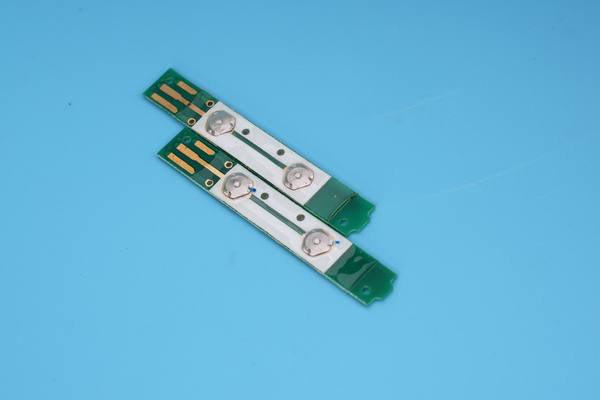
Use the same technical package to evaluate both formats against the same assembly target:
- PCB drawing or Gerbers with contact-pad geometry, key coordinates and datum features.
- Dome outline, diameter or length and width, target force, travel and any life requirement.
- Overlay or actuator drawing, stack thickness, and adhesive keep-out or vent requirements.
- Annual volume, prototype quantity, expected batch size and current placement method.
- Test criteria for contact closure, assembled force, alignment and acceptable rework.
If these inputs are incomplete, prototype both options before treating a production price as comparable. Otherwise, each option may rest on a different assembly assumption.
FAQ
Are loose metal domes less reliable than a dome array?
Not inherently. Reliability depends on the dome specification, contact design, retention, alignment and environment. Compare finished assemblies after handling and actuation testing.
Is a dome array always cheaper in volume?
No. Carrier tooling, sheet yield and rework can outweigh saved placement time for a simple keypad. Compare cost per accepted assembly at the intended production volume.
Can I change one dome force in an array?
Potentially, if the supplier can place different specified domes at defined locations. Mark force by key position on the drawing and validate the finished keypad.
Do loose domes always require manual placement?
No. Some styles can be supplied for automated placement, subject to compatible packaging, pickup and retention processes. Confirm that combination before designing the line around it.
The useful answer to loose metal domes vs dome array comes from a matched assembly trial: same dome, PCB and actuator, with placement time, alignment and yield measured for each format. At EBest Circuit(Best Technology), we can review your PCB drawing, dome specifications, actuator stack and target volume for a format comparison and prototype quote. Send them to sales@metal-domes.com.