
Metal Dome Used in ECG Machine refers to a tactile metal dome placed under an ECG machine keypad, membrane switch, PCB keypad or FPC control panel. It is not the ECG skin electrode that touches the patient. In the keypad, the dome provides a clear click and closes the circuit when a clinician presses a function key, menu key, print key or start/stop control.
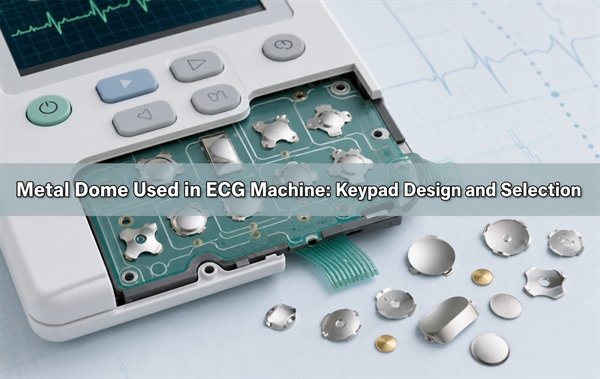
For an ECG machine, the switch structure must support stable input, compact housing design, repeatable tactile feel and cleanable front-panel construction. A metal dome can be useful when the product needs a thin metal dome membrane keypad with definite press confirmation, but the dome must be selected together with the overlay, spacer, adhesive, PCB or FPC contact pattern and enclosure support.
What Does a Metal Dome Do in an ECG Machine?
A metal dome acts as the tactile and electrical switching element inside the ECG machine control interface. When the key is pressed, the dome collapses, touches the contact pads below and sends the input signal to the device circuit. When the force is removed, the dome returns to its original shape and opens the circuit. General design questions about snap action, venting and application method can also be cross-checked against the metal dome FAQ.
This structure is commonly hidden under a printed membrane overlay, silicone key, plastic actuator or flat keypad surface. The user feels the snap response, while the circuit receives a momentary input. The same principle can be used for power controls, menu navigation, lead selection, print commands, waveform storage, alarm silence or function keys, depending on the ECG machine design.
Why Do ECG Machines Still Need Physical Tactile Keys?
Physical keys give direct confirmation when the operator cannot rely only on a touchscreen or visual display. In ECG operation, the user may need to start a recording, adjust settings, silence a prompt or print a report while watching the patient, leads, paper feed or waveform screen.
A tactile metal dome can support this interface because the click confirms that the key has reached its actuation point. For portable ECG machines and compact diagnostic equipment, the low profile of a dome array also helps keep the control panel thin without using tall mechanical switches.
How Is the ECG Machine Keypad Stack-Up Built?
An ECG keypad using metal domes is normally a layered structure. The exact stack-up depends on whether the circuit is built on PCB, FPC or printed membrane, but the design must leave enough movement space for each dome and enough support for consistent actuation.
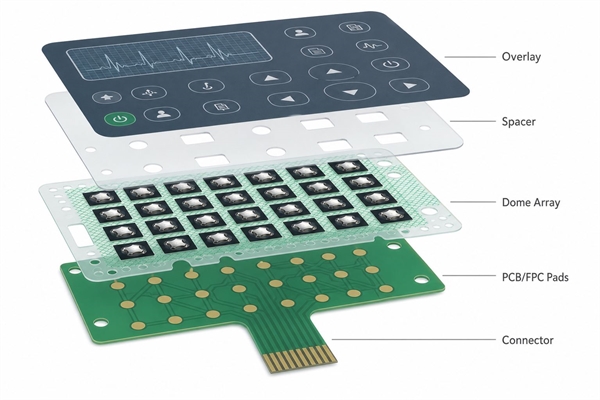
| Layer or Part | Function in the Keypad | Design Check |
|---|---|---|
| Graphic overlay | Shows icons and protects the front surface | Material, printing, embossing, cleaning exposure |
| Adhesive / spacer | Controls dome movement space and layer bonding | Opening size, thickness, vent path, adhesive strength |
| Metal dome | Creates tactile click and electrical contact | Diameter, force, travel, rebound, plating if needed |
| PCB / FPC / membrane circuit | Provides contact pads and signal routing | Pad geometry, finish, clearance, connector layout |
| Housing or actuator | Transfers user force to the dome | Press point alignment, support height, key spacing |
The best result comes from designing the full stack together. A good dome can still feel poor if the spacer opening is too small, the actuator presses off-center or the PCB pad surface is not suitable for repeated contact.
Should an ECG Keypad Use Loose Metal Domes or a Dome Array?
A multi-key ECG keypad usually benefits from a custom dome array instead of loose domes. In a dome array, the domes are pre-positioned on a PET or polyester carrier with adhesive, so the complete sheet can be aligned and placed onto the PCB, FPC or membrane circuit in one process.
Loose domes may be acceptable for simple testing, repair work or a single-button design. For a production ECG keypad, a custom dome array improves placement accuracy, reduces missing or double dome risk, and helps keep the key feel consistent across the full panel. The array can use transparent PET, printed location marks, vent holes, black adhesive pads or special cutouts according to the keypad layout.
Which Metal Dome Parameters Matter Most for ECG Keypads?
The most important parameters are operating force, travel, click ratio, rebound force, dome size, contact resistance and expected life cycle. These values determine whether the key feels clear, returns properly and maintains stable contact during repeated use.
- Operating force: Controls how hard the key must be pressed. Frequently used keys usually need comfortable force, while critical keys may need firmer feedback to reduce accidental operation.
- Travel: Affects the perceived key movement and the required stack-up height.
- Click ratio: Determines how sharp the tactile feedback feels after actuation.
- Rebound force: Helps the dome return cleanly and avoid weak or sticky response.
- Contact resistance: Must stay stable for low-current keypad signals.
- Dome size and shape: Must match button area, PCB pad size, actuator position and available panel space.
For ECG machines, the target should not be the strongest click possible. The better target is a repeatable feel that works through the overlay or keycap, remains comfortable during frequent operation and avoids false triggering.
How Should Dome Shape Be Selected for an ECG Machine?
Dome shape should be selected according to key size, pressing point, panel layout and force requirement. Circle metal dome parts are often suitable for standard keypad buttons. Four-leg domes can provide stable positioning and a crisp feel. Oblong domes may fit longer narrow keys. Triangle domes may be considered where a compact or higher-force design is needed.
The ECG machine layout should guide the choice. A navigation key group, a print key and a power key may not need the same dome force or diameter. If the interface includes several different button sizes, the dome array can combine multiple dome types in one sheet, provided the contact pad patterns and spacer openings are designed correctly.
What Sealing and Cleaning Factors Affect ECG Keypad Design?
Sealing performance depends on the full keypad structure, not the metal dome alone. The overlay material, adhesive bonding, spacer layer, tail exit, housing fit and edge sealing determine how well the keypad resists dust, moisture and cleaning exposure.
For ECG machines used in clinics, hospitals, ambulances or home-care environments, the front surface may need to tolerate repeated wiping. A flat membrane keypad with metal dome feedback can support cleanable surfaces, but the material and adhesive must be reviewed against the intended cleaning method. If the device needs stronger sealing, the design should be tested as a complete assembly.
How Do PCB and FPC Contact Pads Affect Reliability?
The contact pad pattern under the dome must match the dome size and movement. A common design uses an outer ring and a center contact. The dome rests on the outer contact and snaps down to touch the center contact when pressed.
Pad diameter, solder mask clearance, surface finish, carbon ink or plated contact area, trace routing and contamination control can all affect performance. If the pad is too small, the dome may not contact reliably. If the actuator presses off-center, the key may feel uneven. If the surface finish is unsuitable, contact resistance may drift during use.
What Problems Can Occur if the Metal Dome Is Poorly Matched?
A poorly matched metal dome can create weak tactile feedback, unstable contact, noisy operation, double triggering, poor rebound or early wear. These problems often come from stack-up mismatch rather than the dome alone.
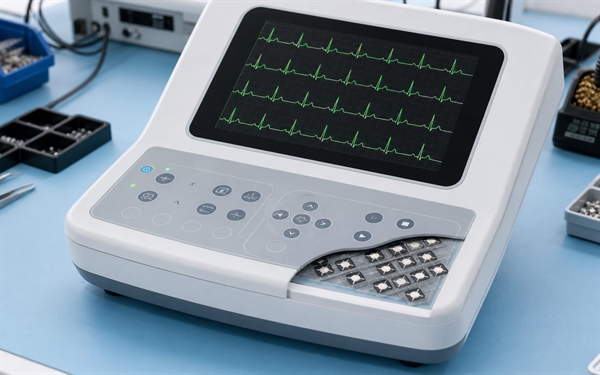
Common causes include incorrect spacer thickness, insufficient venting, dome shift during assembly, contact pad mismatch, weak adhesive bonding, overly hard actuator material, off-center pressing and poor storage or handling. For ECG machine projects, prototype testing should check the actual overlay, housing and circuit together, not only a loose dome sample.
What Tests Should Be Reviewed Before Mass Production?
Testing should confirm both tactile performance and electrical stability. A supplier should not approve the keypad only by visual inspection because the final feel depends on force, movement, contact and assembly alignment. For production review, the metal dome quality control criteria should be connected to the actual keypad stack-up.
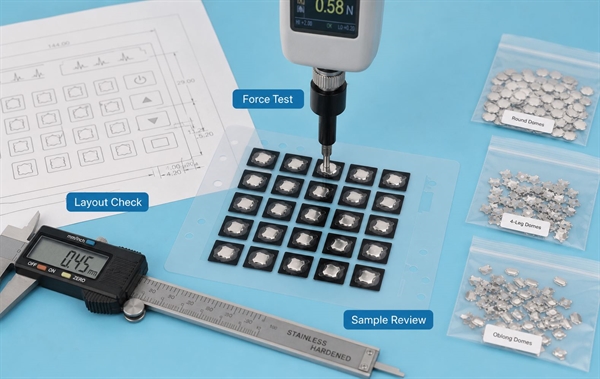
- Operating force and rebound force test
- Travel and click ratio measurement
- Contact resistance check before and after cycling
- Life cycle test based on the expected use level
- Visual inspection for burrs, dents, contamination and dome deformation
- Adhesive alignment and peel strength review
- Functional test on the real PCB, FPC or membrane circuit
- Cleaning or environmental exposure test when required by the device design
EBest Circuit(Best Technology) can support sample review, dome force selection, custom array layout and production inspection for ECG keypad and medical control panel projects. The final test plan should still be matched to the device specification and customer validation process.
What Information Is Needed for an ECG Metal Dome RFQ?
An ECG metal dome RFQ should include enough mechanical and electrical information to check fit, feel and production method. A request that only says “ECG keypad dome” is usually not enough for accurate quotation.
- Keypad drawing, PCB drawing, FPC drawing, Gerber file, PDF, DXF or sample photo
- Button quantity, dome position, key size and center-to-center spacing
- Preferred dome shape, diameter, operating force and travel if known
- Expected stack-up: overlay, spacer, adhesive, circuit and housing actuator
- Contact pad design and surface finish
- Required life cycle, cleaning exposure and operating environment
- Prototype quantity, annual usage and packaging method
- Whether the project needs loose domes, peel-and-place sheets or full dome arrays
For custom layouts, EBest Circuit(Best Technology) can review AutoCAD, PDF, Gerber, PCB, CAM and other drawing formats. For early projects, a clear hand sketch with dimensions and dome positions can also help start budgetary discussion.
FAQ About Metal Dome Used in ECG Machine?
1. Is a metal dome in an ECG machine the same as an ECG electrode?
No. In this article, the metal dome is a keypad switching component under the control panel. It should not be confused with an ECG electrode or skin-contact sensor used for measuring heart signals.
2. Can a metal dome be used under a sealed ECG membrane keypad?
Yes. A metal dome can be integrated under a membrane overlay when the spacer, adhesive, venting path and circuit contact design allow proper dome movement. Sealing should be validated at the complete keypad or device level.
3. Which dome force is best for an ECG machine?
There is no universal force value. The choice depends on key size, overlay stiffness, actuator design, glove operation, false-touch risk and how often the key is used. Prototypes should be tested with the actual enclosure and overlay.
4. Is a dome array better than loose domes for ECG keypads?
For multi-key ECG keypads, a dome array is usually more practical because it controls dome position and speeds assembly. Loose domes may be used for repair, simple testing or single-key structures.
5. What file should be sent for a custom ECG dome array?
Send the keypad layout, dome positions, overall size, cutouts, circuit contact pattern and estimated usage. AutoCAD, PDF, Gerber, PCB and CAM files are useful; a dimensioned sketch can help with early quotation.
Conclusion
Metal Dome Used in ECG Machine projects should be reviewed as a complete keypad system, not as a loose component purchase. The decisive checks are dome force, travel, click feel, PCB or FPC pad design, spacer opening, sealing structure, cleaning exposure and sample testing. For ECG machine keypads, custom dome arrays can improve alignment, assembly speed and key-to-key consistency.
For custom metal dome samples, ECG keypad design review or dome array quotation, contact EBest Circuit(Best Technology) at sales@metal-domes.com.