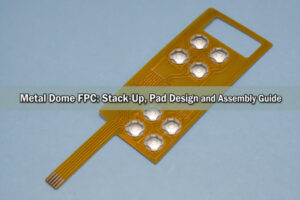

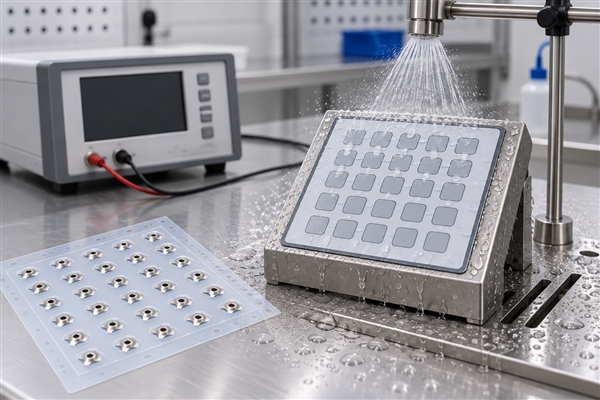
A waterproof membrane keypad keeps liquid away from its metal domes and circuit only when the graphic overlay, perimeter adhesive, tail exit, vent path and enclosure form one controlled barrier. A metal dome by itself is not waterproof. The protection comes from the complete interface and must be verified after assembly.
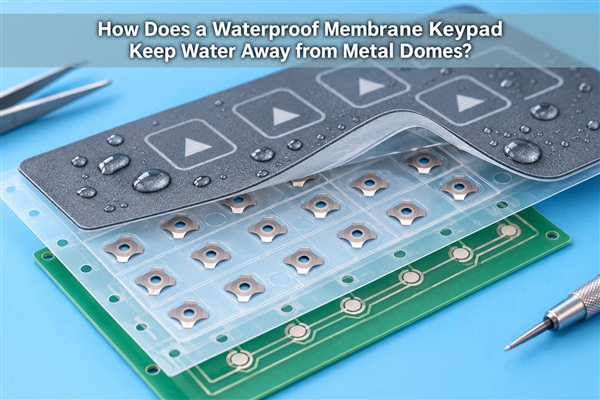
This guide explains where water can enter a waterproof membrane switch, how a keypad stack blocks those paths, why the dome cavity still needs controlled pressure behavior, and which tests connect a waterproof claim to a defined operating condition. It also clarifies the supply boundary between a complete keypad producer and a specialist metal dome or dome-array manufacturer.

What Is a Waterproof Membrane Keypad?
A waterproof membrane keypad is a low-profile user interface with a continuous front overlay and sealed layer boundaries intended to prevent specified liquid exposure from reaching the switch contacts. The active layer may use printed shorting pads, polydomes or stainless-steel metal domes. In a tactile design, the dome collapses over a stationary contact pattern and returns when the load is removed.
The word waterproof is incomplete unless it names an exposure and an acceptance method. Rain, hose spray, temporary immersion and repeated cleaning are different conditions. A valid requirement should state the assembled product, mounting orientation, duration, pressure or depth, temperature, cleaning chemistry and pass criteria.
Where Can Water Enter the Keypad?
Water rarely passes through an intact overlay film first. It usually follows a discontinuity or a poorly supported bond line. The design review should trace every possible path from the wet exterior to the circuit.
| Potential entry path | Typical cause | Design control |
|---|---|---|
| Outer perimeter | Narrow seal width, contamination, surface unevenness or adhesive lift | Continuous seal land, clean substrate, controlled lamination and enclosure support |
| Tail exit | Open channel along the flexible tail or abrupt thickness transition | Defined seal geometry, strain relief and a protected transition into the enclosure |
| Connector area | Connector located in the wet zone or exposed conductors | Keep the connector inside the dry volume or use a qualified sealed interface |
| Cutouts and windows | LED, display or mounting openings interrupt the barrier | Independent gasket or adhesive boundary around each opening |
| Fasteners and housing seams | Insufficient gasket compression or warped mounting surface | Specify flatness, compression, torque and enclosure drainage |
These paths explain why a membrane switch cannot be qualified in isolation when the final seal depends on the housing. A loose sample on a bench may pass a splash check yet fail after the real enclosure bends the adhesive land or routes the tail through an unsealed slot.
How Does the Layer Stack Form a Sealed Barrier?
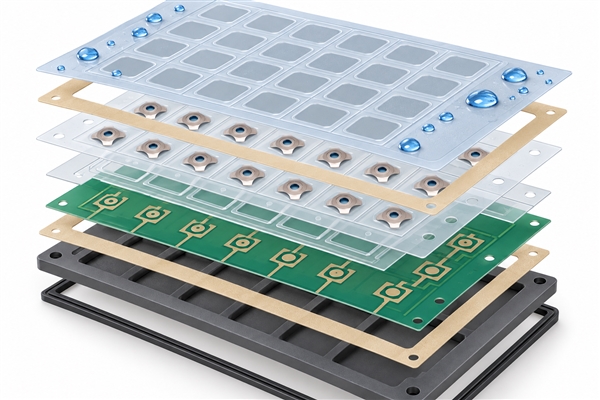
The top overlay provides the first continuous surface. Beneath it, die-cut pressure-sensitive adhesive bonds the overlay to the spacer or carrier while leaving controlled key cavities. A retained dome layer aligns each snap dome above the circuit contacts. Rear adhesive then couples the keypad to a rigid, clean and sufficiently flat mounting surface.
A single-layer metal dome array can retain domes with a thin PET carrier, while assemblies that need a defined spacer, protected routing or pressure path may use additional layers. More layers do not automatically improve sealing. Every interface adds another bond line that must be continuous and compatible with the substrate.
Which Overlay and Adhesive Materials Should Be Specified?
Overlay selection must account for more than water. Outdoor equipment may need UV stability and low-temperature flexibility; medical or food equipment may face disinfectants, oils and repeated wiping; industrial panels may encounter coolants or cleaning solutions. Polyester and polycarbonate can both be used in keypad constructions, but grade, coating, printing system and actual chemical exposure determine suitability. Waterproof flexible membrane switches therefore need a material set matched to the real environment, not merely a film described as water resistant.
Adhesive performance depends on surface energy, roughness, temperature, moisture, chemical contact and seal width. EBest Circuit(Best Technology) supports dome-array carrier constructions with King Label, 3M 467 and 3M 468 adhesives, subject to the actual substrate and engineering review. A rubber glue metal dome array may use silicone or acrylic PSA where the keypad interface needs that construction. The final material choice must be validated on the production housing rather than selected from a catalog name alone.
How Should the Perimeter, Tail Exit and Connector Be Sealed?
The outer seal should be continuous around the switching area and wide enough for the material, cutting tolerance, housing flatness and expected load. Corners should avoid abrupt, narrow necks. Screws or clips must not bend the panel so much that they peel the bond line between attachment points.
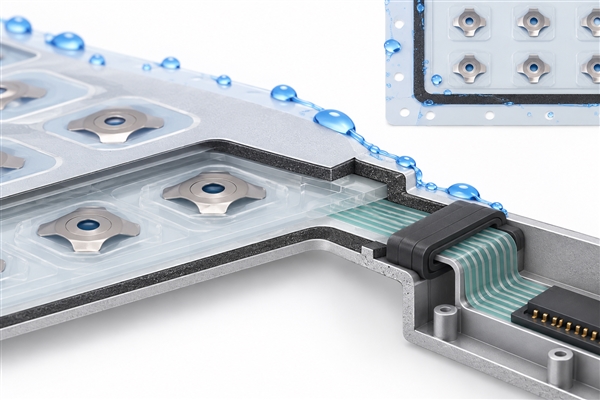
The tail exit needs separate attention because it creates a natural route toward the circuit. The tail should pass through a controlled seal transition with strain relief, not simply leave an open slot at the edge. The connector is best located inside the dry enclosure. If it must cross the wet boundary, that connector and its mounting method require their own environmental rating and validation.
How Do Metal Domes and Vent Paths Work Inside a Sealed Keypad?
Pressing a metal dome changes the volume of its cavity. If air cannot move predictably, pneumatic resistance can raise the apparent actuation force, slow return or make neighboring keys interact. Waterproofing therefore does not mean sealing every dome pocket as an isolated, rigid air chamber.
A double-layer metal dome array can use a spacer and controlled air paths to support consistent snap action. The vent network may connect cavities inside the protected area, lead to a sheltered dry zone or use another pressure-equalization strategy selected for the enclosure. It should not terminate at an exposed edge where it becomes a direct liquid channel.
The actuator also matters. Overlay embossing, a molded key or a plunger should contact the dome crown near its center and avoid excessive over-travel. Waterproof layers add thickness and stiffness, so the finished keypad force curve must be measured as an assembly; the loose-dome trip force is only one input.
What Does IP65 or IP67 Mean for a Membrane Keypad?
IEC 60529 classifies degrees of protection provided by enclosures. An IP code is therefore tied to the tested enclosure or complete interface, not automatically to a loose overlay, adhesive sheet or metal dome array. A component can support an IP target without independently carrying the finished-product rating.
For example, a spray requirement and a temporary-immersion requirement use different exposure methods. The drawing or specification should name the required level, the exact test configuration and what counts as failure: visible ingress, electrical leakage, false actuation, increased contact resistance, damaged graphics, adhesive lift or altered tactile force.
Which Tests Verify Water Resistance and Tactile Performance?
Environmental and switch tests should be planned together. A keypad that keeps water out but develops sluggish keys after conditioning is not a successful tactile interface.
| Verification | What it checks | Important controls |
|---|---|---|
| Defined water exposure | Ingress at the perimeter, openings and tail transition | Mounted assembly, orientation, time, pressure or depth, temperature |
| Insulation and continuity | False closures, leakage and trace damage during or after exposure | Pre-test baseline, powered/unpowered condition and post-test interval |
| Actuation force and rebound | Changes caused by overlay stiffness, trapped pressure or adhesive movement | Finished stack, actuator geometry and controlled test speed |
| Life cycling | Seal and tactile stability after repeated operation | Representative load, rate, temperature and acceptance limits |
| Environmental conditioning | Adhesive lift, material expansion, chemical attack and condensation effects | Actual material set and realistic thermal/chemical sequence |
We provide trip-force measurement, rebound-force measurement, life-cycle testing, electrical checks and dimensional inspection for our metal dome and dome-array supply. Water-ingress acceptance for the finished keypad must still be confirmed in the customer-defined assembly and enclosure configuration.
Waterproof Membrane Keypad vs Silicone Keypad: Which Architecture Fits?
A silicone keypad can provide molded keys, larger travel and a compressible sealing surface. A membrane keypad provides a thinner graphic interface, integrated legends and a laminated structure. Either architecture can use metal domes, and either can fail if the enclosure boundary is not designed correctly.
| Decision point | Membrane keypad | Silicone keypad |
|---|---|---|
| Profile and graphics | Thin panel with printed legends and windows | Molded keys with three-dimensional geometry |
| Sealing method | Continuous overlay, adhesive perimeter and housing support | Molded web, compression lip or gasket plus housing support |
| Tactile element | Metal dome, polydome or printed contact | Silicone web, conductive pill or metal dome beneath the rubber |
| Design priority | Bond-line continuity, tail exit and vent routing | Compression, molding tolerance, tear resistance and return force |
The common search question “are membrane keyboards waterproof?” has no universal yes-or-no answer. The switch technology can support a sealed design, but the exact layer stack, assembly and test evidence determine whether a particular product meets its requirement.
When project teams compare a membrane switch manufacturer with a dome-array supplier, they should define the supply boundary clearly: complete overlay and circuit integration, retained-dome sheet, loose domes, housing gasket and finished-product environmental validation are different deliverables.
Which Applications Need a Waterproof Membrane Keypad?
Outdoor control panels need protection against rain, UV exposure, temperature cycling and condensation. Medical and laboratory interfaces often need repeated wipe-down compatibility and smooth front surfaces. Food-processing and appliance controls may encounter water, oils and detergents. Marine or vehicle controls add vibration, salt-bearing moisture and enclosure movement.
In each application, the waterproof membrane button is only the visible operating zone. The real engineering task is to keep the entire wet-to-dry boundary intact while preserving legibility, tactile confirmation and electrical isolation over the required life.
What Design Inputs Are Needed for a Custom Membrane Keypad?
A custom membrane keypad project should define key coordinates, circuit contacts, dome size and force, actuator geometry, overlay stack, seal land, tail path, connector position, mounting surface, exposure requirement and acceptance tests. The drawing should also identify every opening and which side is considered wet.
When the key pattern is non-standard, our custom dome arrays can be developed from AutoCAD, PDF, Gerber, PCB/CAM or another controlled drawing. Shared datums between the circuit, dome carrier, overlay and housing reduce cumulative registration error. A prototype should then be evaluated in the actual enclosure before the design is released for volume production.
How Does EBest Circuit(Best Technology) Support the Keypad Interface?
EBest Circuit(Best Technology) has manufactured metal domes and metal dome arrays since 2006. We support standard and custom dome shapes, trip force, rebound force, travel, carrier geometry, spacer openings, vent paths and pressure-sensitive adhesive options for PCB, FPC and membrane-switch interfaces.
Our role is to make the tactile contact system fit the customer’s sealed keypad architecture. We do not treat the dome alone as proof of waterproof performance. We review how the dome array, circuit contacts, actuator and protected vent route interact, while the completed assembly is validated against the customer’s specified exposure and enclosure conditions.
For a new waterproof membrane keypad, send the key layout, circuit file, desired tactile force, layer stack, housing drawing and water-exposure requirement to our engineering team at sales@metal-domes.com.