
We are a rubber glue dome array manufacturer serving Israel from our manufacturing base in China. For communications, security, medical and consumer-electronics interfaces, EBest Circuit(Best Technology) builds the tactile layer around the actual keypad stack rather than asking the customer to accept a nearly matching standard sheet. The priority is fit: dome position, key feel, circuit contact and adhesive behavior must work together.
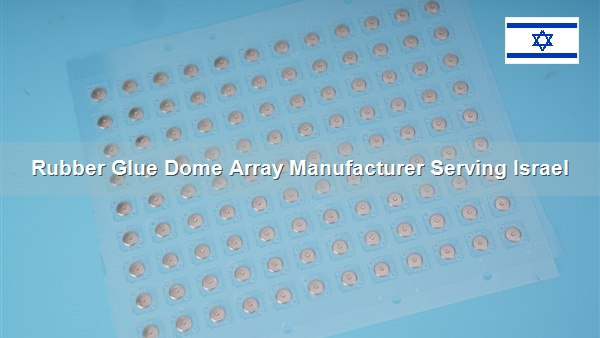
Why do rubber-glue dome arrays fit silicone keypads?
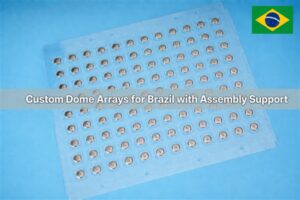
A standard dome array uses an adhesive-backed carrier to hold metal domes over PCB or FPC contacts. A rubber-glue construction adds a rubber adhesive layer on top of the Mylar or EMI layer so the array can bond to a compatible silicone-rubber keypad or to the intended assembly surface. The added layer is useful when the upper keypad and the dome carrier need a controlled interface, but it does not replace mechanical support beneath the domes.

Our rubber glue metal dome arrays are customized around the application. Adhesive choice and surface preparation still need to match the actual rubber formulation, texture and operating environment; “rubber glue” is a construction category, not a promise that one adhesive will bond equally to every elastomer.
Match the replacement to the complete keypad stack
When an Israeli engineering team needs an alternative to an existing dome sheet, matching only the outside dimensions is risky. The replacement must align with every contact pad and actuator while preserving available travel, return clearance and the way the keypad is retained in the enclosure. A dimensional match can still feel wrong if the original dome profile, force or vent path is different.
We review the circuit drawing, keypad drawing and the original part data together. If the original specification is incomplete, a physical sample can help identify geometry and layout, but the final production definition should still be captured in an approved drawing rather than relying on appearance alone.
Define dome geometry, force and contact inputs
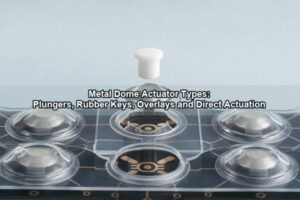
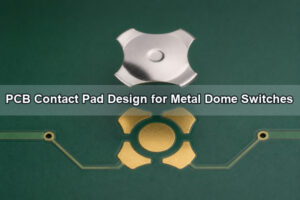
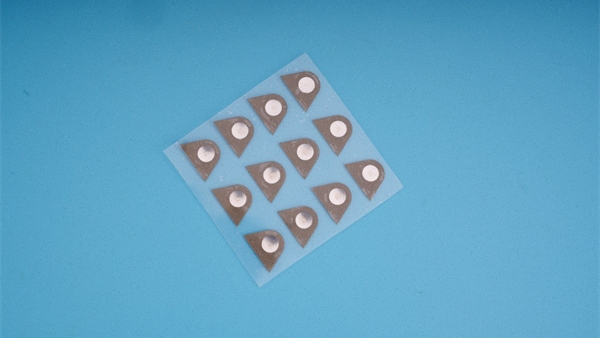
Circle, four-leg, triangle and oblong domes behave differently in a constrained keypad. Diameter or envelope size controls the available footprint; trip force and return behavior influence feel; travel and actuator geometry affect whether the dome can snap and release without over-stress. PCB pad geometry and surface condition also affect electrical contact.
Our custom dome arrays can combine selected dome sizes, shapes and forces on a project-specific carrier. The useful manufacturing input is not simply “same as the old dome.” It is a controlled set of dome coordinates, circuit-pad dimensions, stack height, key force target and environmental requirements.
Control adhesive zones, vents and cutouts
The carrier must retain each dome without trapping it. Adhesive should not migrate onto the active contact area, and the layout must preserve the vent route required by the chosen dome-array construction. Cutouts around LEDs, connectors, locating features or enclosure posts must also be registered to the circuit.
For a replacement project, these details are often where a visually similar part fails. We therefore review adhesive-free zones and mechanical openings as functional features, not just die-cutting details. The liner and application sequence are also defined so the array can be positioned without touching or deforming the dome crowns.
Security and communications interface applications
Communications and security products often place multiple keys in a compact, repeatedly used control surface. Potential applications include access-control keypads, alarm panels, intercom controls, communication terminals and handheld service devices. These are application examples, not claims of a specific customer installation.
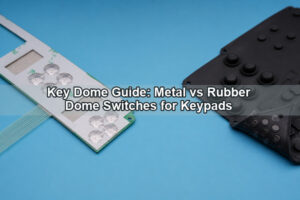
The rubber-glue layer can help integrate the tactile carrier with a silicone keypad, while the metal dome provides the snap response and contact closure. The design still needs firm support under each switching position, protection from contamination and a keypad geometry that does not side-load the dome.
Medical and R&D equipment interface requirements
Medical and laboratory equipment interfaces may need clear tactile confirmation, cleanable surfaces and stable response across repeated operation. The dome array is only one layer in that system. The enclosure seal, overlay or silicone keypad, circuit support and cleaning exposure must be reviewed together before a material or adhesive is selected.
We do not treat a dome array as a certified medical device. Instead, we manufacture the specified interface component and support engineering validation of fit, actuation and electrical behavior. The finished-equipment manufacturer remains responsible for the applicable device-level qualification and regulatory requirements.
Add LGF only when the interface needs distributed light
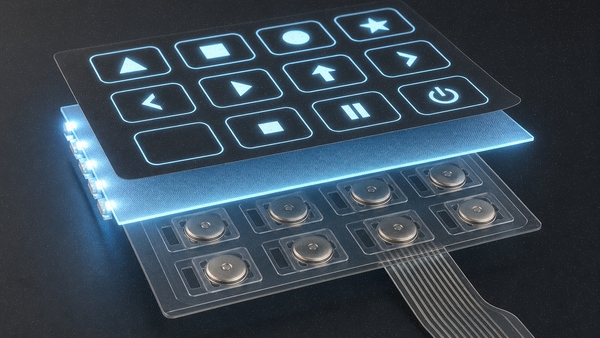
For an illuminated keypad, our LGF dome arrays add a light guide film above the tactile structure to distribute light from the selected LED arrangement. This can combine tactile switching and thin backlighting in one interface stack, but it is not required for an unlit keypad.
LED position, optical pattern, legend size, target brightness and available stack height are application-specific. An LGF layer should therefore be evaluated with the real graphic or rubber keypad rather than specified from dome coordinates alone.
Validate samples before releasing production
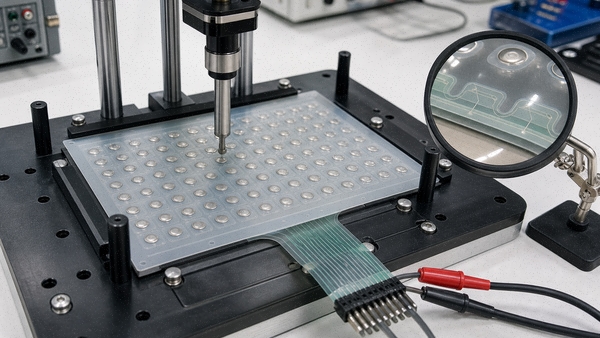
Prototype evaluation should use the intended circuit support, keypad and actuator. Check that every key closes electrically, returns after release and produces an acceptable assembled force. Pay special attention to edge keys, keys near cutouts and positions where the enclosure may flex.
For an alternative-part program, compare the original and proposed assemblies under the same method. Record force, travel, contact and return observations, then freeze the accepted drawing revision. This gives both the Israeli development team and our production team a shared definition of “matches the requirement.”
How do we support Israel projects from manufacturing review to delivery?
We manufacture metal domes and dome arrays in China and support Israeli OEM, EMS and R&D teams with drawing review, sample builds and controlled production. When a project also needs a related FPC, PCB or membrane-switch assembly, we can review the combined scope so interfaces are coordinated through one technical conversation. The agreed drawing and order scope determine what is supplied.
Price depends on dome type, array layout, adhesive construction, tooling, test requirements and production quantity. We focus first on a configuration that fits the product; a lower unit price does not recover the cost of a dome sheet that shifts, feels different or misses the contact pads.
Discuss your replacement or new design with our rubber glue dome array manufacturer team at sales@metal-domes.com. Share the circuit and keypad information available, and we will identify the remaining inputs needed for a manufacturable review.