
What Is an Industrial Tactile Dome?
An industrial tactile dome is a formed metal contact used inside a switch to create tactile feedback and close an electrical circuit when pressed. It is commonly used in industrial control panels, membrane switches, PCB keypads, handheld devices, measuring instruments, access systems, and rugged electronic products. When pressure is applied, the dome collapses at a designed force point, touches the circuit pad, and then returns to its original shape after release.
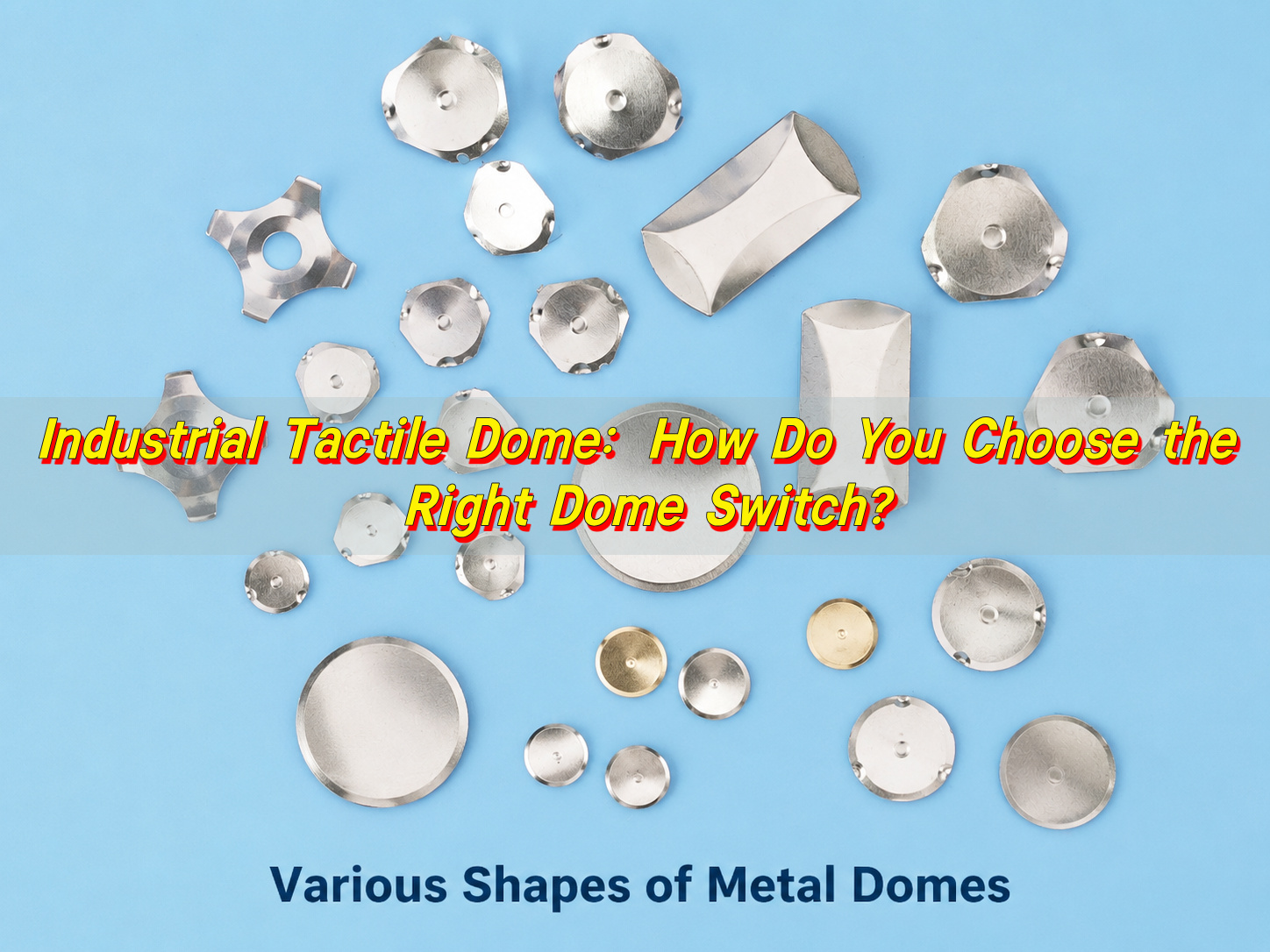
The main function of an industrial tactile dome is to provide a clear and repeatable button response. In industrial equipment, users often operate buttons with gloves, under vibration, or in environments where visual confirmation is limited. A well-selected dome allows the user to feel whether the input has been completed.

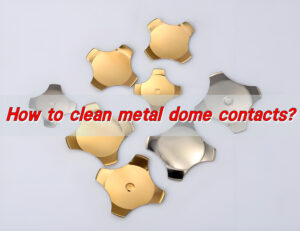
Most industrial tactile domes are made from stainless steel, nickel-plated stainless steel, or gold-plated stainless steel. Stainless steel provides spring performance and mechanical stability. Nickel plating can improve surface protection, while gold plating is often used when lower contact resistance or better corrosion resistance is required. The material choice should match the circuit design, operating environment, expected life, and cost target.
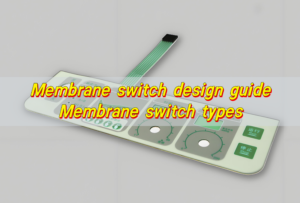
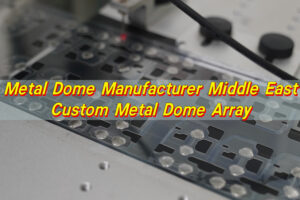
Industrial tactile domes can be supplied as individual domes or assembled into custom metal dome arrays. A dome array places multiple domes on adhesive film or PET film according to the circuit layout. This format improves placement accuracy, reduces manual assembly time, and supports cleaner production for membrane switch and PCB keypad applications.
EBest Circuit supports industrial tactile dome selection, dome array design, and switch structure review. For industrial projects, the dome should not be chosen by diameter and force alone. The final button feel depends on the dome, overlay, spacer, adhesive, circuit pad, housing, and actuator design working together.
Why Are Tactile Domes Used in Industrial Equipment?
Tactile domes are used in industrial equipment because they provide physical feedback in a compact switch structure. The user can feel the button response immediately after pressing, which helps confirm operation without relying only on a screen, sound, or indicator light. This is useful in factories, vehicles, outdoor equipment, medical devices, and field instruments.
Industrial equipment often requires stable input control. A button may be pressed thousands of times during product use. If the switch feel changes quickly, the user experience becomes inconsistent. A proper tactile dome helps maintain a repeatable click, stable rebound, and reliable contact over the expected service life.
Tactile domes also help product designers build thin and sealed interfaces. They can be used under graphic overlays, inside membrane switch panels, on printed circuit boards, or in flexible circuit assemblies. This makes them suitable for products that need a low-profile keypad with clear tactile feedback.
Common reasons for using industrial tactile domes include:
- Clear press feedback for operators.
- Thin structure for compact control panels.
- Compatibility with PCB, FPC, and membrane switch circuits.
- Stable force options for different button functions.
- Support for custom metal dome arrays.
- Practical use in sealed and waterproof switch designs.
In industrial products, the button feel should match the application. A setting button on a handheld device may need medium force for comfortable repeated use. A power or mode button on a control panel may need higher force to create a more deliberate operation. EBest Circuit can help review the switch stack and recommend a dome structure that fits the actual product design.
What Is the Difference Between Industrial Tactile Dome Switches and Standard Dome Switches?
Industrial tactile dome switches and standard dome switches both use metal domes to create a click response, but their design priorities are different. Standard dome switches are often used in consumer electronics or light-duty products where the operating environment is controlled and the button is pressed less frequently. Industrial tactile dome switches are selected for stronger durability, more stable force, better environmental resistance, and more consistent performance in demanding applications.
For industrial products, the switch may be exposed to dust, moisture, vibration, temperature variation, cleaning agents, or heavy use. The dome may also need to work under thicker overlays or inside sealed membrane switch structures. These factors affect material selection, plating, force range, dome shape, adhesive design, and testing requirements.
| Comparison Item | Industrial Tactile Dome Switches | Standard Dome Switches |
|---|---|---|
| Typical Use | Industrial panels, instruments, rugged devices, control systems | Consumer keypads, remote controls, simple electronics |
| Actuation Force | Often medium to high force, commonly about 250 gf to 800 gf | Often light to medium force, commonly about 100 gf to 350 gf |
| Tactile Feel | More defined feedback and stronger rebound | Softer or lighter feedback |
| Service Life | Often designed for higher cycle requirements | Usually designed for moderate use |
| Environment | May include moisture, dust, vibration, gloves, or outdoor use | Usually indoor and less demanding use |
| Assembly Format | Frequently used in custom dome arrays or membrane switch panels | Often used as loose domes or simple dome sheets |
| Testing Focus | Force curve, contact resistance, life cycle, placement, sealing | Basic force and electrical function |
| Main Design Goal | Reliability, consistency, and clear operation | Basic function and cost control |
A standard dome can be suitable when the product has simple operating requirements. An industrial product usually needs tighter control over feel, contact performance, and assembly consistency. The selection should consider how the button will be pressed, how often it will be used, and whether the product needs sealing or environmental protection.
As a tactile dome switch manufacturer, EBest Circuit reviews dome force, dome shape, plating, pad design, adhesive film, overlay thickness, and assembly method together. This helps customers choose a switch structure that performs correctly after final assembly, not only during loose dome testing.
What Is a High Actuation Force Tactile Dome?
A high actuation force tactile dome is a metal dome that requires a stronger press before it snaps down and closes the circuit. Actuation force is usually measured in grams-force, written as gf. In many switch designs, light-force domes are around 100 gf to 180 gf, medium-force domes are around 200 gf to 350 gf, and high-force domes are often around 400 gf to 800 gf. Some custom designs can go higher depending on size, material, and structure.
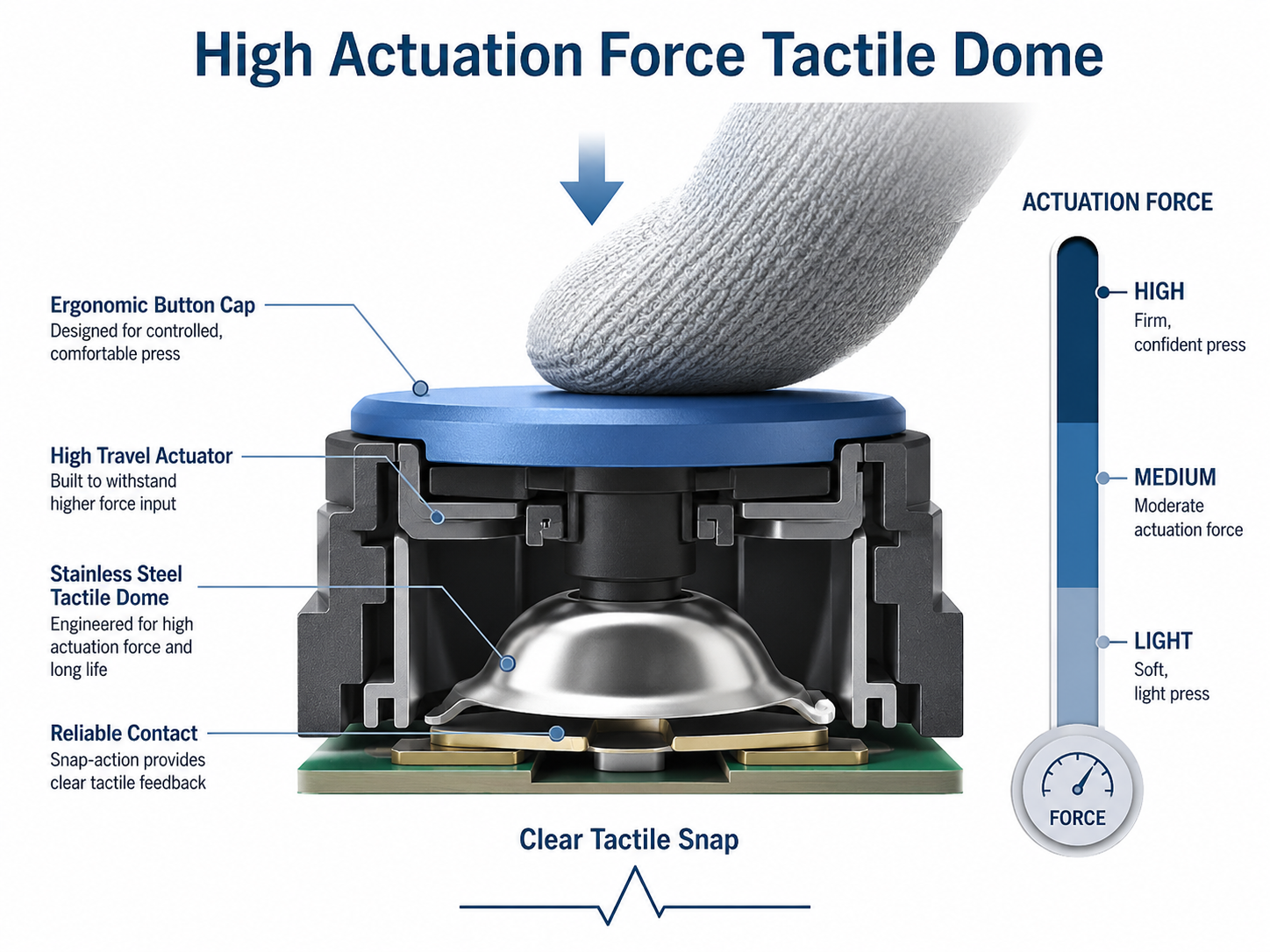
High actuation force is used when the button needs a firmer and more deliberate press. This can help when the product is operated with gloves, when the key area is large, or when the function should not be activated by a very light touch. The stronger force also helps the button feel more defined through thicker overlays or sealed membrane layers.
| Force Category | Typical Force Range | Button Feel | Common Use |
| Light Force | 100 gf–180 gf | Easy press, soft feedback | Small electronics, light-use keypads |
| Medium Force | 200 gf–350 gf | Balanced feedback | Instruments, handheld devices, control panels |
| High Force | 400 gf–800 gf | Firm and clear feedback | Industrial controls, gloved operation, rugged products |
| Extra High Force | 800 gf+ | Very firm press | Special control buttons and custom designs |
High force should be selected carefully. A dome with excessive force can make frequent operation tiring, while a dome with insufficient force may feel unclear under a thick overlay. The best choice depends on key size, overlay thickness, actuator design, button function, and user environment.
EBest Circuit can provide sample review and force matching for high actuation force tactile dome projects. Testing the dome inside the actual product stack is useful because the final feel can change after overlay, spacer, adhesive, and housing parts are added.
When Do You Need High Actuation Force Tactile Domes?
High actuation force tactile domes are used when the switch must give a firm press response and reduce unintended operation. They are common in industrial equipment where buttons are operated with gloves, exposed to vibration, or used for important control functions. A higher force can also help the button remain clear when the switch is covered by a thicker graphic overlay or waterproof membrane structure.
Typical applications include industrial control panels, vehicle control units, outdoor access devices, marine electronics, power tools, measuring instruments, warehouse scanners, rugged handheld terminals, and medical or laboratory equipment. These products often require a button that can be felt clearly during fast operation or in challenging environments.
High-force domes are often suitable when the design includes:
- Thick overlay or membrane layers.
- Gloved operation.
- Large key areas.
- Equipment exposed to vibration.
- Buttons for power, mode selection, reset, or confirmation.
- Rugged products used in outdoor or industrial environments.
The required force should be evaluated with the full switch structure. Overlay thickness, key embossing, spacer height, adhesive thickness, and actuator shape all affect the final response. A dome that feels correct in a test fixture may feel different after it is assembled into the final product.
For this reason, sample testing is recommended before mass production. EBest Circuit can support customers with dome samples, custom metal dome arrays, and assembled switch samples, allowing the engineering team to compare force levels and tactile response under real product conditions.
How Does Actuation Force Affect Button Feel?
Actuation force affects how light, firm, sharp, or comfortable the button feels. A lower-force dome is easier to press and works well for frequent operation. A higher-force dome requires more pressure and creates a more deliberate response. The correct force improves usability and helps the button match its function.
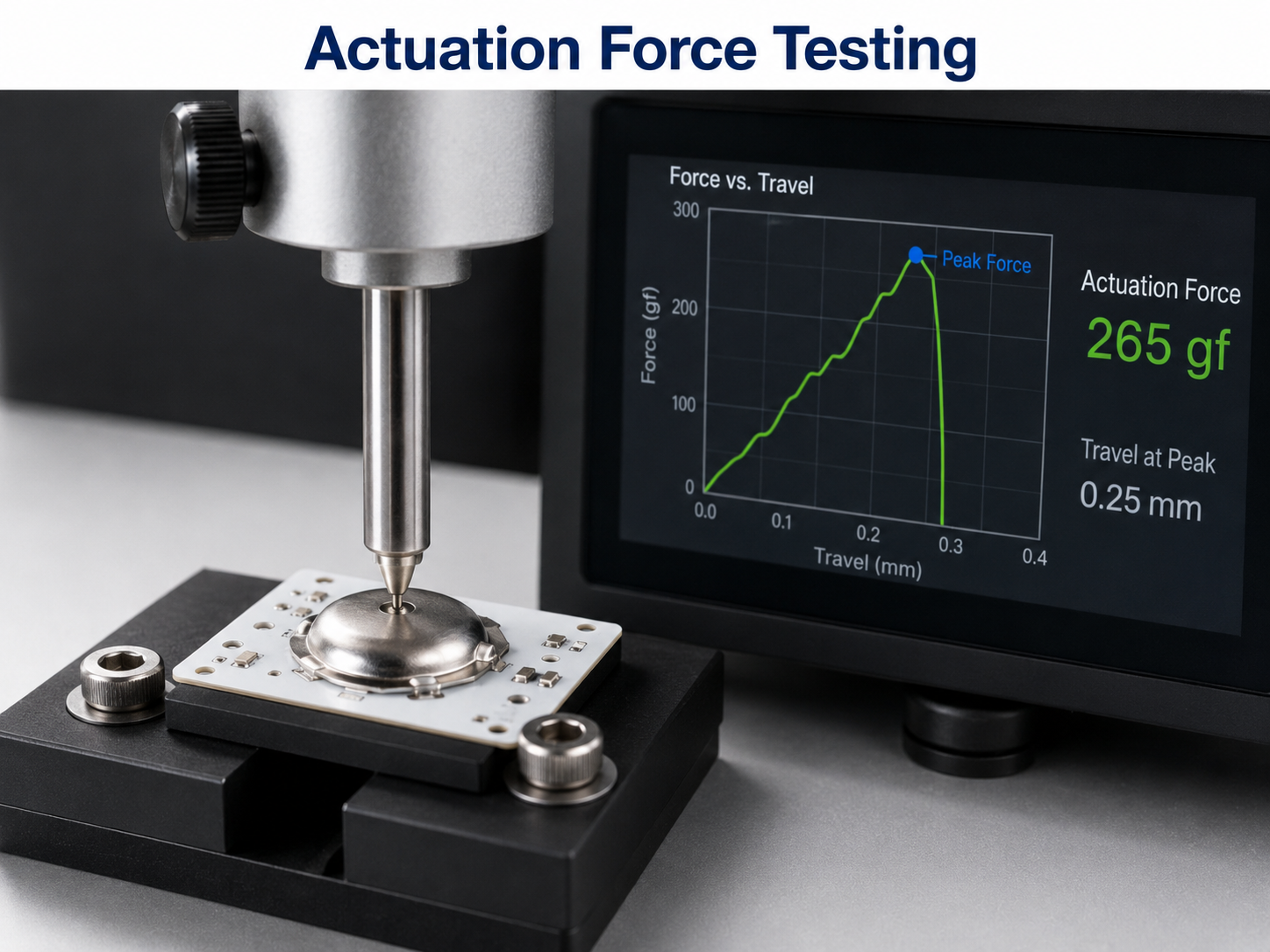
A tactile dome works through a force curve. As the user presses the key, the force increases until the dome reaches its snap point. The dome then collapses and closes the circuit. The drop in force creates the tactile click. When pressure is released, the dome rebounds and opens the circuit. This movement determines the click feel, return feel, and overall button response.
Peak force is important, but it is not the only factor. Two domes with the same actuation force can feel different if their travel, dome height, tactile ratio, material thickness, or overlay structure is different. In industrial tactile dome switches, the final button feel should be checked after the dome is assembled into the complete switch stack.
| Parameter | Meaning | Effect on Button Feel |
| Actuation Force | Force required to snap the dome | Determines how firm the button feels |
| Return Force | Force during dome rebound | Affects reset and release feel |
| Travel | Distance the dome moves during press | Affects perceived depth |
| Tactile Ratio | Relationship between snap force and return force | Affects click sharpness |
| Dome Diameter | Width of the dome | Influences force, stability, and pad design |
| Dome Height | Dome profile before pressing | Affects travel and response |
| Overlay Thickness | Film or cover layer above the dome | Can soften or increase the press feel |
For repeated button use, a medium-force dome often provides a good balance between comfort and feedback. For rugged industrial controls, a high actuation force tactile dome can provide clearer confirmation. The selection should match the user’s hand position, operating frequency, key size, and product environment.
EBest Circuit can help evaluate force targets through sample testing and force curve review. This process helps avoid mismatch between the selected dome and the final button feel after assembly.
How Does Dome Shape Affect Tactile Feedback?
Dome shape affects tactile feedback because it controls how the metal dome collapses, contacts the pad, and rebounds. The shape also influences actuation force, travel, stability, life cycle, and contact behavior. For industrial switch design, dome shape should be selected together with force, size, circuit pad layout, and assembly method.
Common dome shapes include round domes, four legged metal domes, triangle domes, oblong domes, and custom domes. Round domes are widely used because they provide balanced feedback and are available in many sizes and force ranges. Four legged metal domes provide stable support points and are often used in PCB and membrane switch designs. Oblong domes are useful for longer button shapes, while custom domes can be designed for special force or layout needs.
| Dome Shape | Characteristics | Typical Use |
| Round Dome | Balanced click and common size options | Control panels, instruments, handheld devices |
| Four Legged Metal Dome | Stable support and defined contact points | PCB keypads and membrane switch panels |
| Triangle Dome | Compact shape and quick response | Small control areas |
| Oblong Dome | Longer contact area | Rectangular or elongated buttons |
| Custom Dome | Tailored size, force, travel, and contact design | Special industrial switch projects |
The overlay and spacer structure can change how the dome shape feels in the finished product. A sharp dome response may become softer under a thick overlay. In this case, the design may require a different force, dome height, spacer thickness, or embossed key structure.
Placement accuracy also affects tactile feedback. If a dome is not centered on the circuit pad, the button may feel uneven or create unstable contact. Custom metal dome arrays help control placement because the domes are fixed on adhesive film according to the circuit layout.
EBest Circuit reviews dome shape, pad structure, array design, and switch stack together. This helps create a consistent button feel and supports reliable assembly in industrial metal dome switches.
Can Industrial Tactile Domes Support Waterproof Designs?
Industrial tactile domes can be used in waterproof switch designs when the complete switch structure is properly sealed. The dome itself is a metal contact, while waterproof performance depends on the overlay, adhesive, spacer, circuit layer, tail exit, edge seal, and housing design.
Waterproof tactile dome switches are used in outdoor control panels, marine devices, medical equipment, cleaning devices, access systems, and industrial handheld products. These products may be exposed to water drops, humidity, cleaning spray, dust, oil mist, or condensation. A sealed membrane switch structure helps protect the dome and circuit while keeping the button responsive.
| Waterproof Design Factor | Function | Design Consideration |
| Graphic Overlay | Protects the top surface | Thickness and embossing affect tactile feel |
| Adhesive Layer | Bonds and seals layers | Adhesive type affects sealing strength |
| Spacer Layer | Provides dome movement space | Cavity design affects snap action |
| Edge Seal | Protects the panel perimeter | Requires enough bonding width |
| Tail Exit | Common sealing point | Needs reinforced protection |
| Venting Path | Allows air movement during press | Must support dome movement and sealing |
| Housing Compression | Adds sealing pressure | Should be even and controlled |
A waterproof design should balance sealing and tactile response. A thicker overlay or stronger adhesive may improve protection, but it can also change the press feel. Spacer design and venting are important because air movement around the dome affects button movement. The design should allow the dome to move freely while keeping moisture away from the contact area.
Material compatibility is also important. Outdoor products may need UV-resistant overlay materials. Cleaning equipment may need chemical-resistant film and adhesive. Marine or wet-use products may need reinforced edge sealing and careful tail design.
EBest Circuit can review waterproof switch structures and help confirm whether the selected dome force remains clear after sealing layers are added. This is especially important for industrial membrane switch tactile dome applications where sealing, feel, and thin structure must work together.
What Factors Affect Industrial Tactile Dome Life?
Industrial tactile dome life is affected by material, plating, dome shape, actuation force, circuit pad design, assembly accuracy, pressing position, overlay structure, and operating environment. A reliable switch design controls these factors so the dome can keep stable force and contact performance over repeated use.
Life cycle is usually measured by repeated press testing. Depending on dome size, material, force, shape, and application, many metal domes are designed for hundreds of thousands to several million cycles. The actual life in a product depends on how the dome is supported and how the user presses the button.
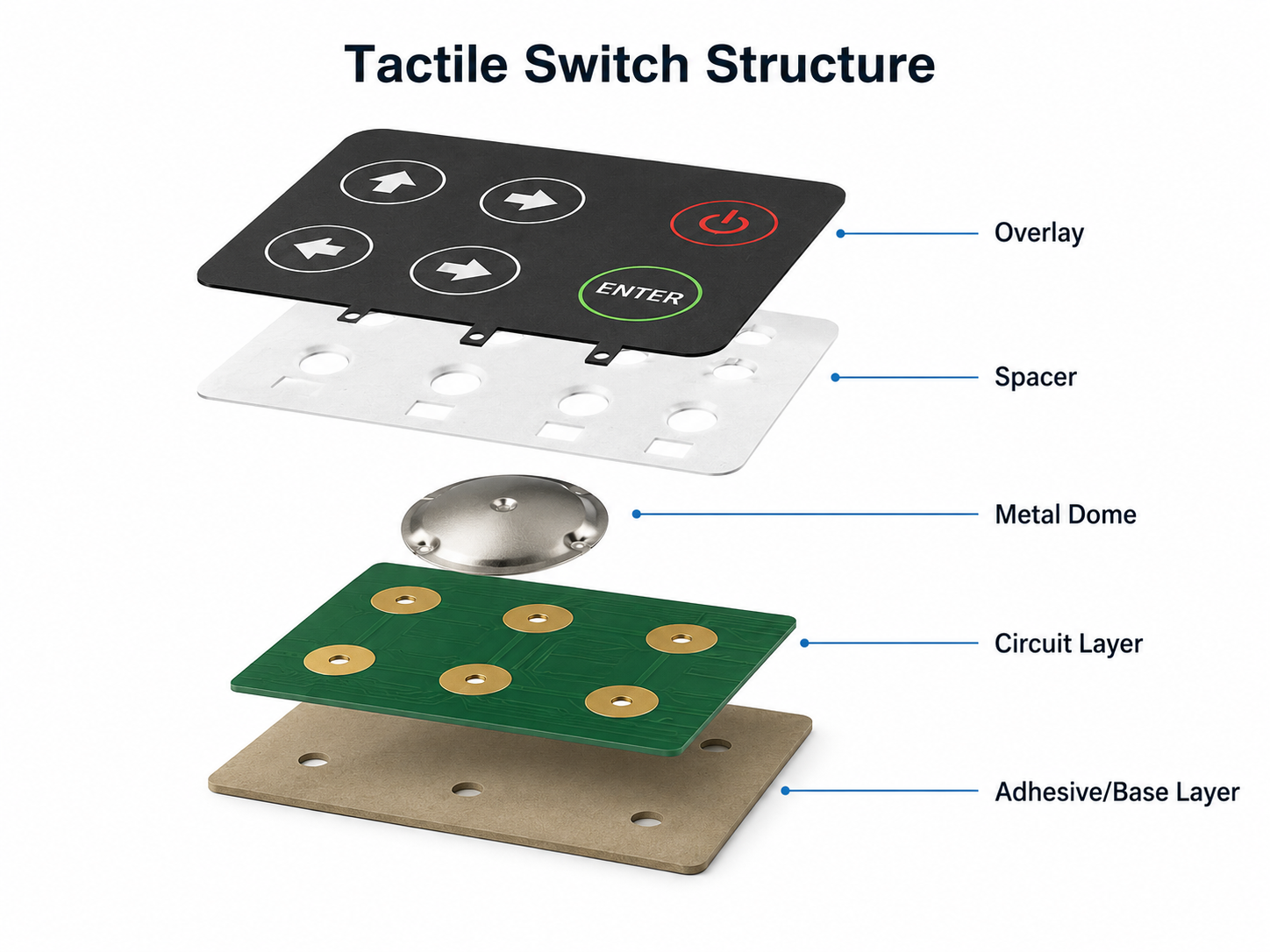
The circuit pad design is important for electrical stability. The pad should match the dome shape and provide reliable contact without creating uneven stress. Surface finish, cleanliness, plating, and pad geometry can all affect contact resistance. In membrane switches, printed silver or carbon contacts should be selected according to circuit requirements and environmental conditions.
The mechanical stack also affects life. The dome should be pressed from the correct position, usually near the center for many common dome types. Off-center pressure can create uneven stress and change the feel over time. Spacer height should allow the dome to move correctly, while the overlay should transfer force smoothly.
Environmental exposure should be considered during design. Moisture, dust, chemicals, vibration, and temperature variation can affect the switch assembly. Proper sealing, stable materials, and reliable adhesive selection help protect the dome and circuit area.
EBest Circuit supports life-focused dome design by reviewing dome material, force range, plating, pad layout, adhesive array, and switch stack. For long-life industrial applications, sample testing and production inspection help maintain consistent performance from prototype to mass production.
How Are Industrial Tactile Dome Switches Tested?
Industrial tactile dome switches are tested through mechanical, electrical, dimensional, and application-related checks. Testing confirms that the switch matches the required force, contact performance, assembly accuracy, and service expectations.
Force testing is one of the most important checks. A force tester presses the dome or assembled switch and records actuation force, return force, travel, and tactile curve. This confirms whether the button feel matches the required specification. For high actuation force tactile dome projects, force testing helps control consistency across samples and production batches.
Electrical testing checks whether the dome closes the circuit reliably. Contact resistance should remain stable for the product circuit. This depends on dome plating, circuit pad surface, contact pressure, cleanliness, and assembly quality.
Life cycle testing repeats the press action for a defined number of cycles. It helps confirm whether the dome maintains force, rebound, and electrical contact after repeated use. For industrial metal dome switches, this test is important because it connects the design target to real operating durability.
Dimensional inspection checks dome diameter, height, shape, array position, adhesive alignment, and surface quality. For custom metal dome arrays, placement accuracy is critical because the dome must align with the circuit pad. Visual inspection also helps detect surface defects, contamination, burrs, or plating issues before assembly.
| Test Item | What It Confirms | Why It Matters |
| Actuation Force Test | Peak force, return force, tactile curve | Confirms button feel and consistency |
| Contact Resistance Test | Electrical contact quality | Supports stable signal input |
| Life Cycle Test | Repeated press durability | Verifies long-term performance |
| Dimensional Inspection | Dome size, height, shape, placement | Supports assembly accuracy |
| Visual Inspection | Surface, burrs, plating, contamination | Helps control production quality |
| Waterproof or Sealing Check | Protection of the switch structure | Supports wet or outdoor applications |
| Sample Assembly Test | Real feel in the final stack | Confirms practical product performance |
For waterproof tactile dome switches or rugged industrial products, additional checks may include sealing review, humidity exposure, temperature cycling, or application-level vibration testing. The exact test plan should match the final product environment.
Choosing the right industrial tactile dome requires a review of force, shape, material, plating, circuit pad design, array format, waterproof structure, and testing requirements. A good dome switch should feel clear, fit the assembly, and perform consistently in the final product. EBest Circuit can support industrial tactile dome switches, industrial metal dome switches, custom metal dome arrays, waterproof tactile dome switches, and snap dome switches industrial design projects. For technical review or quotation, contact sales@metal-domes.com.