
Metal dome environmental testing should expose the actual part or assembly to conditions that represent its storage and use, then compare its mechanical and electrical behavior with a recorded baseline. A bare dome can retain its snap while a mounted key fails because its film shifts or its PCB contact changes. Conversely, a discolored surface does not by itself prove electrical failure. Specify the specimen, exposure, measurement timing and acceptance limits together; a chamber temperature alone is not a test plan.

What Does Metal Dome Environmental Testing Need to Prove?
It needs to show whether the specified switch construction still closes and returns as required after the intended environmental stress. That calls for more than looking for rust. Record trip and return force, the quality of the tactile snap, electrical continuity during actuation, contact resistance under the specified test circuit, and visible changes to the dome, retention film and pads. Which of these are acceptance criteria depends on the product drawing and end-use requirement.

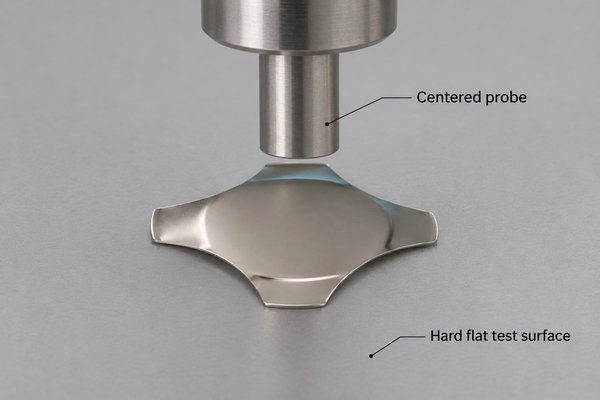
Our metal dome test criteria describe a centered probe, a hard flat support and venting for trip-force measurements. Those controls matter when pre- and post-exposure force readings are compared: an off-center probe or trapped air can look like a material change when the fixture actually changed.
Should You Test a Loose Dome or a Mounted Dome Array?
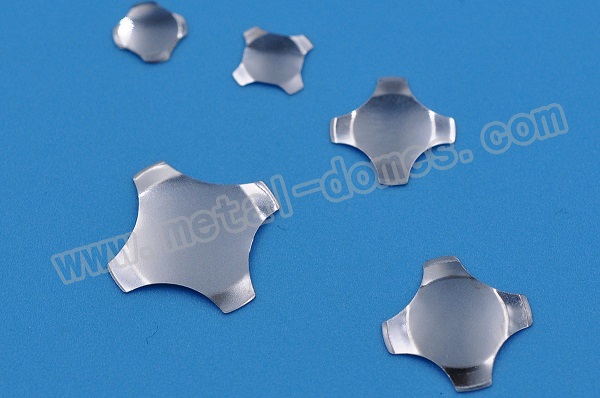
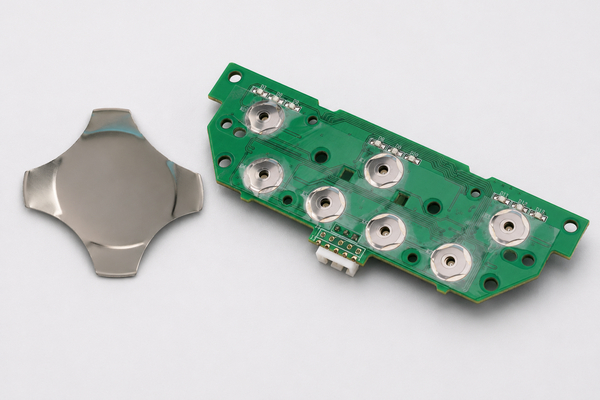
Test the construction whose failure matters to the decision. A loose C-series round dome or F-series four-leg dome can reveal a change in the metal’s force response or surface. It cannot prove that adhesive, a PET carrier, PCB pad finish and actuator still work together. For an assembled keypad, include a representative metal dome array on the intended circuit and, where relevant, its overlay and enclosure.
| Specimen | What it can reveal | What it cannot establish alone |
|---|---|---|
| Loose dome | Metal surface, geometry, trip and return force | PCB contact reliability or carrier adhesion |
| Dome array on representative PCB | Dome position, film edge, vent path and contact closure | Sealing and actuator behavior of a different enclosure |
| Complete button stack | Combined effect of actuator, overlay, enclosure and contacts | A separate material property without further isolation |
What Should Be Recorded Before Environmental Exposure?
Identify the exact dome series, finish, force selection, array construction, adhesive, PCB pad finish and sample lot before placing specimens in a chamber. Photograph the contact area and film edges. Record each key’s initial trip and return force and its closed-contact behavior using the same fixture and electrical circuit planned for the later measurement. Include a control group that is measured but not exposed when the project needs to distinguish test drift from environmental change.
Preconditioning must also be the same. Our published force procedure uses 10 actuations before measuring a loose dome. If the project uses a different method on an assembled key, write it down and apply it consistently rather than comparing unlike readings.
How Is a Metal Dome Humidity Test Run Without Condensation?
A metal dome humidity test for steady damp heat keeps the specimen at a specified temperature and high relative humidity for a specified duration without intended condensation. IEC 60068-2-78:2025 describes this type of exposure; it does not choose a pass limit for every dome assembly. The project’s temperature, humidity, duration, specimen state, recovery interval and electrical checks must be stated separately. See the IEC 60068-2-78 publication for the method’s scope.
Watch the metal-to-pad interface and the edges of a PET carrier. Moisture and residue can change a contact even if the dome still clicks. If the switch is intended to operate during exposure, say whether contacts must be measured in the chamber or only after recovery; those results answer different questions. Our C- and F-series pages list a non-condensing humidity range, but that product-page entry is not a report that every possible dome assembly has passed every humidity profile.
When Is a Cyclic Damp Heat Test for Switches Needed?
A damp heat test for switches with cyclic temperature is relevant when the product may encounter repeated warm, humid periods followed by cooling. IEC 60068-2-30:2025 describes a 12-hour-plus-12-hour cyclic damp-heat method that generally produces surface condensation. That is materially different from steady, non-condensing damp heat. The IEC 60068-2-30 publication describes the method; the customer specification still has to set severity and acceptance criteria.
For a mounted dome, note whether condensate can reach the pad through a vent or an enclosure opening, whether the carrier lifts at an edge, and whether the key closes reliably after the prescribed recovery. Do not add a cyclic-condensation result to a product marked for non-condensing service without an actual qualification of that exact construction.
How Does Metal Dome Thermal Cycling Differ From Damp Heat?
Metal dome thermal cycling changes temperature between specified limits to reveal effects of expansion, contraction and material mismatch. It does not necessarily impose high humidity. IEC 60068-2-14:2023 covers change-of-temperature methods; the IEC publication does not turn a listed operating-temperature range into proof that an assembled dome array has passed a particular cycle count.
State both endpoint temperatures, dwell, transition, number of cycles, power state and when the key is actuated. A loose dome may show a force shift; a laminated array may show carrier movement, adhesive edge lift or a changed actuator-to-dome relationship. Measure after the agreed recovery as well as at a temperature extreme if operation at that extreme is an actual requirement.
What Can Temperature Changes Do to the Dome Array Stack?
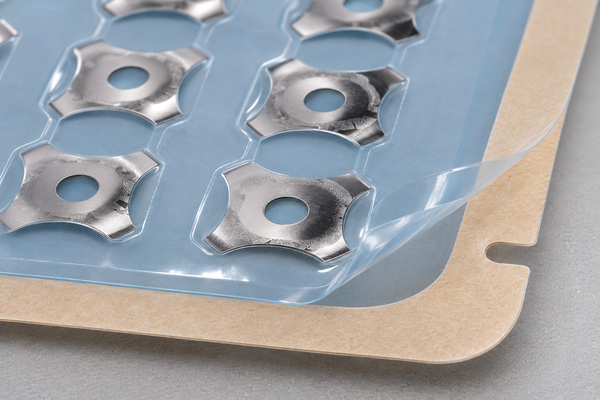
The metal dome, PET film, adhesive, PCB and enclosure do not necessarily expand or relax at the same rate. A stack can therefore change its local preload or vent clearance even when the loose dome is unchanged. On our single- and double-layer array constructions, the carrier and air path are functional parts of the switch, not decorative packaging. Record their actual geometry on the sample being qualified.
Look for dome migration, adhesive squeeze or lift, a blocked air path and a button that remains partially pressed. These are inspection targets, not claims that the phenomena occurred in a particular test. Comparing the same marked key before and after exposure makes a small change easier to locate than looking at a different, unexposed unit.
How Should Contact Closure Be Checked After Exposure?
Use the representative PCB pads and the intended sensing circuit, or a defined laboratory circuit with its voltage, current and measurement threshold recorded. Actuate each marked key through the intended travel and log whether it closes, opens and repeats without intermittent contact. A single continuity beep cannot show how resistance behaves across repeated presses or at the intended operating condition.
If a failure appears only after damp heat, preserve the sample before cleaning. Record the key number, the observed waveform or resistance behavior and the surface condition at the pad and dome. Cleaning first may remove the evidence needed to distinguish contamination or corrosion from a positioning problem.
How Should Trip and Return Force Be Compared?
Compare the same dome or key with the same probe, alignment, support and actuation method before and after exposure. Our loose-dome method centers the probe, keeps it perpendicular, supports the dome on a hard flat surface and vents trapped air. Record trip force and, when specified, return force. A force shift is meaningful only if the measurement setup and preconditioning are controlled.
For an assembled key, the actuator, film and housing add their own force contributions. Report the result as a complete-button measurement rather than attributing all change to the stainless dome. If the button feels weak while a separately measured loose dome remains within its baseline, inspect retention and preload before changing the metal specification.
What Do Corrosion and Adhesive Changes Tell You?
A visible spot is a location to investigate, not an automatic pass or fail. Compare before-and-after photographs, inspect the dome contact area and PCB finish separately, and correlate any discoloration with the electrical measurement. A lifted carrier edge may matter if it shifts the dome or changes the vent route; a cosmetic edge change may have a different disposition if the key still meets the agreed functional criteria.
Do not destroy or polish a failed sample before documenting it. The useful question is where the first measurable change occurred: on the dome, at the PCB pad, in the adhesive/film or in the actuator stack. That separation guides a real corrective action instead of automatically changing plating whenever a humid test fails.
Should Environmental Exposure Come Before Life Cycling?
The order depends on the failure the project needs to expose. An uncycled specimen followed by damp heat isolates environmental sensitivity of a new build. Cycling first and then exposing the specimen asks whether wear or a changed contact surface makes later humidity more damaging. Environmental exposure followed by actuation asks whether a conditioned key can still switch repeatedly. A separate unexposed control helps interpret the result.
Write the sequence and intermediate measurements into the test plan. Our published dome life-test procedure concerns repeated actuation; passing a room-condition life test alone is not the same as passing environmental exposure on a finished assembly.
What Belongs in an Environmental Test Plan and Report?
A useful report lets another engineer identify the exact sample, reproduce the stress and see what changed. The following fields should be completed with project values before testing; a blank field is not an assumed industry default.
| Record field | What to specify | What to retain as evidence |
|---|---|---|
| Specimen identity | Part and revision, dome lot, finish, carrier, PCB and key positions | Sample map and pre-test photographs |
| Exposure profile | Method/edition, temperature, humidity, dwell, cycles, condensation state and power state | Chamber log and deviations |
| Measurement protocol | Probe, force setup, electrical circuit, actuation count and measurement timing | Individual pre-, interim- and post-test results |
| Acceptance | Customer-approved force window, contact behavior, appearance limits and permitted changes | Pass/fail by key and engineering disposition |
| Failure follow-up | Whether a sample may be opened, cleaned or sectioned | As-found photographs and analysis record |
For example, a project may require the same numbered array key to be measured before steady damp heat, after the specified recovery and again after a defined number of presses. The report should show those three results side by side and cite the drawing’s acceptance limits. Without the chosen limits and actual measurements, the example is a reporting method, not a claim of passing performance.
What Should You Send Us for a Test-Ready Dome Build?
To make representative samples, send the dome or array drawing, required force range, PCB contact pattern and finish, carrier/adhesive construction, actuator or overlay stack, expected temperature and humidity exposure, and the electrical circuit to be switched. Include the requested sample quantity and the test method or customer specification if one is already fixed. We can then align the metal dome or array construction with those inputs and identify which measurements belong to the supplied part and which require your complete enclosure or system.
At EBest Circuit(Best Technology), we manufacture metal domes and dome arrays. Any project-specific environmental qualification or report scope must be agreed before it is described as completed.
Metal Dome Environmental Testing FAQs
Does a non-condensing humidity specification cover cyclic damp heat?
No. A non-condensing humidity entry and a cyclic damp-heat exposure that generally creates condensation are different conditions. Confirm the exact assembly and test profile before using one result to support the other.
Can a bare dome pass while the assembled button fails?
Yes. The bare dome does not include the PCB pad, adhesive carrier, actuator or enclosure. Test the assembled stack when its switching performance is the acceptance target.
Is a fixed temperature and humidity value enough to specify the test?
No. The sample state, exposure duration or cycles, measurement timing, recovery, electrical circuit and pass criteria must also be defined.
For metal dome environmental testing samples, send the drawing and environmental requirements to sales@metal-domes.com so we can review the build and quotation.