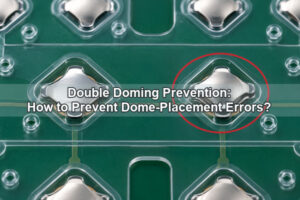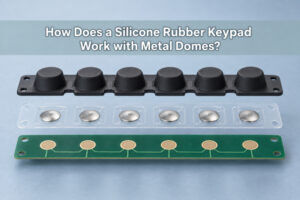

What Is a Four Leg Dome?
A four leg dome is a tactile metal dome with four supporting legs formed around the dome body. It works as a momentary switch in PCB keypads, membrane switches, control panels, remote controls, medical devices, automotive buttons, and industrial equipment. When pressed, the dome collapses toward the circuit contact, closes the electrical path, and returns after the force is released.

The four-leg structure distributes pressing force across multiple support points. This helps the dome maintain stable contact behavior, especially when the key is pressed slightly off-center. For applications that require repeatable tactile feedback, this structure is often selected for medium and large key areas.
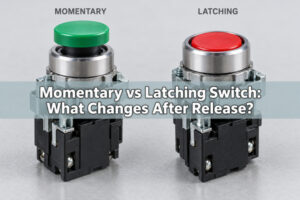
Four leg domes are available in different sizes, heights, force levels, plating options, and contact styles. Dimpled versions provide a defined center contact point, while non-dimpled versions are used when the circuit layout or stack height requires a flatter contact profile. Selection should be based on PCB pad design, overlay thickness, spacer opening, actuator size, and target actuation force.
In production, the dome should be evaluated with the full switch structure, not as a standalone part. The PCB pad, adhesive spacer, overlay, actuator, and assembly tolerance all affect final performance. EBest Circuit (Best Technology) supports this type of design review for metal dome array and membrane dome switch projects.
What Is a Triangle Dome?
A triangle dome is a tactile metal dome with a triangular body shape. It also functions as a momentary switch. In its resting state, the circuit remains open. When pressed, the dome snaps down, touches the contact pad, closes the circuit, and returns after release.
The main advantage of a triangle dome is its compact footprint. It is often used in handheld devices, slim keypads, side buttons, portable instruments, and other products with limited PCB space. Its geometry allows tactile switching in layouts where a larger dome may not fit.
Triangle domes can provide a direct and firm tactile response. This makes them suitable for small function keys and compact control areas. Some triangle domes include legs or locating features to help position the dome on the PCB or circuit layer.

Triangle domes can also be supplied as part of a metal dome array. In this format, multiple domes are fixed on an adhesive carrier film, often PET, and assembled over the circuit layer. This improves alignment and production efficiency for membrane dome switch assemblies.
Four Leg Dome vs Triangle Dome: What Is the Main Difference?
The main difference between a four leg dome and a triangle dome is support structure and layout suitability. A four leg dome has four support points, which provides balanced force distribution and stable tactile response. A triangle dome has a compact triangular geometry, which makes it suitable for narrow spaces and small key layouts.
Both dome types can be used in PCB keypads, metal dome arrays, and membrane switch assemblies. The correct choice depends on available space, key size, target force, PCB pad design, actuator position, expected cycle life, and assembly method.
| Comparison Item | Four Leg Dome | Triangle Dome |
|---|---|---|
| Structure | Four supporting legs around the dome body | Triangular dome body |
| Main Advantage | Balanced support and stable tactile response | Compact layout and direct actuation |
| Typical Feel | Crisp and steady | Firm and direct |
| PCB Stability | Strong when pad layout matches the four legs | Strong when positioning and pad design are controlled |
| Space Requirement | Requires more footprint area | Suitable for limited space |
| Off-Center Pressing | More tolerant due to four support points | More dependent on actuator alignment |
| Metal Dome Array Use | Suitable for multi-key arrays requiring consistency | Suitable for compact arrays or special key layouts |
| Common Applications | Industrial keypads, medical controls, automotive buttons, appliance panels | Handheld devices, side keys, compact controls, small function buttons |
| Selection Priority | Stability, tactile consistency, durability | Compact design, firm click, layout efficiency |
A four leg dome is generally selected when the key area allows a larger footprint and the product requires stable tactile feedback. A triangle dome is generally selected when space is limited and the switch still requires a defined actuation feel.
For metal dome array design, dome alignment, adhesive opening, pad geometry, and actuator position must be controlled together. EBest Circuit (Best Technology) can review these details before production to improve assembly reliability and tactile consistency.
How Do Four Leg Domes and Triangle Domes Work?
Four leg domes and triangle domes work through elastic deformation. The dome sits above the contact area in the open state. When force is applied, the dome flexes downward. At the actuation point, it snaps down and contacts the pad, closing the circuit. After release, the dome returns to its original shape and opens the circuit.
The tactile click provides physical confirmation that the key has been pressed. This is important for products used without constant visual feedback, such as industrial controls, handheld tools, medical instruments, and automotive interfaces.
The switching process includes four stages:
- Resting state: The dome stays above the contact pad, and the circuit is open.
- Pre-load stage: The user applies force, and the dome begins to flex.
- Actuation point: The dome snaps down and closes the circuit.
- Return stage: The dome springs back and opens the circuit.
The two dome types differ in force distribution. A four leg dome spreads pressure through four support points, while a triangle dome uses a compact triangular structure. This affects how the dome feels under the overlay and actuator.
PCB contact design is critical. Pad shape, plating, solder mask clearance, contact spacing, and surface cleanliness all affect switch reliability. In a membrane dome switch, overlay thickness and spacer clearance also influence movement, force, and return behavior.
Which Dome Offers Better Tactile Feedback?
A four leg dome provides balanced tactile feedback because its support points distribute force evenly. It is suitable for medium and large keys that require consistent response over repeated use.
A triangle dome provides compact and direct tactile feedback. It is suitable for small keys, narrow spaces, and layouts that require firm actuation in a limited area.

Tactile feedback depends on dome shape, actuation force, travel, tactile ratio, dome height, actuator shape, overlay thickness, and spacer design. The final feel should be tested in the complete switch stack.
| Tactile Factor | Meaning | Four Leg Dome | Triangle Dome |
|---|---|---|---|
| Actuation Force | Force needed to trigger the switch | Available in light, medium, and firm options | Often used for compact, firm-force keys |
| Travel | Dome movement before contact closure | Can provide a fuller press feel | Usually shorter and more direct |
| Click Definition | Clarity of tactile snap | Balanced and consistent | Sharp and compact |
| Off-Center Pressing | Performance when pressed away from center | Better tolerance due to four support points | Requires accurate actuator alignment |
| Best Fit | Recommended use | Larger keys and frequent-use buttons | Small keys and tight layouts |
Testing should be done under the real overlay, adhesive, spacer, and actuator. A dome tested alone may feel different after full assembly. Overlay stiffness can reduce click sharpness, while actuator hardness can increase the perceived snap.
For products with several key sizes, both dome types may be used in the same design. Four leg domes can be used for main keys, while triangle domes can be used for compact function keys.
Which Dome Has Better Stability on the PCB?
A four leg dome provides strong PCB stability when the pad layout matches the four support points. The structure helps reduce tilt and supports consistent contact behavior during repeated pressing.
A triangle dome can also be stable when it has proper positioning support. Some triangle domes use locating legs or matching PCB features to improve alignment. This is useful for compact layouts where space is limited.
PCB stability depends on dome geometry, pad design, adhesive control, actuator position, PCB flatness, and assembly cleanliness. Poor alignment or restricted dome movement can affect both tactile feel and electrical contact.
Key stability checks include:
- Pad geometry: Pads should match the dome shape and contact path.
- Dome alignment: The dome should remain centered during assembly and use.
- Adhesive opening: The opening should allow free dome movement.
- Actuator position: Force should be applied near the intended press area.
- Surface finish: The contact area should support stable conductivity.
- Cleanliness: Dust, oil, and residue should be controlled.
In a metal dome array, each key must maintain consistent placement and movement. Adhesive registration, spacer thickness, and circuit alignment should be controlled as one assembly system.
Which Dome Is Better for a Metal Dome Array?
A four leg dome is suitable for metal dome arrays that require stable tactile feedback, repeated operation, and consistent key feel. It is commonly used in industrial panels, medical keypads, appliance controls, and automotive switch modules.
A triangle dome is suitable for metal dome arrays with compact key spacing, narrow buttons, or special routing limits. It helps preserve tactile response while reducing footprint area.

A metal dome array is made by fixing multiple domes onto an adhesive carrier film. This allows the domes to be assembled as one aligned sheet instead of being placed individually. The structure can also include spacers, vents, protective films, or light guide films, depending on the product design.
| Array Requirement | Better Option | Reason |
|---|---|---|
| Large key area | Four Leg Dome | Provides stable press behavior |
| Small key area | Triangle Dome | Fits compact layouts |
| Uniform feel across many keys | Four Leg Dome | Supports balanced tactile consistency |
| Limited PCB space | Triangle Dome | Reduces footprint area |
| Industrial keypad | Four Leg Dome | Suitable for frequent operation |
| Compact handheld device | Triangle Dome | Supports slim button design |
| Mixed keypad layout | Both | Different key sizes may require different dome shapes |
| Firm anti-mispress key | Triangle Dome | Supports compact high-force designs |
For mixed keypads, the two dome types can be combined. Main operation keys may use four leg domes, while smaller function keys may use triangle domes. This allows each button to match its space, force, and use requirement.
Before selecting the array structure, engineers should define the key map, key size, force level, routing space, actuator position, and expected use frequency. These factors determine dome shape, adhesive structure, and PCB contact design.
How Does Dome Shape Affect Actuation Force?
Dome shape affects actuation force by changing how the metal flexes under pressure. A four leg dome distributes force through four support areas. A triangle dome uses a compact triangular structure that can produce a direct and firm snap in a smaller space.
Actuation force is the force required to collapse the dome and close the circuit. It is usually measured in grams-force or newtons. The right force depends on key function, user environment, overlay design, and expected press frequency.
| Force Range | User Feel | Common Application | Design Note |
|---|---|---|---|
| 100–180 gf | Light | Small consumer controls, low-force keys | Suitable for frequent pressing |
| 180–280 gf | Balanced | Remote controls, handheld products, general keypads | Common range for many interfaces |
| 280–400 gf | Firm | Industrial panels, appliance controls, medical devices | Good for deliberate operation |
| 400–700 gf | Strong | Rugged equipment, automotive buttons, gloved operation | Requires controlled actuator design |
| Above 700 gf | Heavy | Special safety or anti-mispress keys | Should be verified in the final assembly |
A higher force should match a clear functional requirement. Frequently used keys often benefit from moderate force. Rugged or safety-related buttons may require firmer actuation to reduce unintended operation.
The final operating force can change after assembly. Overlay thickness, adhesive height, spacer clearance, actuator material, embossing, and housing pressure can increase or reduce the perceived force. Therefore, force testing should be performed on the complete switch structure.
Which Dome Has Better Cycle Life?
Cycle life depends on dome shape, force level, material thickness, actuator travel, pad finish, environment, and assembly design. A four leg dome is often selected for high-use keys because its support structure distributes stress across multiple points. A triangle dome can also provide long service life when the force level, actuator design, and assembly structure are controlled.
Smaller or higher-force domes should be validated carefully because mechanical stress can increase during repeated actuation. The expected press frequency should guide dome selection and testing.
| Life Factor | Impact on Performance | Design Recommendation |
|---|---|---|
| Dome Shape | Affects stress distribution | Match shape to key size and force target |
| Actuation Force | Higher force increases mechanical demand | Use only the required force level |
| Dome Size | Influences travel and stress | Avoid undersized domes for large keys |
| PCB Pad Finish | Affects contact reliability | Select a finish suitable for repeated contact |
| Actuator Travel | Controls pressing depth | Prevent excessive over-travel |
| Adhesive and Spacer | Affects dome movement | Keep clearance consistent |
| Environment | Dust, moisture, and chemicals affect reliability | Use sealing or protection when required |
Cycle life should be evaluated based on real use. An industrial control key may be pressed far more often than a household appliance key. A medical keypad may need stable operation under sealed overlays and cleaning exposure. A handheld scanner may need repeated actuation during daily shifts.
Life testing should be performed on the final assembly when possible. Testing only the dome may not reflect the effect of overlay stiffness, actuator pressure, adhesive clearance, or PCB contact finish.
What Design Factors Should Be Checked Before Choosing a Dome?
Before choosing a dome, check mechanical space, key size, actuation force, tactile response, PCB pad layout, cycle life target, surface finish, actuator design, environment, and assembly method. These factors determine whether a four leg dome or triangle dome is more suitable.
A four leg dome is preferred when the key has enough space and requires stable tactile feedback. A triangle dome is preferred when the layout is narrow or the PCB area is limited. Dome diameter, height, travel, and spacer clearance must fit the mechanical stack.
The PCB pad layout should match the selected dome. Pad spacing, solder mask clearance, plating, trace routing, and surface cleanliness affect electrical contact and long-term reliability. For a membrane dome switch, adhesive registration and spacer opening also require control.
| Design Factor | What to Check | Why It Matters |
|---|---|---|
| Key Size | Button area and actuator diameter | Determines dome size and shape |
| Stack Height | Overlay, spacer, adhesive, and actuator height | Affects travel and tactile response |
| Force Target | Required actuation force | Controls user comfort and operation style |
| Tactile Response | Click clarity and return behavior | Affects user confirmation |
| PCB Pad Layout | Contact geometry and routing | Supports reliable electrical closure |
| Cycle Life | Expected number of presses | Guides dome rating and validation |
| Environment | Dust, moisture, temperature, cleaning exposure | Influences sealing and material selection |
| Assembly Method | Loose dome, tape format, or dome array | Affects production efficiency and alignment |
| Actuator Design | Pressing point and over-travel control | Protects dome performance |
| Sample Testing | Final stack evaluation | Confirms real operating behavior |
For prototypes, loose domes can be used for early testing. For production, a metal dome array is usually more efficient because it improves alignment and reduces handling variation.
In summary, four leg domes are suitable for stable tactile feedback, balanced PCB support, and durable multi-key arrays. Triangle domes are suitable for compact spaces, narrow layouts, and firm actuation in small devices. For dome selection, metal dome array design, membrane dome switch review, or production support, EBest Circuit (Best Technology) can help evaluate dome type, PCB contact structure, adhesive layer, and assembly feasibility. For project support or quotation, contact sales@metal-domes.com.