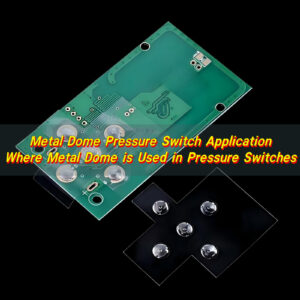

What is dome switch overlay thickness and how does it affect tactile feel, force, travel, and durability? Learn material selection, design rules, testing, defects, and purchasing tips.

What is Dome Switch Overlay Thickness?
Dome switch overlay thickness refers to the total thickness of the top graphic, protective, or functional layer placed above a metal dome switch structure. In a typical metal dome keypad or metal dome array, the overlay is the user-facing layer that receives finger pressure and transfers that force to the metal dome below.

This thickness may include a PET or PC graphic overlay, adhesive layers, spacer layers, embossing structure, surface coating, or decorative film. In simple designs, the overlay may only be a printed polyester layer. In more complex control panels, it may include several laminated layers designed for waterproofing, insulation, tactile response, and long-term wear resistance.
For engineers, overlay thickness is not only a mechanical dimension. It affects actuation force, tactile ratio, key travel, return feel, sound, durability, sealing performance, and assembly tolerance. Even a small thickness change can make the same metal dome feel lighter, heavier, softer, or less responsive.
In metal dome switch design, the dome itself provides the tactile snap, but the overlay controls how that snap is felt by the user. This is why overlay thickness should be defined early in the design stage, not treated as a cosmetic detail after the circuit and dome force have already been selected.
Why is Dome Switch Overlay Thickness Important?
Dome switch overlay thickness is important because it directly changes how force is transmitted from the user’s finger to the metal dome. If the overlay is too thick or too rigid, the dome may feel dull, heavy, or delayed. If the overlay is too thin or too soft, the keypad may feel unstable, weak, or easy to damage.
A metal dome usually has a specified actuation force, such as 160 gf, 250 gf, 350 gf, or 500 gf. However, the final pressing force felt by the user is not only determined by the dome. It is also affected by overlay stiffness, adhesive thickness, spacer height, key shape, embossing design, and assembly compression.
For industrial control panels, automotive keypads, medical device buttons, remote controls, and handheld electronics, stable tactile response is critical. Users need to know that the button has been pressed successfully. A poorly selected overlay thickness can reduce this feedback and increase operation errors.
Overlay thickness also affects durability. A thin overlay may crack, deform, or wear out faster under high-frequency pressing. A thick overlay may increase internal stress and reduce dome recovery performance. The correct thickness creates a balance between tactile clarity, surface protection, assembly reliability, and long service life.
How Does Dome Switch Overlay Thickness Affect Tactile Feedback?
When a user presses the overlay, the force passes through the top layer, adhesive, spacer, and actuator area before reaching the dome. During this process, part of the force may be absorbed by the overlay material. The thicker or softer the overlay, the more energy may be absorbed before the dome collapses.
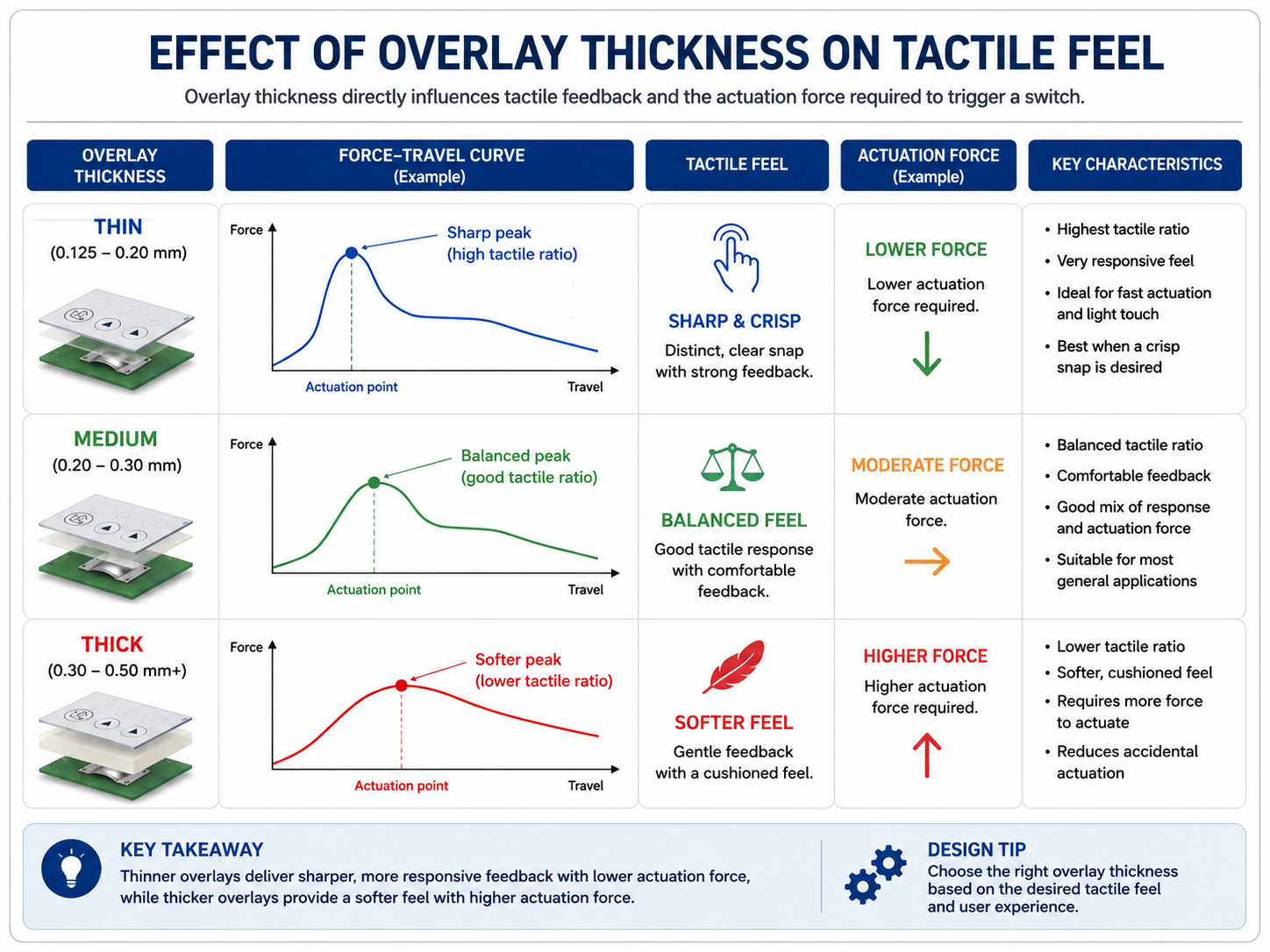
This changes tactile feedback in several ways. A thin and flexible overlay usually gives a sharper snap feel because less force is lost before reaching the dome. A thicker overlay may produce a softer and more cushioned feel, which can be useful in some consumer products but may not be ideal for precise industrial controls.
The tactile ratio is also affected. Tactile ratio refers to the difference between peak force and contact force. A higher tactile ratio creates a clearer snap sensation. If the overlay is too thick, the user may feel a flatter response even when the metal dome itself has a good tactile ratio.
The overlay can also influence key travel. A thick overlay or high embossing structure may increase the perceived movement distance. A very thin overlay may make the travel feel short and sharp. For this reason, engineers often need to test overlay samples together with the selected dome instead of evaluating the dome alone.
What is the Common Thickness Range for Dome Switch Overlays?
The common thickness range depends on the material, keypad structure, product environment, and required tactile performance. For many metal dome keypad applications, the overlay thickness is commonly between 0.125 mm and 0.50 mm, but this is not a fixed rule.
PET overlays are often used in thinner designs because they provide good flexibility, printability, and fatigue resistance. PC overlays may be thicker when better surface hardness, appearance, or dimensional stability is needed. Silicone or rubber overlays may be much thicker because they are molded structures rather than thin graphic films.
| Overlay Material | Common Thickness Range | Typical Use | Tactile Effect |
|---|---|---|---|
| PET polyester film | 0.125–0.30 mm | Metal dome arrays, membrane keypads, control panels | Sharp and flexible tactile feel |
| PC polycarbonate film | 0.175–0.50 mm | Graphic overlays, display panels, decorative control surfaces | Stronger surface, slightly stiffer feel |
| Silicone rubber overlay | 0.50–2.00 mm or more | Soft-touch keypads, sealed buttons, wearable devices | Softer, cushioned tactile feel |
| Adhesive layer | 0.05–0.20 mm | Bonding overlay to spacer or circuit layer | Can affect force transfer and sealing |
| Embossed key area | Varies by design | Raised button areas for better finger location | Improves key recognition and local force concentration |
For most metal dome switch overlay designs, the key point is not simply “thicker is better” or “thinner is better.” The correct design depends on the dome force, dome diameter, button size, overlay material, spacer height, and end-use environment.
What Materials Are Used for Dome Switch Overlays?
The most common materials for dome switch overlays are PET, PC, silicone rubber, adhesive films, and protective coatings. Each material has different mechanical behavior, surface properties, printing compatibility, and environmental resistance.

PET polyester is widely used in metal dome switches because it has good flexibility, stable fatigue performance, and strong resistance to repeated bending. It is suitable for printed graphic overlays, membrane switch panels, and metal dome array assemblies. PET is often preferred when long-term flex life and consistent tactile feedback are important.
PC polycarbonate provides better appearance, clarity, impact resistance, and surface strength. It is often used for graphic overlays that require a premium look or a more rigid surface. However, PC may not have the same flex fatigue resistance as PET in some repeated bending applications, so it should be evaluated carefully for high-cycle keypads.
Silicone rubber is used when a soft-touch surface, waterproof sealing, or molded key shape is required. It can improve comfort and environmental protection, but it may reduce the sharpness of the metal dome snap if the structure is too thick or too soft.
Adhesive films are also part of the overlay system. Their thickness, hardness, and bonding stability influence the final tactile feel. A soft adhesive may absorb force, while an uneven adhesive layer can create inconsistent button response across the panel.
How Do PET and PC Overlay Thickness Compare?
PET and PC are both common overlay materials, but they behave differently in dome switch design. PET is generally more flexible and better suited for repeated key actuation. PC is stronger and more rigid, making it suitable for applications where appearance, surface hardness, or display window clarity matters.
For tactile performance, PET usually provides a cleaner and more direct key feel in thin overlay designs. PC may feel slightly harder or less flexible, especially when the thickness increases. This does not mean PC is unsuitable, but the dome force and actuator design must be matched carefully.
| Comparison Item | PET Overlay | PC Overlay |
|---|---|---|
| Flexibility | Better flexibility | More rigid |
| Fatigue resistance | Strong for repeated pressing | Depends on grade and design |
| Surface appearance | Good printed appearance | Better clarity and premium surface |
| Tactile feedback | Usually sharper in thin designs | May feel firmer or slightly damped |
| Common thickness | 0.125–0.30 mm | 0.175–0.50 mm |
| Typical applications | Metal dome arrays, membrane switches, industrial keypads | Graphic panels, display overlays, decorative control surfaces |
| Engineering concern | Printing, bonding, surface protection | Stress cracking, stiffness, chemical compatibility |
If the main goal is long-cycle tactile performance, PET is often a strong choice. If the project requires better appearance, harder surface, or optical clarity, PC may be selected, but the thickness and dome force should be tested together.
What Design Factors Should Engineers Consider Before Choosing Overlay Thickness?
Engineers should consider the complete switch stack-up before selecting dome switch overlay thickness. The overlay does not work alone. It interacts with the dome, spacer, adhesive, circuit layer, actuator area, printing layer, and mechanical enclosure.
The first factor is metal dome force. A low-force dome under a thick overlay may feel weak or fail to give a clear snap. A high-force dome under a thin overlay may feel too hard for the user. The force should match the product function, user group, and pressing frequency.
The second factor is button size and shape. A large button area may distribute force too widely, making the dome harder to actuate. A smaller actuator point or embossed key center can focus pressure on the dome center and improve response.
The third factor is spacer height. If the spacer is too thin, the dome may be preloaded or compressed. If it is too thick, the user may need more travel before activation. Spacer thickness and overlay thickness should be considered together.
The fourth factor is environmental sealing. Products used in outdoor, automotive, medical, or industrial environments may require thicker protective layers or stronger adhesives. However, sealing requirements should not destroy tactile performance. The design must balance protection and usability.
How Does Overlay Thickness Affect Actuation Force?
Overlay thickness can increase or decrease the actual force required to activate the switch. The metal dome may have a rated force, but the user often feels a different value after the overlay and full keypad structure are assembled.
A thicker overlay usually increases the force required because it adds stiffness and absorbs part of the finger pressure. If the overlay is too stiff, the force may spread across the panel rather than concentrate on the dome center. This can make the button feel heavy or unclear.
A thinner overlay can transmit force more directly, but it may also make the switch feel too sharp or less protected. In high-use products, a very thin overlay may show surface wear, cracking, or deformation over time.
The best practice is to test actuation force at the final assembly level. Testing only the dome force is not enough. Engineers should measure force-travel curves after the overlay, adhesive, spacer, metal dome, and circuit layer are fully assembled.
| Design Change | Possible Effect on Actuation Force | Engineering Risk |
|---|---|---|
| Thicker PET overlay | Higher perceived force | Duller tactile response |
| Thicker adhesive layer | Force absorption | Inconsistent response |
| Raised embossing | Better force concentration | Risk of cracking if poorly formed |
| Larger button surface | Force spreads wider | Harder dome activation |
| Stronger dome force | Clearer snap | User fatigue in frequent operation |
| Softer silicone cover | Comfortable touch | Reduced tactile sharpness |
For critical applications, force testing should include tolerance samples, aging samples, and environmental test samples.
How Does Overlay Thickness Affect Durability and Lifetime?
Dome switch overlay thickness affects durability because the overlay is repeatedly pressed, bent, and exposed to surface friction. Over time, the overlay may experience wear, cracking, delamination, printing damage, or deformation.
A properly selected overlay can protect the metal dome array and circuit layer from dust, moisture, oils, and mechanical damage. It also helps maintain stable button position and prevents direct contact with internal components.
A very thin overlay may provide excellent tactile response at the beginning, but it may not survive long-term heavy use if the material is not suitable. A very thick overlay may protect the surface better but can increase internal stress, especially around embossed areas or sharp corners.
Lifetime also depends on the dome type. A high-quality metal dome can reach hundreds of thousands or even over one million actuations under proper design conditions. However, if the overlay structure causes off-center pressing, excessive preload, or poor rebound, the actual service life may be reduced.
To improve durability, engineers should avoid sharp embossing transitions, poor adhesive bonding, incorrect spacer height, and unstable material combinations. The overlay should be tested under real pressing conditions, not only under static inspection.
What Are the Common Overlay Structures for Metal Dome Switches?
A metal dome switch overlay can be simple or complex depending on the product requirements. The most basic structure includes a printed PET or PC overlay bonded to a spacer layer above a metal dome. More advanced designs may include embossing, hard coating, shielding layers, waterproof adhesive, or decorative surface treatments.
A typical metal dome switch stack-up may include:
| Layer | Function | Engineering Note |
|---|---|---|
| Graphic overlay | User-facing printed or protective layer | Controls appearance and finger feel |
| Surface coating | Scratch, chemical, or UV resistance | Useful for harsh environments |
| Adhesive layer | Bonds overlay to spacer or dome array | Must be uniform and stable |
| Spacer layer | Creates clearance for dome movement | Affects travel and preload |
| Metal dome | Provides tactile snap and electrical contact | Force and diameter must match design |
| Circuit layer or PCB | Carries electrical signal | Can be FPC, PET circuit, or PCB |
| Back adhesive | Mounts assembly to housing | Must match final assembly surface |
In engineering practice, the overlay thickness should not be evaluated as a single layer only. The total stack-up thickness and compression behavior are more important for final tactile performance.
What Are the Advantages of Proper Dome Switch Overlay Thickness?
Proper dome switch overlay thickness improves both user experience and manufacturing reliability. It helps the switch feel stable, responsive, and consistent across different buttons and production batches.
The first advantage is better tactile clarity. When the overlay thickness matches the dome force and spacer design, the user can feel a clear snap at each press. This reduces uncertainty and improves product usability.
The second advantage is longer service life. Correct thickness helps prevent excessive stress, off-center loading, and surface damage. It also supports stable dome rebound after repeated use.
The third advantage is better sealing and protection. A suitable overlay can block dust, moisture, oil, cleaning chemicals, and mechanical abrasion. This is especially important for medical devices, industrial panels, outdoor equipment, and automotive electronics.
The fourth advantage is more stable production quality. When thickness tolerance is controlled, the final keypad has more consistent actuation force, appearance, and assembly fit. This reduces rework and quality complaints.
What Problems Happen When Overlay Thickness is Wrong?
Wrong overlay thickness can create several functional and quality problems. Some problems appear immediately during prototype testing. Others only appear after aging, repeated pressing, or field use.
If the overlay is too thick, the switch may feel heavy, dull, or slow. The dome may not collapse cleanly, especially when users press from the edge of the button instead of the center. In some cases, the dome may fail to return properly because the overlay structure creates too much resistance.
If the overlay is too thin, the surface may feel too sharp or fragile. The printed graphics may wear quickly. The button area may show deformation, cracking, or surface dents after repeated use.
Uneven overlay thickness can also cause inconsistent key feel across the same panel. One button may feel strong, while another feels weak. This is often caused by poor lamination, adhesive variation, spacer tolerance, or material deformation.
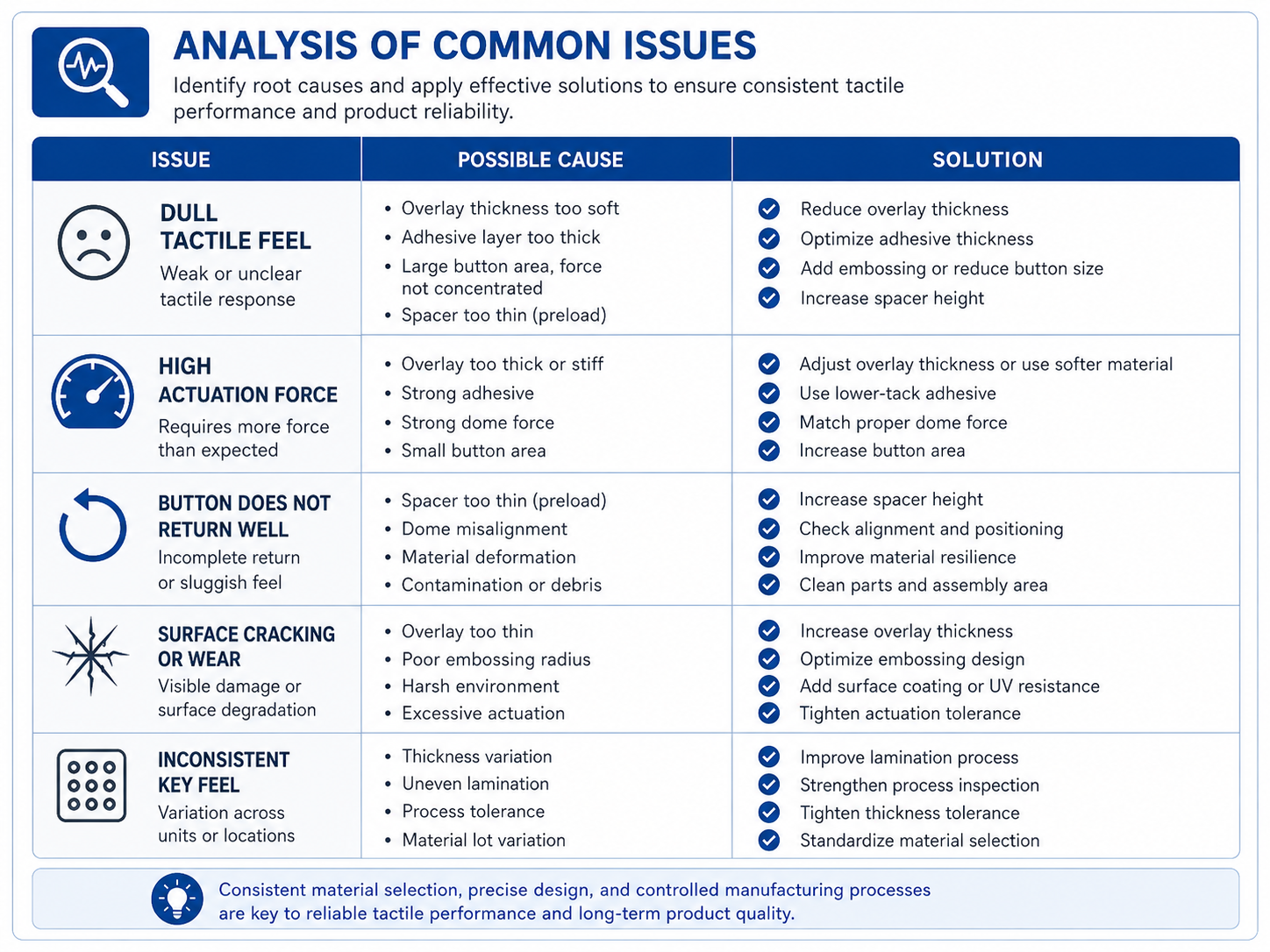
| Problem | Possible Cause | Engineering Solution |
|---|---|---|
| Dull tactile feel | Overlay too thick or too soft | Reduce thickness or use higher-force dome |
| High actuation force | Excessive stiffness or poor force transfer | Adjust overlay, embossing, or dome force |
| Weak snap feel | Low tactile ratio after assembly | Test final stack-up and optimize spacer |
| Button does not return well | Preload or material resistance | Check spacer height and adhesive compression |
| Surface cracking | Poor embossing radius or thin film | Improve forming design and material grade |
| Inconsistent keys | Thickness or lamination variation | Tighten process tolerance and inspection |
| Premature wear | Wrong material or surface coating | Use PET/PC grade with suitable protection |
These issues are easier to correct during the sample stage than after mass production. Prototype testing is essential before tooling and large-volume orders.
How Should Engineers Choose the Right Dome Switch Overlay Thickness?
Engineers should choose dome switch overlay thickness based on functional performance first, then appearance, cost, and production convenience. The correct choice should be verified through testing, not only by theoretical calculation.
Start by defining the target user experience. For example, an industrial control panel may need a firm and clear tactile response. A consumer remote control may need a lighter and softer feel. A medical device may need stable feedback, easy cleaning, and strong sealing.
Next, select the dome force and diameter. A small dome under a thick overlay may be difficult to activate. A large dome under a thin overlay may feel too sensitive. The dome and overlay should be tested as a matched system.
Then define the material and thickness range. PET is often suitable for flexible tactile overlays. PC is suitable for higher surface rigidity and appearance. Silicone is suitable for soft-touch and sealed designs. Adhesive and spacer thickness should be included in the stack-up review.
Finally, create samples and measure the final actuation force, tactile ratio, travel, rebound, and durability. The best design is the one that performs consistently after assembly, aging, and environmental testing.
What Testing Methods Are Used for Dome Switch Overlay Thickness?
Testing should confirm both dimensional accuracy and functional performance. Thickness inspection alone does not prove that the switch will feel good or last long. A complete validation plan should include mechanical, electrical, environmental, and aging tests.
Thickness can be measured using a micrometer, digital thickness gauge, optical measurement system, or laser measurement equipment. For laminated structures, engineers should measure multiple points across the panel to identify thickness variation.
Actuation force testing is usually performed with a force-displacement tester. This test measures peak force, contact force, travel, rebound, and tactile ratio. It is one of the most important tests for dome switch overlay design.
Durability testing checks how the overlay and dome perform after repeated pressing. Depending on the application, test cycles may range from tens of thousands to over one million actuations. After cycling, the switch should still maintain stable force, contact performance, and surface appearance.
Environmental tests may include high temperature, low temperature, humidity, thermal cycling, UV exposure, chemical resistance, and cleaning agent resistance. These tests are especially important for automotive, medical, outdoor, and industrial products.
What Quality Standards Should Dome Switch Overlays Follow?
There is no single universal standard that defines one correct dome switch overlay thickness for all products. The required quality standard depends on the application, customer drawing, material specification, and end-use industry.
However, engineers usually control several key items: material certification, dimensional tolerance, adhesive bonding strength, surface appearance, actuation force, electrical contact resistance, insulation performance, and environmental reliability.
For many export projects, materials may need to meet RoHS and REACH requirements. Some industrial or medical projects may also require additional material traceability, cleaning resistance, or safety documentation. Automotive projects may require stricter durability and environmental validation.
A good supplier should provide material data, thickness tolerance, production capability, test method, and quality inspection records. For custom metal dome arrays, the supplier should also understand the relationship between overlay thickness, dome force, spacer design, and final tactile response.
| Quality Item | Why It Matters | Common Inspection Method |
|---|---|---|
| Overlay thickness | Controls tactile response and assembly fit | Micrometer, laser measurement |
| Adhesive uniformity | Prevents uneven key feel | Visual inspection, peel test |
| Actuation force | Confirms user pressing experience | Force-displacement testing |
| Tactile ratio | Measures snap clarity | Force curve analysis |
| Electrical contact | Confirms switch function | Resistance test |
| Printing adhesion | Prevents graphic wear | Tape test, abrasion test |
| Environmental resistance | Confirms field reliability | Humidity, temperature, chemical tests |
| Lifetime cycle | Confirms durability | Repeated pressing test |
For high-reliability products, quality control should be defined before mass production, not after problems appear.
Where Are Dome Switch Overlays Used?
Dome switch overlays are used in products that require compact, reliable, and tactile user input. They are common in consumer electronics, industrial equipment, automotive controls, medical instruments, household appliances, communication devices, and handheld electronics.
In consumer electronics, dome switch overlays are used in remote controls, game controllers, earbuds, smart home devices, and portable instruments. These products often require a balance between soft touch, attractive appearance, and long service life.
In industrial control systems, overlays are used on machine panels, testing instruments, measuring devices, CNC controllers, and operator interfaces. These applications usually require strong durability, clear tactile response, oil resistance, and stable performance in harsh environments.
In automotive electronics, dome switch overlays are used in steering wheel controls, dashboard panels, car key fobs, center console buttons, and interior control modules. These applications need stable operation under temperature changes, vibration, humidity, and long-term repeated use.
In medical devices, overlays must support easy cleaning, reliable actuation, and consistent tactile feedback. The surface may need chemical resistance, sealing performance, and clear printed symbols for safe operation.
What Real Engineering Cases Show the Importance of Overlay Thickness?
Case 1: Industrial control keypad with dull tactile response
A control panel used a high-durability PET overlay, but the initial prototype felt weak and unclear. The metal dome itself passed force testing, but after full assembly the tactile ratio dropped. The cause was excessive adhesive thickness and a large flat button area that spread the pressing force. The solution was to reduce adhesive thickness, adjust the spacer, and add a localized embossed actuator area. The final keypad achieved a sharper snap and more consistent response.
Case 2: Automotive key fob with surface wear after repeated use
A car key fob used a thin printed overlay to improve tactile sensitivity. Early samples felt good, but wear appeared after repeated pressing and pocket friction. The issue was not the dome force but the insufficient surface protection of the overlay. The solution was to use a more suitable surface coating and slightly increase the overlay thickness while keeping the dome force unchanged.
Case 3: Medical device button with inconsistent key force
A medical control interface required sealed keys and easy cleaning. The prototype used a soft upper layer that caused inconsistent actuation force across the panel. Some keys felt acceptable, while others required more force. The root cause was uneven lamination pressure and adhesive compression. By tightening lamination parameters and controlling layer thickness tolerance, the final switch assembly became more stable.
These cases show that dome switch overlay thickness should be tested as part of the full keypad structure. A good metal dome cannot compensate for a poorly designed overlay stack-up.
What Should Be Checked Before Mass Production?
Before mass production, engineers should confirm the complete drawing, material stack-up, thickness tolerance, dome force, spacer height, adhesive type, printing structure, and final assembly method. Any unclear detail may create production variation later.
The sample approval stage should include real functional testing. A visual sample is not enough. The sample should be pressed, measured, aged, and tested under realistic operating conditions. If possible, samples should be tested after assembly into the final housing.
The production team should also confirm whether the product needs embossing, hard coating, waterproofing, shielding, back adhesive, or special packaging. These features may change the final thickness and tactile response.
A practical pre-production checklist should include:
| Item to Confirm | Why It Matters |
|---|---|
| Final overlay material | Affects tactile feel, durability, and surface appearance |
| Total stack-up thickness | Affects assembly fit and actuation force |
| Metal dome force and diameter | Determines snap feel and electrical contact |
| Spacer thickness | Controls dome movement and preload |
| Adhesive type and thickness | Affects bonding, sealing, and force transfer |
| Embossing design | Improves finger location and force concentration |
| Printing method | Affects appearance and wear resistance |
| Environmental requirements | Determines material and coating selection |
| Lifetime requirement | Guides dome and overlay durability testing |
| Packaging method | Protects domes and overlays during shipping |
Mass production should not begin until the approved sample, drawing, tolerance, and test standard are fully aligned.
What Factors Affect the Cost of Dome Switch Overlay Thickness?
The cost of a dome switch overlay is influenced by material type, thickness, printing complexity, tooling, embossing, adhesive system, tolerance requirement, order quantity, and quality testing level.
A simple PET overlay with basic printing is usually more cost-effective. A thicker PC overlay with hard coating, window treatment, embossing, and strict cosmetic requirements will cost more. Silicone overlays may require molding tools, which increases initial cost but may be suitable for sealed or soft-touch products.
Thickness tolerance also affects cost. Very tight tolerance requires better material control, more precise lamination, and more inspection. For high-reliability products, this cost is often justified because it reduces failure risk and field complaints.
Order quantity is another major factor. Prototype and small-batch production have higher unit cost because setup, tooling, material preparation, and inspection are spread over fewer pieces. Larger production runs can reduce unit cost, especially when the design is stable.
Engineers should avoid choosing the lowest-cost overlay without considering tactile performance and reliability. A small saving in overlay material may lead to higher rework cost, warranty claims, or product failure later.
How to Choose a Reliable Dome Switch Overlay and Metal Dome Supplier?
A reliable supplier should understand both overlay production and metal dome switch performance. Many problems happen when the overlay supplier only focuses on printing, while the dome supplier only focuses on dome force. For best results, the complete switch structure should be reviewed together.
The supplier should be able to discuss material selection, thickness tolerance, dome force matching, spacer design, adhesive selection, embossing, testing, and mass production control. They should also provide engineering feedback during sample development, not only manufacture according to drawings.
For OEM and ODM projects, the supplier should support custom thickness, custom metal dome force, metal dome array design, peel-and-place assembly, tape and reel packaging, and batch quality inspection. These capabilities help reduce assembly errors and improve production efficiency.
A strong supplier should also provide transparent communication. If a requested overlay thickness may reduce tactile feedback or increase failure risk, the supplier should point it out during the design stage. This engineering support is often more valuable than a small price difference.
FAQs About Dome Switch Overlay Thickness
Q1: What is the best dome switch overlay thickness?
There is no single best thickness for every product. The right thickness depends on dome force, overlay material, button size, spacer height, and tactile feel requirements. For many PET overlay designs, 0.125–0.30 mm is common, but final testing is necessary.
Q2: Does a thicker overlay make the switch more durable?
A thicker overlay can improve surface protection, but it does not always improve switch performance. If it is too thick or too stiff, it may reduce tactile clarity and increase actuation force. Durability must be balanced with force transfer.
Q3: Why does my metal dome feel different after adding the overlay?
The overlay changes force transmission. Adhesive thickness, spacer height, embossing, and material stiffness can all affect the final feel. A dome that feels good alone may feel different after it is assembled into a full keypad stack-up.
Q4: Can overlay thickness affect metal dome actuation force?
Yes. The metal dome has its own rated force, but the final user pressing force can change after adding the overlay and adhesive layers. This is why force-displacement testing should be done on the complete assembly.
Q5: Is PET better than PC for dome switch overlays?
PET is often better for flexible and high-cycle tactile applications. PC is better when appearance, rigidity, or optical clarity is more important. The best choice depends on the product structure, environment, and user experience target.
Q6: Can silicone be used above a metal dome switch?
Yes. Silicone can provide a soft-touch and sealed surface, but it may reduce the sharp snap feel if the structure is too thick or too soft. The silicone hardness, key shape, actuator design, and dome force must be matched carefully.
Q7: What causes inconsistent tactile feel between buttons?
Common causes include uneven overlay thickness, adhesive variation, spacer tolerance, poor lamination, off-center dome placement, or different button sizes. The complete switch stack-up should be inspected and tested across all keys.
Q8: Should the overlay be embossed for metal dome switches?
Embossing can improve finger location and help concentrate force on the dome center. However, poor embossing design may create cracking or stress concentration. The embossing height, radius, and material thickness must be controlled.
Q9: How do I test dome switch overlay thickness?
Thickness can be measured with micrometers, optical systems, or laser measurement tools. Functional testing should include actuation force, tactile ratio, travel, rebound, electrical contact, environmental aging, and lifetime cycling.
Q10: Can overlay thickness be customized for OEM projects?
Yes. Custom overlay thickness is common in OEM metal dome switch and metal dome array projects. The supplier can adjust PET, PC, adhesive, spacer, and dome force to match the required tactile feel and assembly structure.
Q11: Does overlay thickness affect waterproofing?
Overlay thickness can support sealing, but waterproofing also depends on adhesive selection, edge bonding, venting design, and housing structure. A thick overlay alone cannot guarantee waterproof performance if the bonding structure is weak.
Q12: What should buyers provide before requesting a quotation?
Buyers should provide drawings, expected size, overlay material, thickness requirement, dome force, circuit type, lifetime target, environmental requirements, quantity, and assembly method. If these details are not ready, samples can be developed first.
Summary:
Dome switch overlay thickness is a critical design factor in metal dome switch performance. It affects tactile feedback, actuation force, key travel, rebound, durability, sealing, appearance, and production consistency.
For engineering selection, PET is often suitable for flexible and high-cycle tactile applications, PC is useful for rigid and decorative surfaces, and silicone is suitable for sealed or soft-touch products. The final choice should be verified through sample testing, force-displacement measurement, environmental validation, and lifetime cycling.
If your project requires custom metal dome switches, dome switch overlays, metal dome arrays, tactile keypad solutions, OEM manufacturing, ODM development, sample production, or bulk order support, our engineering team can help you optimize overlay thickness, dome force, adhesive structure, and assembly design. For technical support or quotation, please contact us at sales@metal-domes.com