
When customers compare four leg dome vs triangle dome, they are usually trying to solve a practical switch design problem: which metal dome gives the right click feel, stable positioning, suitable force, and reliable life for a PCB or membrane switch project? Both are common forms of snap dome used in a tactile dome switch, but their structures create different mechanical behavior.
A metal dome switch may look simple, but the dome shape affects how the switch feels, how it sits on the PCB, how it responds to off-center pressing, and how well it performs in a metal dome array. Choosing the wrong dome can lead to weak tactile feedback, unstable alignment, uneven contact, or early fatigue. Choosing the right one helps the final product feel consistent and dependable.
What is a four-leg dome?
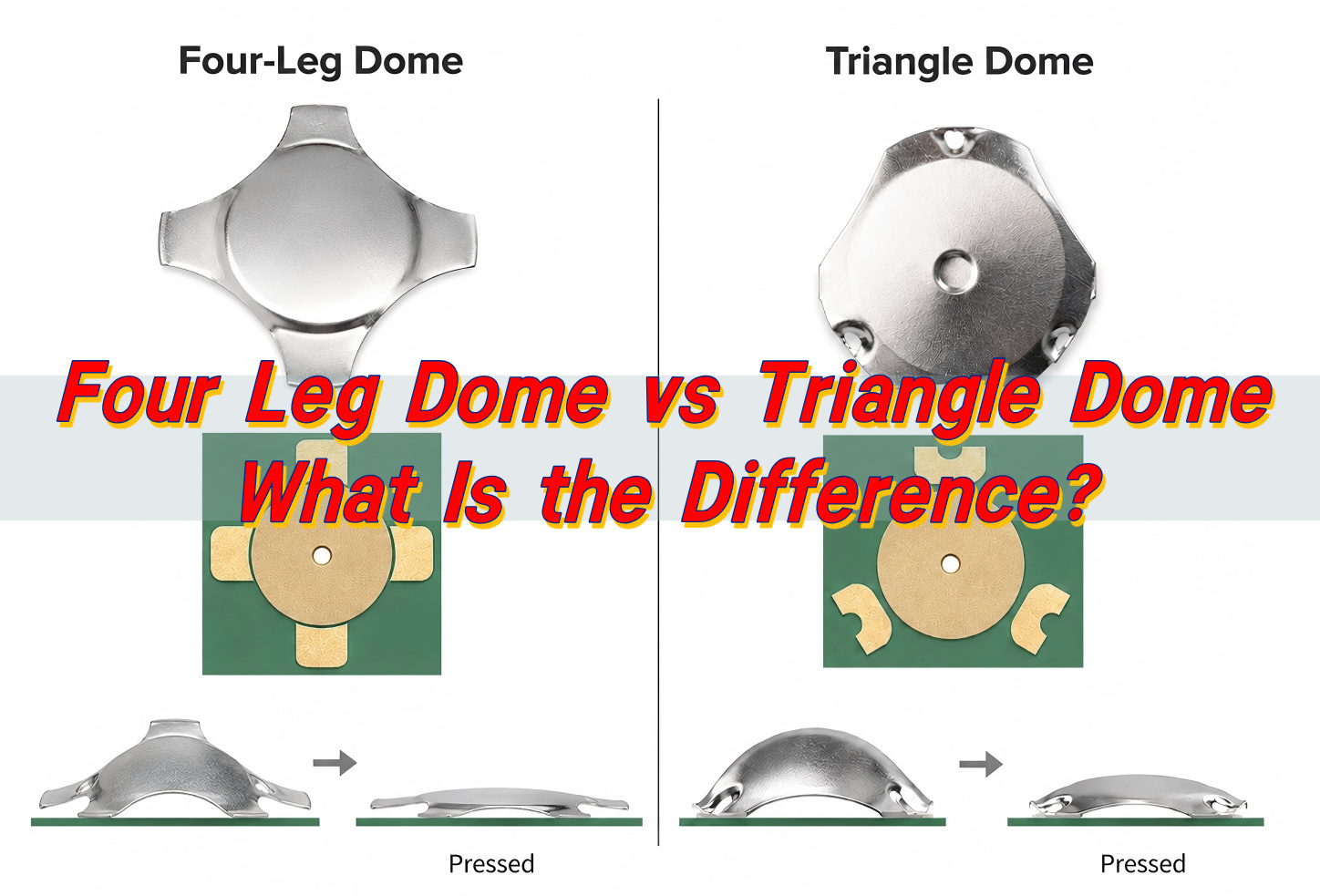
A four-leg dome is a metal snap dome with four supporting legs around its edge. The legs help the dome sit evenly on the PCB contact pads or on a spacer layer inside a membrane switch. When the user presses the center of the dome, it collapses downward and touches the central contact area. When the pressure is released, it springs back to its original shape.
The main feature of a four-leg dome is balanced support. Because the dome has four contact points, it usually has better positioning stability than a dome with fewer support points. This makes it suitable for applications where the button must remain centered, the key area is relatively large, or the product may receive uneven finger pressure.
Four-leg domes are often used in:
- Industrial control panels
- Automotive keypads
- Remote controls
- Medical device buttons
- Instrument panels
- Metal dome arrays with multiple keys
- Products requiring stable tactile response over many operations
In engineering terms, a four-leg dome is often chosen when stability, repeatable actuation, and alignment control matter more than saving a very small amount of space.
What is a triangle dome?
A triangle dome is a metal snap dome with a three-point support structure. Its shape is usually more compact than a four-leg dome, and it can provide a clear tactile response in small button areas. Like other metal dome switches, it works by elastic deformation: the dome snaps downward under force, creates an electrical connection, and then returns after release.
The key advantage of a triangle dome is space efficiency. Since it has three support areas, it can fit well into compact keypad layouts where board space is limited. It can also produce a sharp click feel when the force, diameter, travel, and material thickness are properly selected.
Triangle domes are often used in:
- Small handheld electronics
- Compact control buttons
- Consumer product keypads
- Small membrane switch panels
- Tight PCB layouts
- Short-travel tactile switches
A triangle dome is not simply a “smaller four-leg dome.” Its three-point structure changes how force is distributed. This can be useful in compact designs, but it also means the PCB pad layout, adhesive layer, and pressing position need more careful control.
What are the different types of domes?
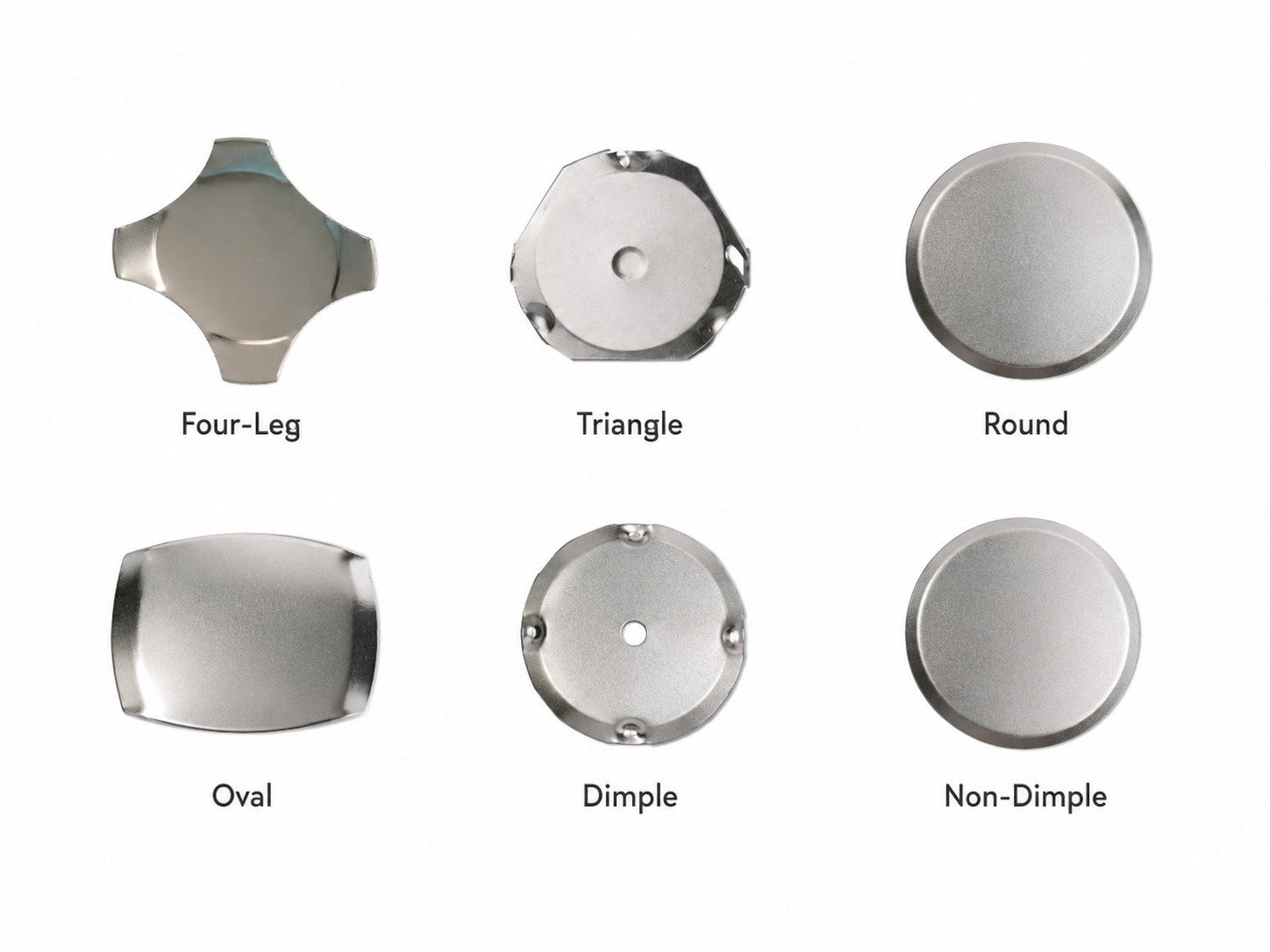
Metal domes can be classified by shape, support structure, size, force, surface treatment, and whether they are supplied as loose domes or as a metal dome array. The right type depends on the product layout, button size, target feel, electrical contact design, and expected service life.
| Dome type | Main feature | Typical use |
|---|---|---|
| Four-leg dome | Four support points, good positioning stability | Industrial panels, automotive buttons, larger key areas |
| Triangle dome | Three-point support, compact layout | Small buttons, handheld electronics, tight PCB designs |
| Round dome | Simple circular structure, smooth press feel | General tactile switches and membrane panels |
| Oval dome | Longer contact shape, useful for narrow buttons | Long keys, side buttons, slim control panels |
| Dimple dome | Raised center point for improved contact control | Designs needing more direct center actuation |
| Non-dimple dome | Smooth top surface, softer contact transition | Overlay-based keypads and general switch panels |
| Plated dome | Nickel, gold, silver, or other surface finish | Applications requiring improved contact reliability |
| Metal dome array | Domes pre-positioned on adhesive carrier film | Mass production, faster assembly, consistent alignment |
The practical choice is not based on shape alone. A dome with the right shape but the wrong force, travel, plating, or pad design can still perform poorly.
Four-leg dome vs. triangle dome: Which to choose?
The choice depends on the product’s button size, required tactile feedback, available PCB space, user pressing behavior, and assembly method. Four-leg domes are usually better when positioning stability and uniform support are important. Triangle domes are usually better when the design needs a compact switch structure with a clear click in limited space.
| Selection factor | Four-leg dome | Triangle dome |
| Positioning stability | Usually stronger because of four support points | Good, but more sensitive to alignment and pressing angle |
| PCB space | Needs more layout room | Better for compact layouts |
| Tactile feel | Stable, balanced, and consistent | Sharp and responsive when well matched |
| Off-center pressing | Better tolerance | More affected by uneven pressure |
| Metal dome array use | Very suitable for array assembly | Suitable, but alignment design is more critical |
| Large buttons | Often the safer choice | Less ideal for wide press areas |
| Small buttons | Can be used, but may be oversized | Often easier to fit |
| Assembly control | More forgiving | Requires tighter control of pad and adhesive position |
| Typical design priority | Stability and repeatability | Compact size and crisp response |
For a customer evaluating a PCB or PCBA solution, the safe decision logic is simple: use a four-leg dome when the switch area is larger, the product needs stable operation, or users may press off-center. Use a triangle dome when the button area is small and the design needs a compact tactile switch with a clear snap.
Which Dome Gives Better Tactile Feedback?
Tactile feedback is not determined by the number of legs alone. It is affected by dome diameter, material thickness, stainless steel grade, surface treatment, dome height, actuation force, travel, and click ratio. However, shape still plays an important role.
A four-leg dome usually gives a more balanced and controlled tactile response. Because the support points are evenly distributed, the dome tends to collapse in a predictable way. This helps the button feel stable, especially when the overlay or keycap is larger than the dome itself.

A triangle dome can give a sharper click in a compact area. In small keypads, this can feel more responsive to the user. The trade-off is that the feel may change more noticeably if the pressing position is not centered or if the adhesive layer causes a slight offset.
| Tactile factor | Four-leg dome | Triangle dome |
| Click consistency | Usually more consistent | Good when accurately positioned |
| Sharpness of click | Balanced and controlled | Often crisp in small designs |
| Off-center press feel | More stable | More sensitive |
| Best user experience | Larger or high-reliability buttons | Small and compact buttons |
A strong click is not always better. For medical, automotive, or industrial panels, a controlled and repeatable click is often more valuable than a very sharp feel.
Which Dome Has Better Positioning Stability?
A four-leg dome normally has better positioning stability. Its four support points help prevent rotation, shifting, and uneven seating during assembly and operation. This is especially useful when the dome is placed under an overlay, inside a spacer structure, or as part of a metal dome array.
Triangle domes can also be stable, but they depend more heavily on accurate placement. Because there are only three support areas, small alignment errors can have a larger effect on the press feel and contact position. This does not mean triangle domes are unreliable. It means the design window is narrower.
Positioning stability matters in real products because a metal dome rarely works alone. It interacts with the PCB pad, spacer opening, adhesive layer, overlay, actuator, and user finger pressure. If the dome shifts, the switch may still work electrically, but the click feel can become uneven.
For products that need consistent button feel across many units, four-leg domes are often easier to control in production. For compact products, triangle domes remain useful, but the tolerance design should be checked carefully before mass production.
Which Dome Is Better for a Metal Dome Array?
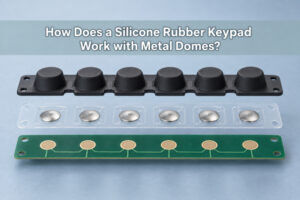
A four-leg dome is usually the preferred choice for a metal dome array when the product needs strong alignment, stable assembly, and repeatable tactile performance. A metal dome array places multiple domes on an adhesive carrier film, allowing the manufacturer to apply many switch contacts at once. In this structure, dome position must match the PCB pads and overlay button centers accurately.
Triangle domes can also be used in a metal dome array, especially when the key pitch is small. The challenge is that compact arrays leave less room for spacer openings, adhesive clearance, and press-position tolerance. If the dome is too close to nearby traces, holes, or other keys, the switch feel may become inconsistent.
For quotation or prototype review, customers should provide:
- PCB Gerber files
- Dome location drawing
- Target actuation force
- Dome diameter or available key area
- Overlay or keycap structure
- Spacer thickness and opening size
- Required cycle life
- Working environment, such as humidity or temperature
- Surface finish requirement for contact pads
- Sample quantity and expected production volume
At EBest Circuit, metal dome array projects are usually reviewed together with the PCB pad design, overlay stack-up, adhesive structure, and assembly tolerance. This helps avoid a common issue: selecting a dome only by force while ignoring the mechanical stack around it.
How Does Dome Shape Affect Actuation Force?
Actuation force is the force required to make the dome snap downward and close the switch contact. In many metal dome switch designs, typical forces may range from light touch levels around 100 gf to stronger industrial key levels above 400 gf. The actual range depends on dome size, material thickness, height, and supplier design.
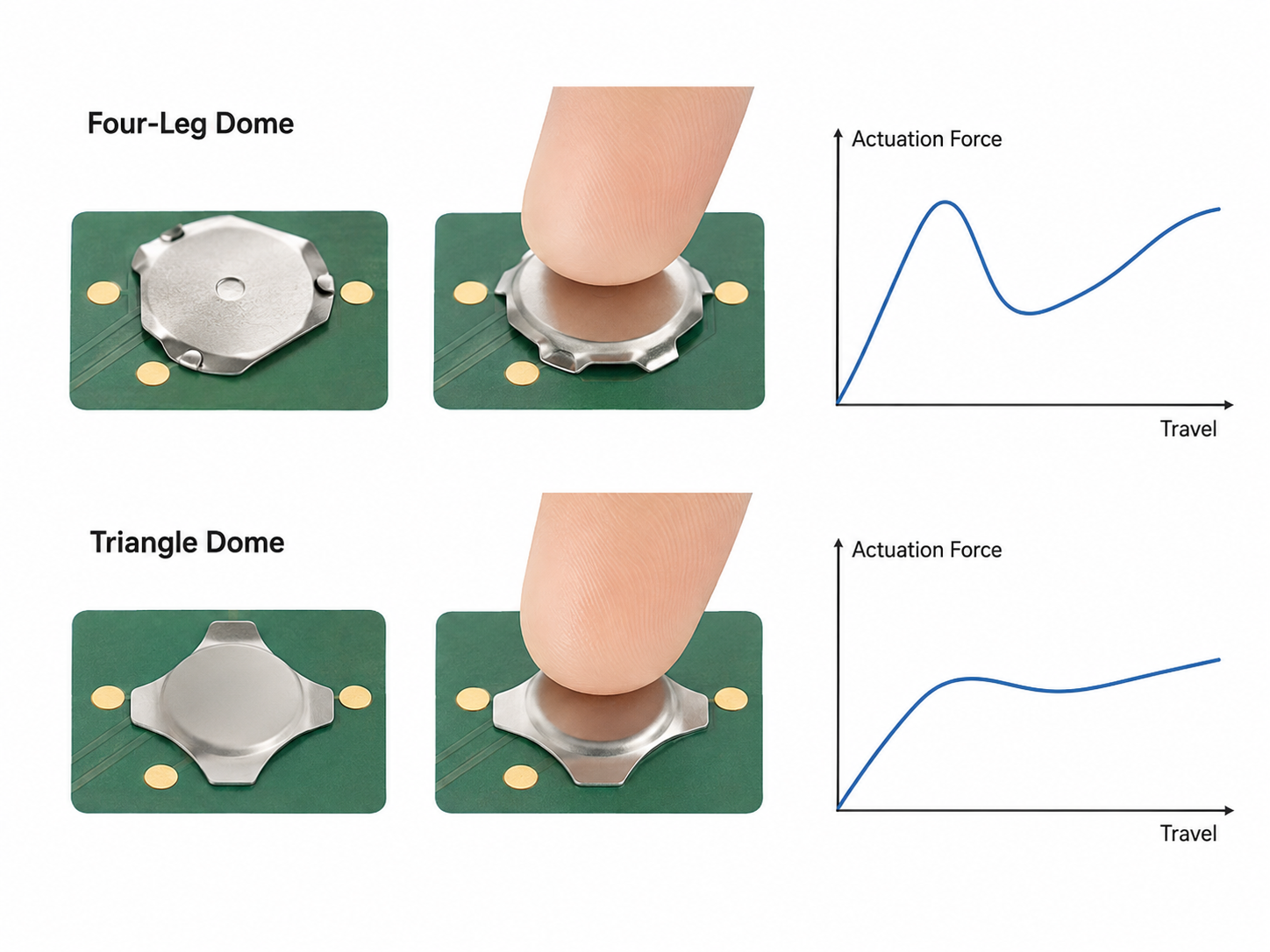
Dome shape affects how force spreads through the structure. A four-leg dome distributes support across four points, which can produce a stable force curve. A triangle dome has three support areas, which may create a sharper transition in smaller sizes.
| Factor | Effect on actuation force |
| Larger dome diameter | Often allows softer force and longer travel |
| Thicker material | Usually increases actuation force |
| Higher dome profile | Can increase snap response and travel |
| Four-leg structure | Helps distribute force more evenly |
| Triangle structure | Can support compact designs with crisp force response |
| Dimple design | Can improve center contact and change press feel |
| Plating and surface finish | Can affect contact reliability, not the main force source |
The right force should match the user environment. A handheld consumer device may need a lighter touch. An automotive or industrial panel may need a stronger force to reduce accidental operation and give a more confident click.
How Does Dome Shape Affect Click Feel?
Click feel is the user’s physical perception of the switch action. It is closely related to actuation force, return force, travel, and tactile ratio. A dome with a clear difference between press force and release force usually feels more tactile.
Four-leg domes tend to feel more even and controlled. This is useful when the button is pressed through a plastic keycap, silicone keypad, or thick graphic overlay. The user may not press exactly at the center every time, so the extra support helps maintain a similar feel.
Triangle domes can feel quick and crisp, especially in small buttons with short travel. This makes them attractive for compact electronics where the user expects a clear response from a small key. The design must keep the actuator centered over the dome. If the actuator is offset, the click may feel tilted or inconsistent.
A good click feel should be evaluated with the full stack-up, not with a loose dome on a table. The overlay film, adhesive thickness, spacer opening, PCB surface finish, and actuator shape all change the final feel. For this reason, prototype testing is important before confirming mass production.
How Does Dome Shape Affect Cycle Life?
Cycle life refers to how many times the dome can be pressed before its tactile performance or electrical function falls outside the required range. Many metal domes are designed for hundreds of thousands to several million cycles, but the actual life depends on shape, force, material, surface treatment, pressing method, and assembly quality.
A four-leg dome can offer better long-term consistency in applications with uneven pressing because its support structure helps distribute load. This can reduce the risk of localized stress caused by off-center operation. It is a strong choice for products where users may press the button from different angles.
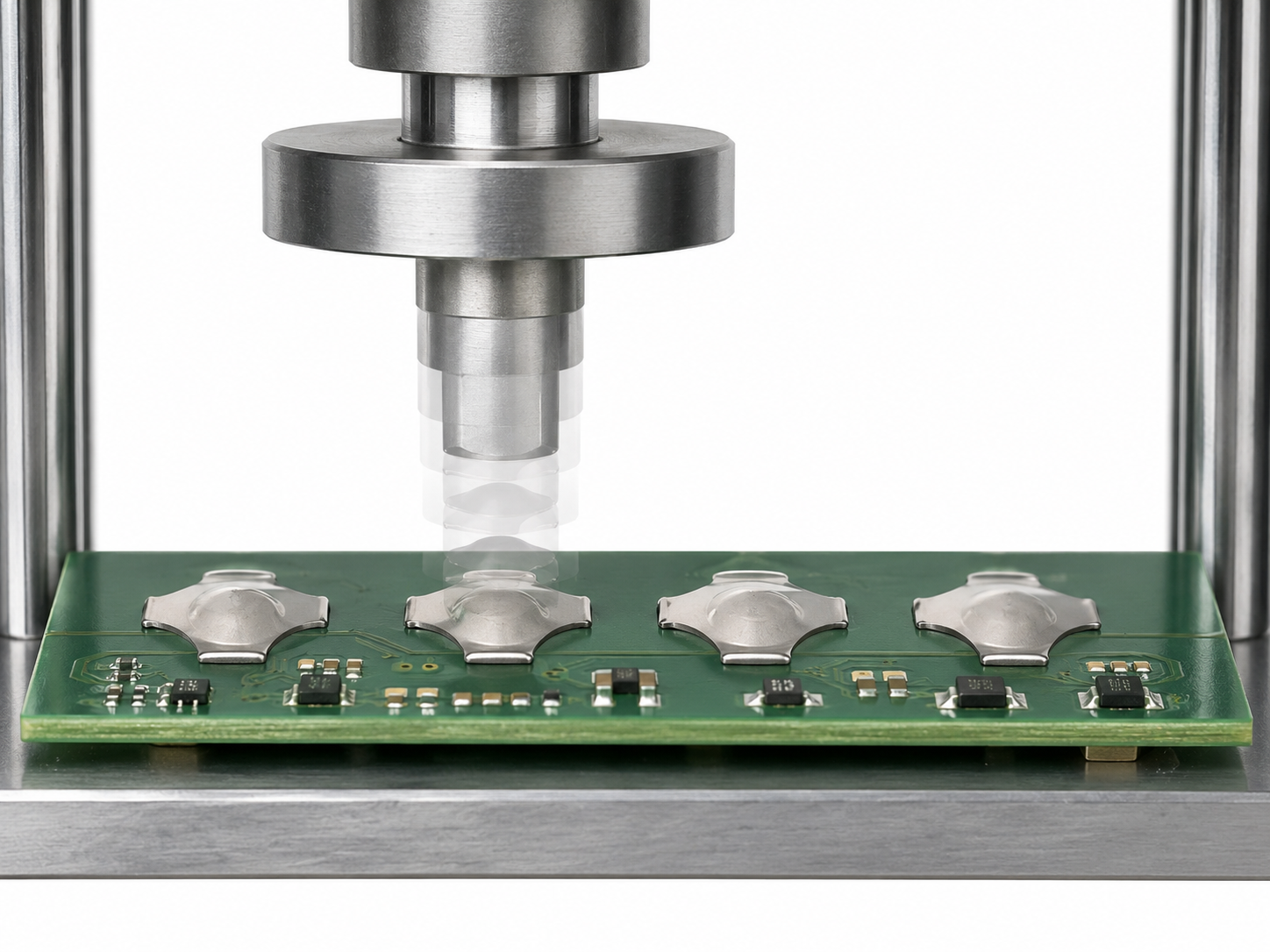
A triangle dome can also achieve good cycle life when used within its design range. It performs best in small buttons where the actuator is well centered and the force is not excessive. If the triangle dome is used in a large key area without proper mechanical support, stress may concentrate more easily.
| Cycle life factor | Practical impact |
| Correct force selection | Avoids overloading the dome structure |
| Centered actuator | Reduces uneven deformation |
| Proper spacer opening | Prevents edge interference |
| Clean PCB contact pads | Supports stable electrical contact |
| Suitable plating | Helps reduce contact oxidation risk |
| Controlled assembly tolerance | Keeps feel consistent between units |
| Real prototype testing | Confirms performance before mass production |
For purchasing decisions, cycle life should not be judged by a catalog number alone. Customers should define the expected use case, operating environment, button size, and test requirement. A dome used in a low-frequency control panel does not need the same life target as a frequently pressed handheld device.
Conclusion
The difference between a four-leg dome and a triangle dome is mainly about structure, stability, space, and feel. A four-leg dome is usually better for stable positioning, larger key areas, metal dome arrays, and applications where consistent tactile feedback matters. A triangle dome is a good option for compact buttons where space is limited and a crisp click is required.
For real PCB or PCBA projects, the best choice should be based on the full switch structure, not the dome alone. PCB pad layout, spacer thickness, overlay design, adhesive position, actuation force, travel, and cycle life all need to work together.
If you are developing a tactile dome switch, snap dome switch, or metal dome array, EBest Circuit can help review the PCB layout, dome selection, prototype requirements, and production details before quotation. For project evaluation, send your drawing, Gerber files, target force, quantity, and application requirements to sales@metal-domes.com