
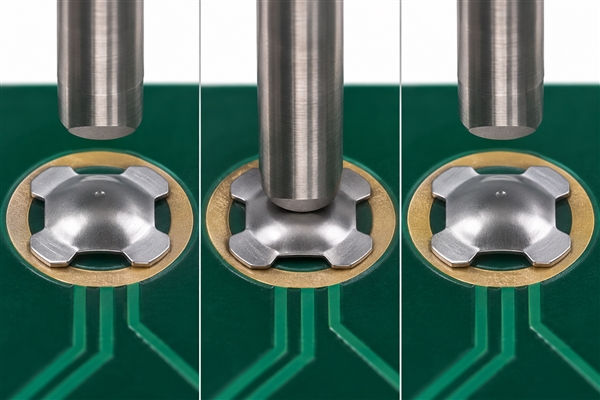
Metal dome preconditioning means actuating a snap dome a defined number of times before recording its force-displacement result. The purpose is to compare domes after the same initial cycling history, not to hide a poor first actuation or claim that every dome will change by the same amount. A published Snaptron force-test procedure uses ten conditioning actuations and records the eleventh. That is a useful documented method, but it is not a universal cycle count: specify the method, fixture and reading cycle when comparing data.

What Is Metal Dome Preconditioning?
Preconditioning is a controlled sequence of complete press-and-release cycles performed before the reported measurement. It puts all test samples at a stated initial cycling point. The resulting force curve is a conditioned reading; the first-actuation curve remains a different observation and can matter when a product must feel right on its very first press.

The term describes a test condition, not a guaranteed material improvement. Some domes may show little change, while a large or continuing shift can point to an unstable part, fixture or assembly. Record the actual force and travel values instead of writing only that a dome was “stabilized.”
For a loose dome, preconditioning occurs in the force-test fixture. For a completed keypad, repeated presses also load the actuator, adhesive film and PCB support. Those are different measurement systems; do not compare their results as though only the metal dome were being tested.
Why Precondition Before a Force Test?
Preconditioning before force test makes the reported cycle repeatable across operators and lots. If one technician records the first press and another records the eleventh, a difference may reflect test history rather than a change in the dome specification. The cycle count is therefore part of the measurement definition.
A conditioned result is most useful when incoming inspection, supplier data and engineering validation share the same support, probe, speed and cycle sequence. Where first-use feel is critical, capture that first cycle separately; do not replace it with the conditioned result. The two readings answer different product questions.
Preconditioning also helps locate an unexpected force shift. Compare early-cycle and later-cycle traces on the same sample under controlled conditions. A changing reading is a reason to inspect the setup and part, not proof by itself that the dome has reached a stable state.
How Many Preconditioning Cycles Are Needed?
Use the cycle count specified by the applicable test method or agreed drawing. Snaptron’s published procedure preconditions a dome with ten actuations and takes the force reading on the eleventh. That example should be cited as Snaptron’s method, not copied into a universal acceptance rule for every dome series or supplier.
If no method is specified, agree on a count before comparing suppliers or production lots. Note whether every cycle reaches the trip point, fully releases and uses the same probe travel. “Ten presses” without a defined stroke and return condition does not make two datasets equivalent.
When a project needs to know whether the force has actually stabilized, record several successive curves rather than declaring success at an arbitrary count. Define an engineering comparison criterion for that project; no universal percentage drift limit is established by the cited procedure.
Which Fixture Conditions Must Stay Constant?
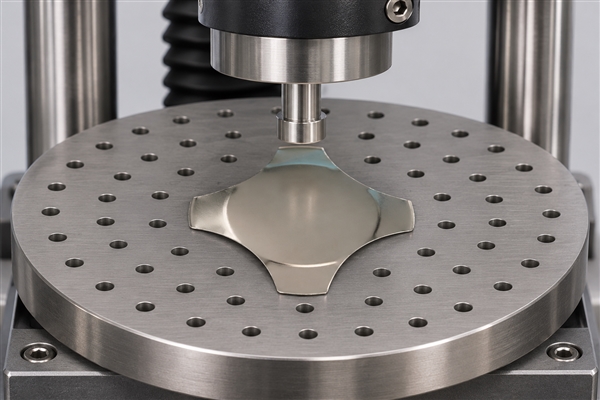
Probe shape, centering, support and speed can alter a force reading. In Snaptron’s published force procedure, a flat-bottom probe is centered within 0.010 in (0.254 mm), the dome is supported on a rigid, flat, vented surface, and the test speed is 0.050 in/s (1.27 mm/s). Its stated probe diameters are 0.050 in (1.27 mm) for domes at least 5 mm across and 0.032 in (0.813 mm) for smaller domes. These numbers describe that source’s method, not our universal production settings.
Keep the dome free of tape or adhesive when following a loose-part method that calls for it. A retained array, by contrast, may need its own assembly-level test because film and adhesive change the boundary condition. Check the dome array format when planning an installed-keypad comparison; its result should be labelled as an assembly result.
Before cycling, document at least these setup variables:
- Dome part number, orientation and whether the sample is loose or installed.
- Probe diameter, tip shape, alignment and travel or stop position.
- Support surface, venting, hold-down method and test speed.
- Cycle count, reading cycle and environmental condition.
How Do You Run a Repeatable Preconditioning Sequence?
Begin with a clean, correctly seated dome and a calibrated force-displacement setup. Align the probe to the specified point, then confirm that the support is flat and does not restrain the spring differently from the agreed method. A centered reading on a tilted fixture is still a poor comparison.
Cycle through the specified press-and-full-release stroke without changing the fixture between cycles. If the method calls for ten preconditioning cycles, perform those ten and capture the next curve as the conditioned reading. Record trip force, return force and associated travel from that curve using the definitions in the selected method.
A practical sequence is:
- Identify and photograph the sample and seating condition.
- Verify probe, support, alignment and speed against the method.
- Save the first-cycle curve if first-use behavior is part of the requirement.
- Complete the specified preconditioning cycles with full return.
- Save the designated measurement cycle and label its cycle number.
- Repeat under the same setup for the planned sample size.
What Should a Force-Test Report Include?
A force-test report should let another reader reproduce the measurement and understand which cycle the numbers describe. Report the trace or at least the measured trip force, return force and travel together with the test conditions. A lone “actuation force” value cannot reveal a changed return behavior or a different stroke definition.
Keep the first-use and conditioned results in separate columns when both are required. The comparison below is a reporting template, not a set of acceptance limits.
| Field | First-use record | Conditioned record |
|---|---|---|
| Cycle number | First measured press | Named post-conditioning cycle |
| Force and travel | Trip, return and travel | Trip, return and travel |
| Fixture | Probe, support, speed | Same settings or documented change |
| Purpose | Initial product feel | Comparable specified test point |
The useful conclusion is not that one column is inherently better. It is whether the difference is repeatable and relevant to the product requirement. If the fixture changed between columns, repeat the test with a controlled setup before attributing the shift to the dome.
What If the Force Keeps Changing?
A continuing drift after the defined cycles needs investigation. First verify centering, stroke, speed, support and full release. Then inspect for a bent leg, damaged dome, pad interference or an assembly layer that moves during repeated presses. Compare several samples to distinguish one damaged part from a repeatable lot-level behavior.
Do not simply add more cycles until the number looks acceptable. Extending the conditioning sequence changes the reported test point. If a longer sequence is technically justified, document it as a revised method and retain the original data for comparison.
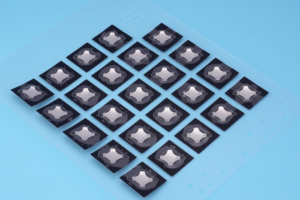
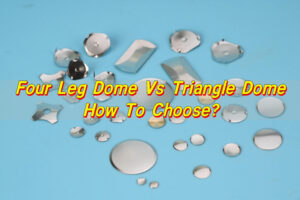
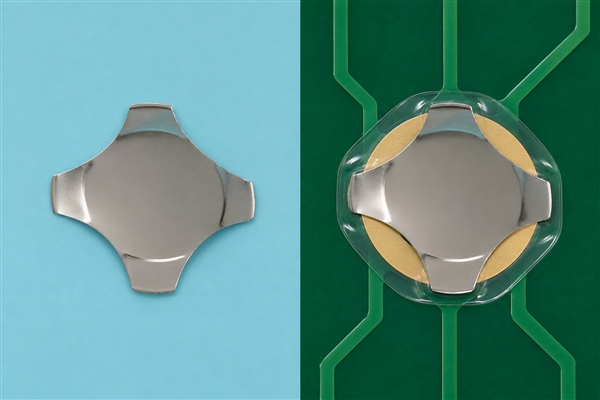
For a loose four-leg part, inspect whether each foot sits consistently; the F-Series metal dome page illustrates this format. A round dome has a different edge support; compare the actual C-Series metal dome geometry rather than treating a four-leg photo as a round-dome fixture drawing.
Is Preconditioning the Same as Preload or Life Cycling?
No. Metal dome preconditioning is a defined number of initial actuation cycles before a measurement. Preload is static force or deflection already present in an unpressed assembly. A preloaded dome can be preconditioned, but cycling does not remove an incorrect rest gap. See our metal dome preload guide when the key feels partly pressed before use.
Life cycling is a durability test over a much larger specified sequence, often with an endpoint or periodic checks. Preconditioning is not a substitute for that test and cannot establish service life. Our environmental testing guide discusses other test conditions that likewise need their own method.
Keep these three terms separate in drawings and test reports. State the assembled rest condition for preload, the early-cycle sequence for preconditioning and the full duty profile for durability. That prevents a conditioned force value from being mistaken for a lifetime guarantee.
When Should You Test the Loose Dome and the Assembled Key?
Test loose domes when you need to compare the spring component independent of the housing and keypad stack. Use a defined loose-part fixture and record its probe and support. This is the right context for comparing supplier force specifications that were measured on an individual dome.
Test the assembled key when the question is what the user will feel and what the circuit will do. The actuator, retaining film, adhesive, PCB flatness and cover tolerances affect the final force curve. Matching loose-part data does not guarantee matching keypad feel after assembly.
For a design review, request both datasets only when each serves a decision. Label them distinctly; a before/after assembly comparison without a defined method can otherwise assign a stack-up effect to the metal spring.
Metal Dome Preconditioning FAQs
Does preconditioning permanently increase the dome force? Not as a general rule. Its purpose is to define the reading cycle. Measure any change under the same setup; the direction and size of change are part-specific results, not a universal benefit.
Can a manual continuity test replace a force curve? No. Continuity can confirm closure at a point, but it does not report trip force, return force or travel. Use the electrical check alongside, not instead of, the defined mechanical test where those characteristics matter.
What should be sent with a dome sample request? Share the drawing or series, required force/travel definitions, test method and whether the target is a loose dome or assembled keypad. We can then discuss the appropriate dome format and the information needed to compare samples on the same basis.
EBest Circuit(Best Technology) supplies metal dome formats for keypad applications. Send the drawing and measurement conditions to sales@metal-domes.com so we can discuss the relevant format without treating one supplier’s test cycle as a universal specification.