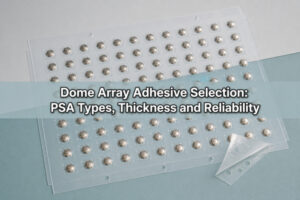

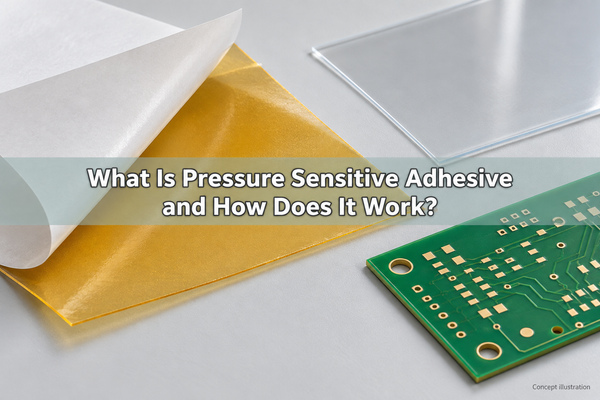
Pressure sensitive adhesive (PSA) forms a bond when pressure brings a tacky adhesive layer into close contact with a surface. A finished PSA tape normally needs no mixing, water activation or heating at the point of assembly. Labels, protective films and peel-and-place electronic components use this behavior, but their adhesive grades are not interchangeable.
For a membrane switch or metal dome array, the useful question is not simply whether the tape feels sticky. The adhesive must hold the film in position without lifting at the edges, sliding under load or entering a contact area.
What Is Pressure Sensitive Adhesive?
PSA is a class of adhesive defined by its bonding behavior, not one chemical formulation. It remains tacky under its specified application conditions and bonds through contact and pressure. Acrylic, rubber-based and silicone formulations can all be pressure-sensitive.
The adhesive is only one part of a tape construction. A backing or carrier supports it; a removable release liner protects it before use. Calling a component a “PSA sheet” does not identify its chemistry, thickness, carrier or suitability for a particular surface.
How Does Pressure Sensitive Adhesive Work?
PSA combines flow with internal strength. Under application pressure, the adhesive conforms to microscopic surface irregularities, increasing the real contact area. This is called wet-out. Interfacial attraction holds the surfaces together, while the adhesive’s cohesion helps it resist splitting or flowing away.
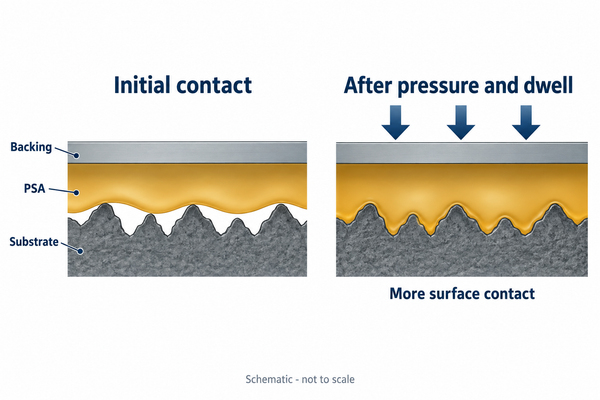
Pressure cannot compensate for every problem. Dust creates a weak intermediate layer; oil or mold release can prevent useful contact. A very thin adhesive may touch only the peaks of a rough surface. Increasing pressure indefinitely can squeeze a soft adhesive beyond its intended boundary or damage a delicate assembly.
Bond strength may build during dwell after application. That does not automatically mean the adhesive is chemically curing. Compare samples after the same specified dwell, temperature and application procedure, rather than comparing one freshly applied specimen with another left overnight.
Is PSA the Same as Hot Melt Glue?
No. Conventional hot melt glue generally needs heat during assembly and develops its bond as it cools. A hot melt pressure sensitive adhesive is coated while hot during manufacturing but remains tacky after cooling, allowing a finished tape or label to bond later under pressure.
Likewise, a water-based or solvent-based PSA can require drying during coating production. The finished dry adhesive film does not normally require the customer to add water or solvent. A liquid PSA supplied for coating must follow its own drying and application instructions; it is not interchangeable with a ready-to-laminate transfer tape.
This distinction prevents a common purchasing error: specifying “hot melt” without saying whether the delivered product is a coating adhesive, a finished PSA tape or a heat-activated bonding film.
Which Types of PSA Are Used?
Choose a chemical family as a starting point, then qualify a specific grade. Family names alone do not establish temperature limits, peel strength or clean removability.
| Adhesive family | Useful characteristics | What must be checked |
|---|---|---|
| Acrylic pressure sensitive adhesive | Many grades offer durable aging and useful UV resistance; modified grades address difficult surfaces | Initial wet-out, surface compatibility, chemical exposure and exact temperature rating |
| Rubber-based PSA | Often provides strong initial tack and rapid bonding | Heat, oxidation, UV exposure, creep and plasticizer compatibility |
| Silicone pressure sensitive adhesive | Selected grades bond silicone-based surfaces or withstand demanding temperatures | Actual substrate compatibility, suitable release liner, processing and contamination requirements |
“Acrylic” does not mean every acrylic tape bonds equally well to polypropylene, painted metal and solder mask. Similarly, silicone PSA is not automatically approved for every silicone rubber formulation. Evaluate the finished surface, including coatings and additives.
What Is the Difference Between PSA Tape and Transfer Tape?
The main distinction is what remains in the joint after the release liner is removed. Construction controls handling and finished thickness independently of adhesive chemistry.
| Construction | Layers that remain after installation | Practical use or limitation |
|---|---|---|
| Single-coated tape | Backing plus adhesive on one side | Film retention, masking or surface protection; it does not provide two exposed bonding faces |
| Adhesive transfer tape | Adhesive without a permanent carrier | Thin bonding of overlays or films; delicate die-cut features need controlled handling |
| Double-coated tape | Adhesive on both sides of a permanent carrier | Easier handling and dimensional support; each face can have different bonding requirements |
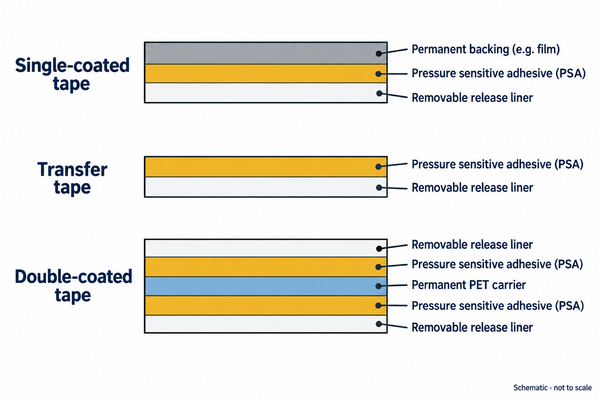
Pressure sensitive adhesive sheets and rolls describe the supply format, not a different bonding mechanism. When comparing thickness, exclude the removable liner and distinguish adhesive thickness from total tape thickness. A nominally thicker double-coated tape may contain a carrier rather than proportionally more adhesive.
For example, a drawing calling for a 0.10 mm finished bond line must not be satisfied by a 0.10 mm “total thickness” that includes a liner removed during installation. Confirm the datasheet’s measurement definition before approving a substitute.
What Do Tack, Peel and Shear Mean?
These measurements describe different loads and cannot be reduced to one “adhesive strength” number. Select the test that represents how the assembly will actually fail.
| Property | What it measures | Required context |
|---|---|---|
| Tack | Initial bond formation after brief contact | Contact method, force, time, substrate and test temperature |
| Peel adhesion | Resistance to progressive separation from an edge | Peel angle, speed, width, backing, substrate and dwell |
| Shear holding power | Resistance to sliding under a parallel load | Bonded area, applied load, temperature and time or displacement criterion |
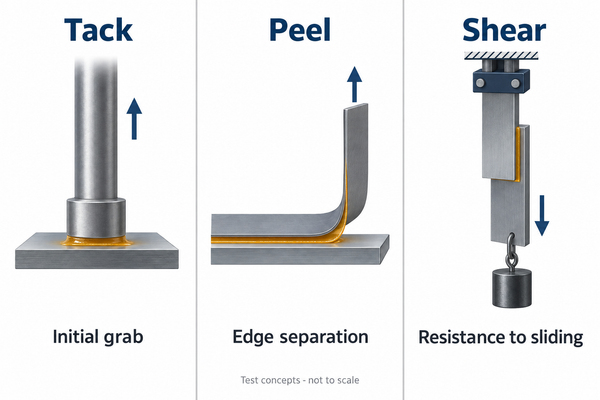
A tape can grab immediately yet creep under a sustained load. Another can have high peel adhesion but perform poorly when an overlay is bent around a small radius. Compare like-for-like tests: a 90-degree peel result is not directly interchangeable with a 180-degree result, and a steel-panel result does not establish adhesion to your solder mask.
Normalize units before comparing values. For example, 10 N per 25 mm equals 0.4 N/mm of width; it is not a pressure or an allowable operating load. Treat typical datasheet results as screening information, not a guaranteed finished-assembly acceptance limit.
What Is Pressure Sensitive Adhesive Used For?
Pressure sensitive adhesive examples include labels, removable protective films, graphic overlays, gasket attachment and peel-and-place switch components. These applications share a bonding mechanism but differ in expected service life, load and removal requirements. A removable shipping label is not a substitute for a permanent control-panel bond.
In electronics, PSA can attach an insulating film, retain a light gasket or mount a switch carrier. Ordinary PSA does not provide an electrical connection; conductive tapes are separately specified products. An adhesive layer also does not establish an enclosure’s waterproof rating by itself.
Our single-key dome arrays use a peel-and-place format to position a dome on the circuit. The adhesive secures the carrier while the metal dome supplies the switching action. Adhesive must remain outside the intended electrical contact region.
For an additional bonding interface between a keypad and carrier, our rubber-glue dome arrays can use selected acrylic or silicone PSA constructions. “Rubber glue” is the product-family name here, not proof that every version contains a rubber-based adhesive.
How Do You Apply PSA to PCB and Plastic Surfaces?
Apply the selected PSA to a clean, dry, compatible surface within its specified application-temperature range. On a PCB, identify the actual bonding surface: solder mask, legend ink, exposed metal or coating. “FR4 board” alone is not an adequate surface specification.
- Check the part, adhesive grade, shelf-life status and liner orientation before exposing the adhesive.
- Remove contamination using a cleaning method compatible with the surface, inks and components. Allow cleaning fluid to evaporate fully.
- Align from stable datums and peel the liner progressively without touching the exposed adhesive.
- Apply controlled pressure to the intended bond area, avoiding trapped air and wrinkles. Support the board so the lamination load does not bend it.
- Allow the specified dwell before loading or comparing bond strength. Inspect registration and edge adhesion before the assembly is enclosed.
For a metal dome assembly, direct the lamination load onto the adhesive lands rather than forcing the dome crown downward. Keep contact openings and designed vent paths clear. Use a proven fixture or roller procedure instead of an arbitrary instruction to “press harder.”
Do not confuse minimum application temperature with service temperature. A tape that survives cold operation after bonding may not wet out adequately if first applied to a cold surface.
Why Does PSA Peel or Creep?
Peeling usually starts where contact is weak or edge stress is high; creep is movement within the adhesive under sustained load. Diagnose the failure location before changing the material.
- Clean separation at one surface: investigate contamination, poor wet-out or incompatibility with that finish.
- Adhesive residue on both surfaces: investigate cohesive failure, excessive load or softening at the test temperature.
- Edge lift on a curved overlay: check film springback, bend radius and available bond area, not only initial tack.
- Adhesive spreading into an opening: check grade, coat thickness, pressure, temperature and clearance from the opening.
These observations are diagnostic clues, not a complete root-cause verdict. Inspect several specimens and reproduce the failure under controlled conditions. For a switch, include repeated actuation and electrical checks after environmental exposure; a sheet can remain attached while the key no longer returns correctly.
Can Pressure Sensitive Adhesive Be Removed?
Some PSAs are designed for removal; others are intended for permanent attachment. Clean removal depends on the exact adhesive, surface, dwell, aging, temperature and removal method. A “removable” label is not a promise of residue-free removal from every painted or printed surface.
For electronic assemblies, isolate power and use an approved rework procedure before peeling a bonded film. Support the substrate and avoid lifting pads, printed conductors or fragile overlays. Do not flood a switch with a pressure sensitive adhesive remover: a solvent can attack inks or plastics, wick into contacts and leave contamination. Check compatibility on a representative spare part first.
Do not assume a removed PSA layer can be reused. Contamination, stretching and disturbed adhesive can reduce repeatability even when it still feels sticky. A replacement die-cut layer or complete carrier may be the more controllable repair.
How Do You Specify PSA for Electronic Assemblies?
Specify the interface and test conditions, not just “strong double-sided tape.” Provide the two mating surfaces, finished bond-line thickness, adhesive part number if locked, expected temperature and chemical exposure, permanent or removable requirement, and the die-cut outline with adhesive-free areas.
For a switch carrier, also identify the placement datums, contact openings and handling format. Our custom dome arrays support defined carrier outlines, dome positions and openings. EBest Circuit(Best Technology) can review the carrier construction against these inputs without treating an adhesive datasheet as a guarantee for the complete switch.
Prototype approval should record the actual substrate finish, preparation, pressure procedure, dwell and test conditions. Compare fresh and conditioned samples using the same method. Confirm both adhesion and switch operation before approving a material substitution.
A suitable pressure sensitive adhesive provides enough contact and holding power without adding unwanted thickness, residue or movement. For a dome-array or membrane-switch bonding review, send your stack drawing and mating-surface details to sales@metal-domes.com.