

Tape & reel packaging is one of the most widely used component delivery methods in the electronics industry. It helps manufacturers load components directly into SMT pick-and-place machines while protecting delicate parts during transportation and storage. Compared with loose bulk packaging, it greatly improves assembly efficiency and reduces placement errors.
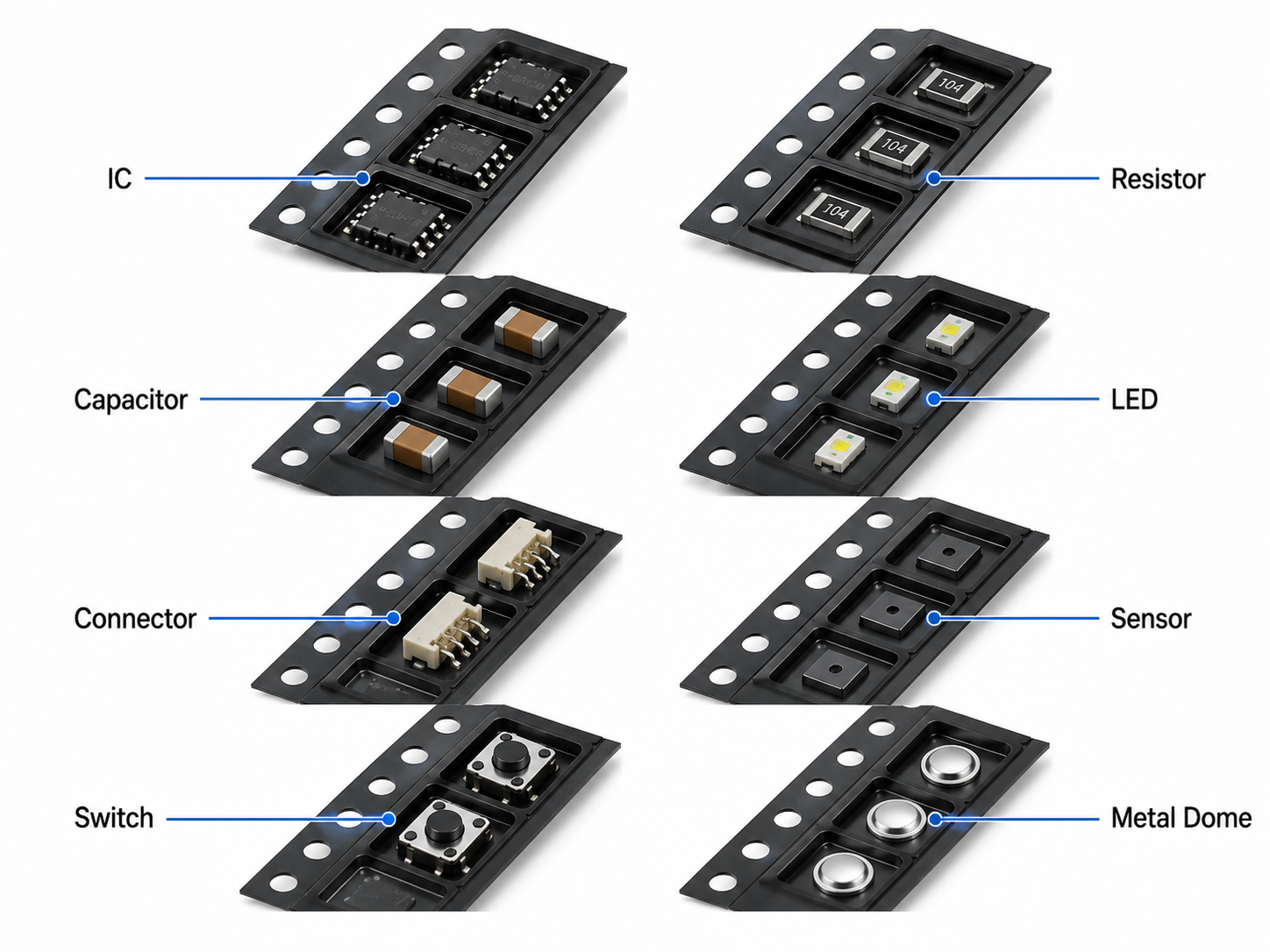
Today, tape and reel packaging electronics solutions are used for ICs, resistors, capacitors, LEDs, connectors, switches, and metal domes. Companies such as EBest Circuit (Best Technology) also provide custom tape and reel packaging services for metal dome arrays and precision electronic components to support high-speed automated production.

What is a tape and reel packaging?
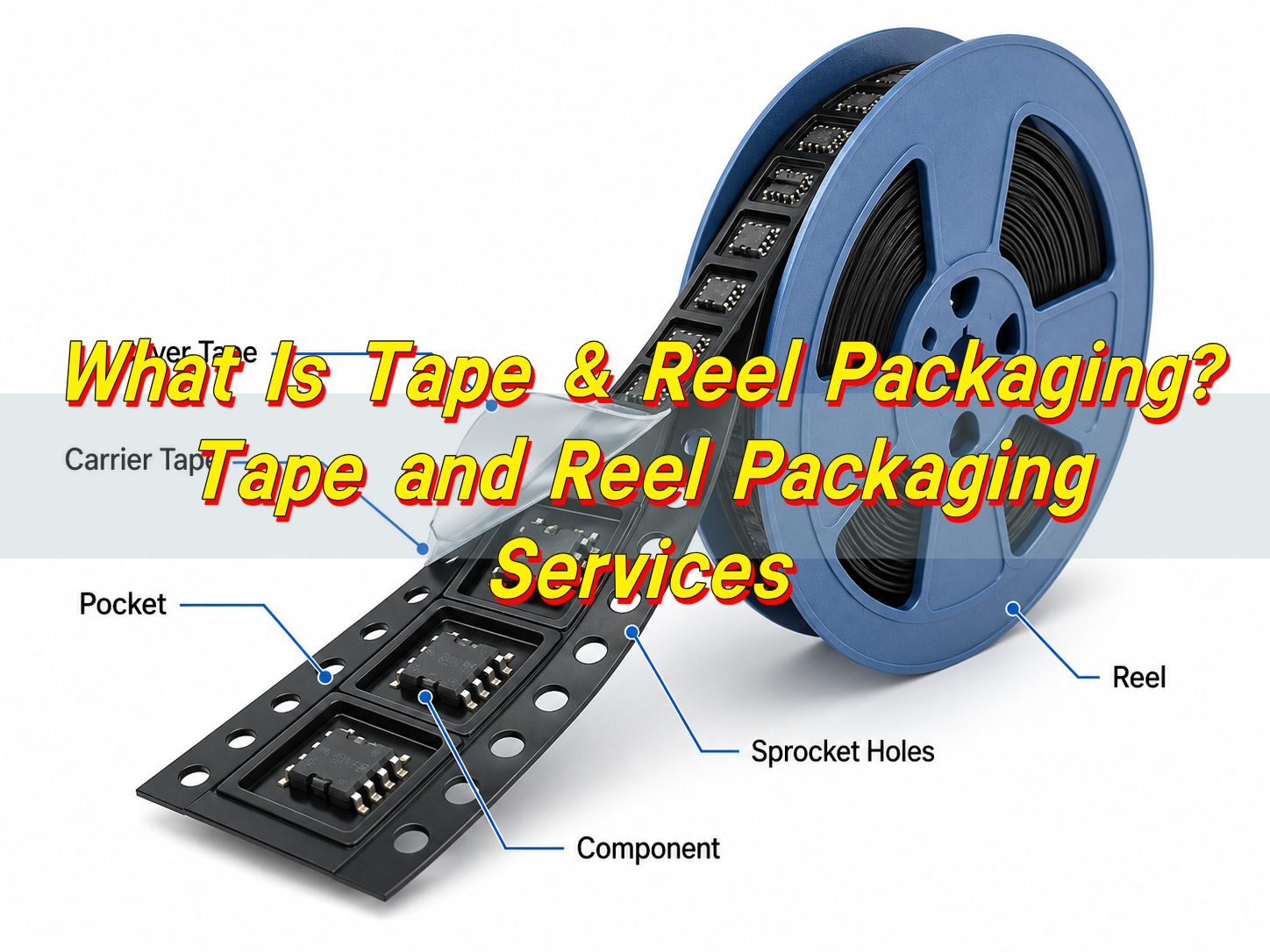
Tape and reel packaging is a standardized method used to store, transport, and feed electronic components into automated SMT assembly equipment. Components are placed into evenly spaced pockets on a carrier tape, sealed with a cover tape, and wound onto a reel for easy machine loading.
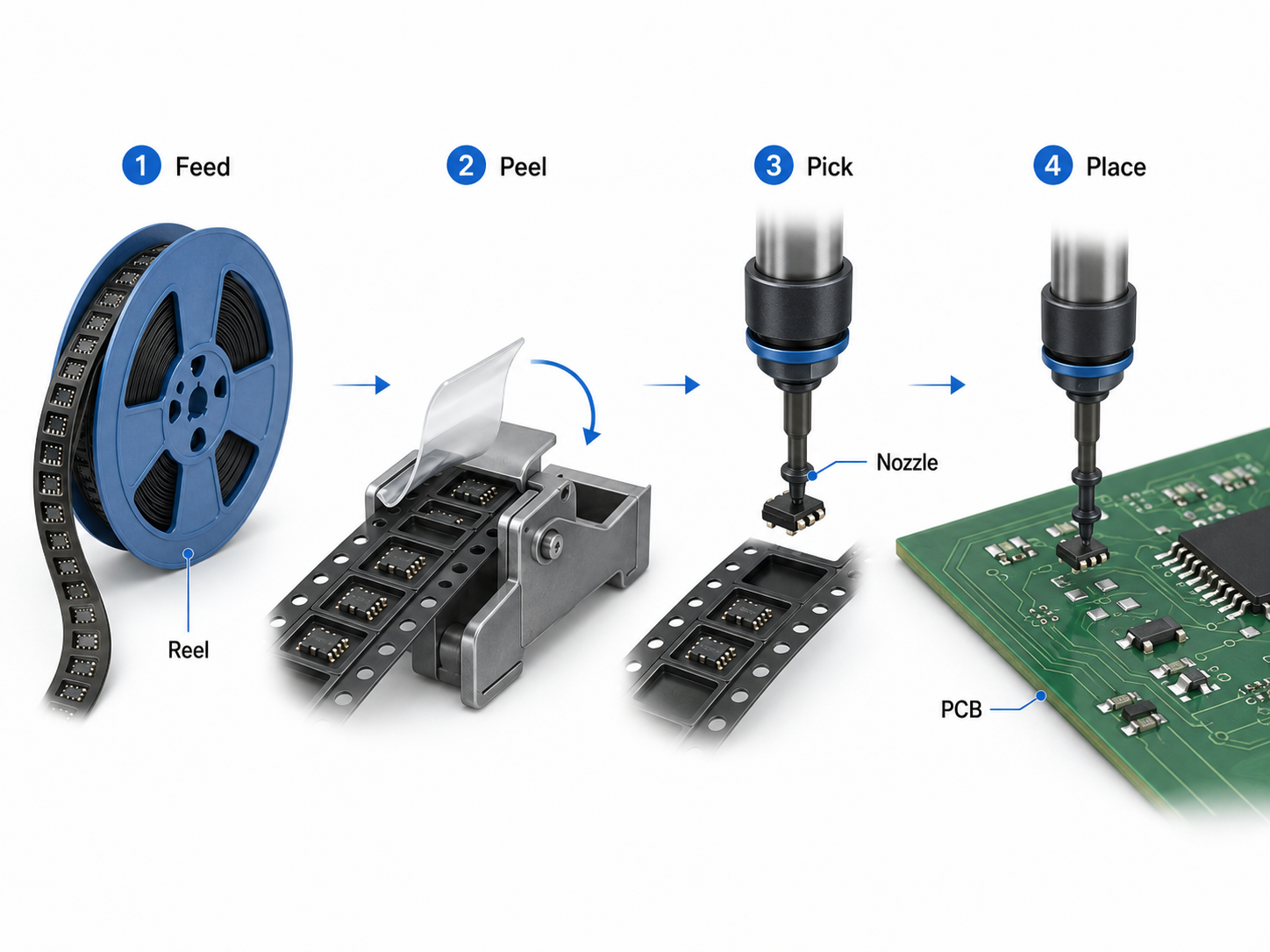
The system is designed for high-speed automated placement. During PCB assembly, the pick-and-place machine pulls the carrier tape forward, removes the cover film, and picks each component from its pocket with precise positioning.
The basic structure includes:
- Carrier tape
- Cover tape
- Reel hub
- Leader and trailer sections
- Anti-static protection materials when required
Tape and reel packaging standards are widely defined by industry organizations such as EIA and IEC to ensure compatibility between packaging suppliers and SMT equipment manufacturers. The packaging format supports extremely fast production speeds. Depending on the assembly line and component size, some SMT systems can place tens of thousands of components per hour with minimal manual intervention.
For delicate products such as metal domes, tape on reel packaging also improves orientation accuracy. This is especially important for four-leg domes, triangle domes, and custom tactile switch components that require precise alignment during automated assembly.
At EBest Circuit (Best Technology), custom tape reel packaging solutions are commonly used for metal dome products to improve production efficiency and maintain stable tactile performance after placement.
Why Is Tape and Reel Packaging Used in Electronics?
Electronics manufacturing relies heavily on automation. Without standardized packaging, automated assembly would become slower, less accurate, and more expensive. Tape and reel packaging electronics systems solve these challenges by creating a reliable feeding method for SMT equipment.
Several important advantages explain why reel packaging for tape has become the industry standard.
Improved Assembly Speed
Modern pick-and-place machines operate at extremely high speeds. Tape and reel packaging allows components to feed continuously into the machine without stopping for manual loading. Compared with bulk handling, automated reel feeding can dramatically improve throughput and reduce labor costs.
For example:
| Packaging Method | Typical Placement Efficiency |
|---|---|
| Bulk Packaging | Low |
| Tube Packaging | Medium |
| Tape & Reel Packaging | Very High |
Some advanced SMT lines can process over 50,000 placements per hour using properly designed tape and reel systems.
Better Component Protection
Electronic components are sensitive to:
- Mechanical shock
- Electrostatic discharge
- Moisture contamination
- Pin deformation
- Surface scratches
Tape and reel packaging material helps isolate each component inside an individual pocket. This reduces physical contact and improves transportation safety. Anti-static carrier materials are also available for sensitive semiconductor devices.
Accurate Component Orientation
Orientation matters in automated placement. Incorrect alignment can lead to placement errors, polarity issues, or soldering defects. Tape and reel packaging standards define component orientation rules so machines can consistently identify pickup positions.
This becomes especially valuable for asymmetrical components such as:
- Connectors
- LEDs
- IC packages
- Metal domes
- Tactile switches
Lower Manual Handling Costs
Manual handling increases the risk of contamination and assembly mistakes. Tape and reel packaging services reduce operator involvement and support more stable production quality. For large-volume manufacturing, this creates measurable cost savings over time.
Easier Inventory Management
Reeled components are easier to:
- Count
- Store
- Label
- Transport
- Track in production systems
Many factories integrate barcode systems directly onto reel labels for automated inventory control.
How Does Tape & Reel Packaging Work?
The tape and reel process may look simple from the outside, but it involves precise engineering to ensure compatibility with automated assembly equipment.
The workflow generally follows several stages.
Component Loading
Components are placed into formed carrier tape pockets. The pocket size must match the component dimensions closely enough to prevent movement while still allowing reliable pickup.
Depending on the product, loading may be:
- Fully automated
- Semi-automated
- Custom manual-assisted
For precision tactile products such as metal domes, orientation control is especially important during loading.

Cover Tape Sealing
After loading, a transparent or opaque cover tape seals the carrier tape pockets. The sealing force must be carefully controlled.
If the seal is too weak:
- Components may fall out during shipping
If the seal is too strong:
- SMT feeders may struggle to peel the tape smoothly
Reliable peel force is an important part of tape and reel packaging standards.
Reel Winding
The sealed tape is wound onto reels with specified diameters. Common reel sizes include:
- 7-inch reels
- 13-inch reels
- Custom industrial reels
Leader tape and trailer tape sections are added to support machine loading.
SMT Machine Feeding
Inside the pick-and-place machine:
- The reel rotates forward
- Cover tape peels back
- Components become exposed
- Vacuum nozzles pick components
- Components are placed onto the PCB
The process repeats continuously at high speed.
For custom tape and reel packaging services, feeder compatibility testing is often performed before mass production.
What Components Are Suitable for Tape and Reel Packaging?
Tape and reel packaging supports a wide range of electronic components across many industries.
Common components include:
- Integrated circuits
- Capacitors
- Resistors
- Inductors
- LEDs
- Connectors
- Sensors
- SMT switches
- Metal dome arrays
- Tactile domes
- MEMS devices
Small SMT components are especially suitable because automated assembly equipment depends on standardized feeding systems.
For custom metal dome applications, tape & reel packaging improves orientation consistency and placement accuracy. EBest Circuit (Best Technology) provides customized carrier tape designs for different dome structures and actuation requirements.
The suitability of tape and reel packaging depends on several factors:
| Factor | Importance |
|---|---|
| Component Size | Determines pocket dimensions |
| Shape Stability | Prevents rotation during feeding |
| Surface Durability | Protects delicate finishes |
| Orientation Requirements | Ensures accurate placement |
| Weight | Affects pickup reliability |
Very large or highly irregular components may require alternative packaging methods.
What Is the Difference Between Cut Tape and Reel Packaging?
Cut tape and full reel packaging both use carrier tape systems, but they serve different production needs. Cut tape refers to a short section removed from a larger reel. It is commonly used for prototypes, small production runs, and engineering evaluation. Reel packaging uses a continuous reel designed for automated manufacturing environments.
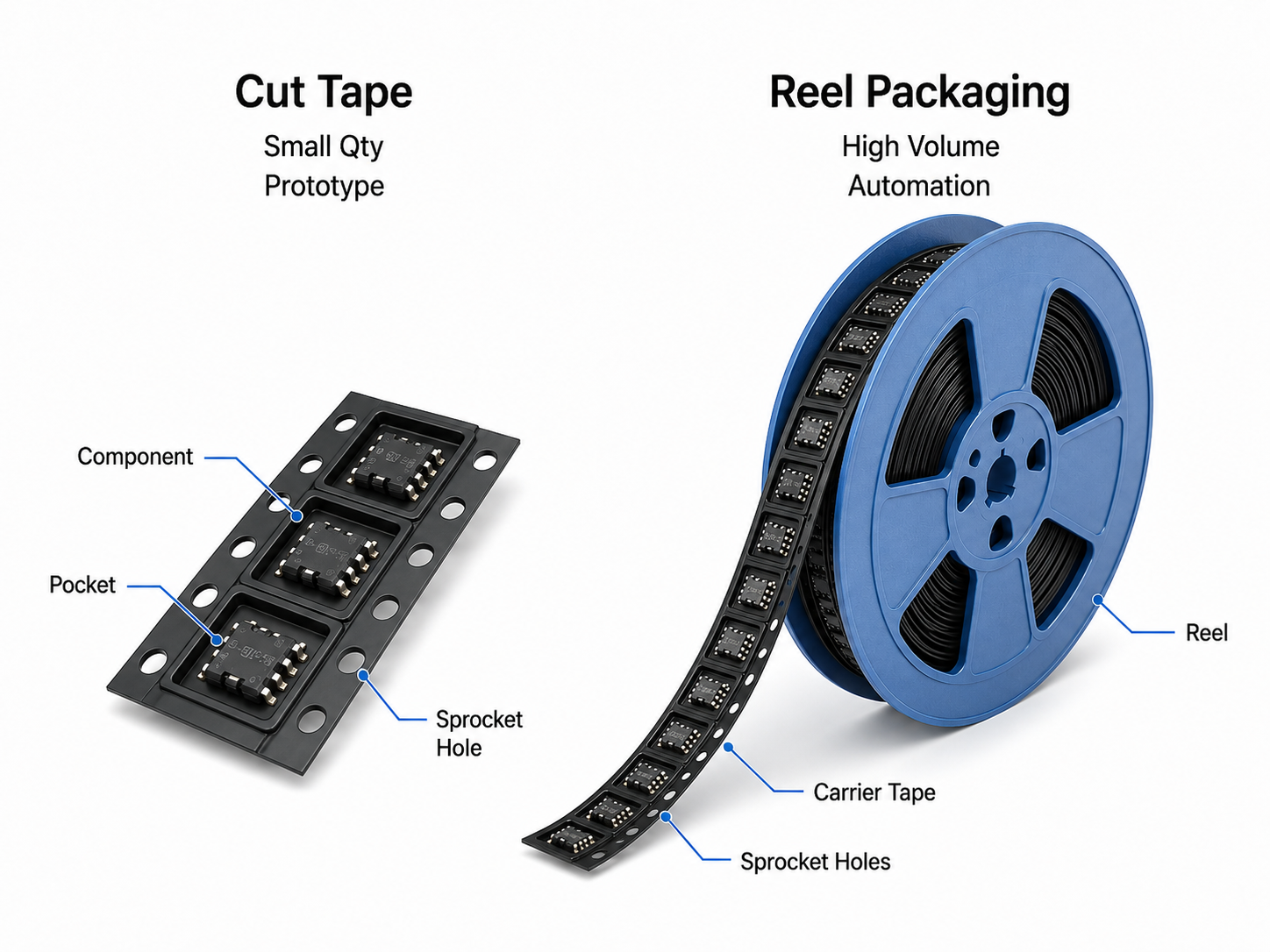
Before comparing them in detail, it helps to understand their intended purposes:
- Cut tape focuses on flexibility and small quantities
- Reel packaging focuses on automation and production efficiency
| Feature | Cut Tape | Reel Packaging |
|---|---|---|
| Quantity | Small | Large |
| Automation Suitability | Limited | Excellent |
| Storage Convenience | Moderate | High |
| SMT Feeding Efficiency | Lower | Very High |
| Handling Risk | Higher | Lower |
| Prototype Use | Excellent | Possible |
| Mass Production | Less Suitable | Ideal |
| Cost Efficiency | Better for small orders | Better for large orders |
Cut tape is popular for laboratory use and prototype assembly because engineers may only need a few parts. Tape reel packaging becomes far more efficient once production volume increases.
When Should You Choose Tape and Reel vs Cut Tape?
The decision between tape and reel vs cut tape depends mainly on production scale, automation level, and handling requirements.
Choose Cut Tape When:
- Building prototypes
- Testing new designs
- Ordering small quantities
- Performing laboratory evaluation
- Using manual assembly methods
Cut tape reduces inventory waste during development stages.
Choose Tape & Reel Packaging When:
- Running automated SMT lines
- Producing large quantities
- Requiring stable orientation
- Minimizing labor costs
- Improving feeding consistency
For high-speed production, tape and reel packaging services provide major efficiency advantages. Manufacturers working with precision tactile components often prefer reel systems because proper orientation directly affects assembly quality.
At EBest Circuit (Best Technology), many industrial customers switch from loose dome packaging to tape and reel systems after scaling production because automated mounting significantly improves consistency and reduces placement time.
What Is the Difference Between Tube and Reel Packaging?
Tube packaging is another common component delivery method in electronics manufacturing. Instead of using carrier tape pockets, components are stored inside long plastic tubes.
Tube packaging works well for certain larger packages, especially connectors and through-hole components. However, tape and reel systems dominate modern SMT production because they support faster automation.
Here is a direct comparison.
| Feature | Tube Packaging | Tape & Reel Packaging |
|---|---|---|
| Feeding Method | Linear tube feed | Continuous reel feed |
| SMT Speed | Medium | Very High |
| Orientation Stability | Moderate | Excellent |
| Space Efficiency | Lower | Higher |
| Handling Convenience | Moderate | Excellent |
| Component Protection | Good | Excellent |
| Automation Compatibility | Good | Excellent |
| Small Component Support | Limited | Outstanding |
Tube packaging still remains useful for:
- Large connectors
- Long pin components
- Some IC packages
- Specialized industrial parts
However, for compact SMT production, tape on reel packaging offers better speed and efficiency.
What Are Common Tape and Reel Packaging Standards?
Standardization is essential in electronics manufacturing. Without common dimensions and feeding rules, components would not work reliably with automated equipment.
Tape and reel packaging standards define:
- Tape width
- Pocket dimensions
- Reel size
- Component orientation
- Sprocket hole spacing
- Peel force requirements
One of the most widely referenced standards is EIA-481. This standard helps ensure compatibility between:
- Component suppliers
- Packaging providers
- SMT machine manufacturers
- Electronics assembly facilities
Common tape widths include:
| Tape Width | Typical Components |
|---|---|
| 8 mm | Small passive components |
| 12 mm | Medium SMT parts |
| 16 mm | Larger components |
| 24 mm+ | Large connectors and modules |
Tape and reel packaging material may include:
- Polystyrene
- Polycarbonate
- Conductive plastic
- Anti-static materials
- Embossed carrier films
The choice depends on component sensitivity and feeding requirements. For metal dome packaging, custom pocket geometry is often developed to maintain orientation and prevent deformation during transportation.
EBest Circuit (Best Technology) designs customized tape reel packaging solutions that align with automated SMT placement requirements while maintaining stable tactile characteristics after assembly.
How Does Tape and Reel Packaging Protect Components?
Protection is one of the most important functions of tape and reel packaging. Electronic components can easily suffer damage during transportation, storage, or handling if packaging is not properly designed.
Tape and reel systems provide several layers of protection simultaneously.
Physical Protection
Each component sits inside an individual cavity that prevents excessive movement. This reduces:
- Impact damage
- Pin bending
- Surface scratches
- Edge chipping
For precision tactile components such as metal domes, controlled pocket depth helps maintain shape consistency.
Electrostatic Protection
Many semiconductor devices are sensitive to electrostatic discharge. Anti-static tape and reel packaging material helps reduce ESD risk during transportation and machine feeding.
Conductive carrier tapes are commonly used for:
- ICs
- Sensors
- MEMS devices
- Precision electronic components
Moisture Protection
Some components require moisture-sensitive handling. Reel systems can be combined with:
- Moisture barrier bags
- Vacuum sealing
- Desiccants
- Humidity indicators
This helps maintain component reliability before assembly.
Stable Feeding Performance
Properly designed carrier tapes reduce component flipping or jamming during automated feeding.
Reliable feeding improves:
- SMT uptime
- Placement accuracy
- Production yield
- Assembly consistency
For high-volume manufacturers, stable feeding directly affects operational efficiency.
FAQs About Tape & Reel Packaging
Is tape and reel packaging only for SMT components?
Most tape and reel packaging electronics applications focus on SMT components, but some specialized through-hole components can also use reel systems.
Can tape and reel packaging be customized?
Yes. Custom tape and reel packaging services are widely available for unusual component shapes, custom dimensions, and orientation-sensitive products.
What reel size is most common?
7-inch and 13-inch reels are the most common sizes, although custom sizes are also used in industrial applications.
Why is component orientation important?
Correct orientation ensures SMT machines pick and place components accurately. Incorrect orientation can cause placement defects or assembly failures.
Does tape and reel packaging reduce production costs?
Yes. It improves automation efficiency, reduces labor handling, lowers placement errors, and minimizes component damage during manufacturing.
Is tape and reel packaging suitable for metal domes?
Absolutely. Tape and reel packaging is widely used for metal domes because it improves placement speed and orientation accuracy in automated SMT assembly.
EBest Circuit (Best Technology) provides custom tape and reel packaging services for metal dome arrays used in industrial control systems, medical electronics, communication devices, and automotive applications.
What materials are used for carrier tapes?
Common materials include:
- Polystyrene
- Polycarbonate
- Conductive plastics
- Anti-static embossed films
The material selection depends on component sensitivity and production requirements.
How long can components remain in reel packaging?
When stored correctly under recommended humidity and temperature conditions, reel-packaged components can maintain stable quality for long periods.
Conclusion:
Tape & reel packaging has become a core part of modern electronics manufacturing because it combines speed, precision, protection, and automation compatibility in one efficient system. From semiconductor devices to precision tactile components, reel-based feeding supports stable SMT production while reducing handling risks and improving placement consistency.
For specialized products like metal domes, custom tape and reel packaging services deliver even greater benefits through accurate orientation control and faster automated placement. EBest Circuit (Best Technology) continues to support electronics manufacturers with customized tape reel packaging solutions designed for reliable production efficiency and stable product performance.
For more information about custom metal dome tape & reel packaging services, contact: sales@metal-domes.com