
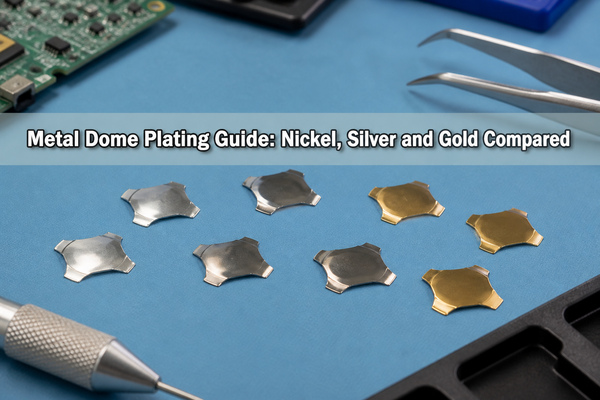
This metal dome plating guide compares nickel, silver and gold finishes by contact behavior, corrosion stability, signal level, durability and inspection needs. The spring-grade stainless steel underneath provides the snap action, while the plated surface controls much of what happens where the dome touches the PCB pad. There is no universally best finish: the correct choice depends on the electrical signal, atmosphere, contact force and validation target.
Finish names alone are not a complete specification. Plating thickness, coverage, adhesion, porosity, cleanliness and the matching PCB contact surface can matter as much as the selected metal. These factors should be reviewed together rather than treating color as proof of electrical performance.
What Is Metal Dome Plating?
Metal dome plating is a thin functional metallic coating deposited over the formed stainless steel dome. Nickel, silver and gold are common options. The coating becomes the working electrical interface at the point where the dome bridges the center and outer PCB contacts.
Plating does not replace the spring material. The dome still depends on the stainless steel grade, temper, thickness and formed geometry for its actuation force, travel, return and fatigue life. The finish is selected mainly for electrical contact and environmental behavior.
Why Are Metal Domes Plated?
Metal domes are plated to create a more controlled contact surface than bare stainless steel alone. A suitable finish can reduce and stabilize contact resistance, limit surface oxidation or tarnish, improve corrosion performance and keep the electrical closure more repeatable over the intended life.
The benefit is system-dependent. A clean, adequately loaded contact in a protected indoor keypad may tolerate a general-purpose finish, while a low-level signal or contaminated atmosphere may require a surface that remains stable with less electrical energy available to break through films.
What Is the Base Material Under the Plating?
Spring-grade stainless steel, commonly from the 301 family, is widely used under the plating because it can be formed into a stable snap geometry and return repeatedly. The selected temper and forming process are critical to the force-displacement curve. Other grades may be used when a different balance of forming, corrosion resistance and spring behavior is required.
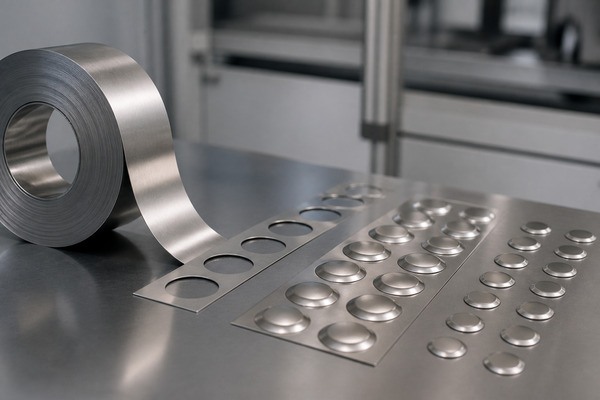
A custom metal dome should therefore define the mechanical dome construction and the finish as separate controlled requirements. Changing the plating cannot compensate for an unsuitable base thickness, temper or geometry.
Nickel vs Silver vs Gold Plating: What Changes?
The useful comparison is not a simple ranking. Nickel emphasizes durability and cost control, silver emphasizes electrical conductivity, and gold emphasizes resistance to oxidation and stable low-level contact. The final result still depends on deposit quality, contact pressure, PCB pad condition and exposure.
| Finish | Main strength | Main limitation | Typical selection logic |
|---|---|---|---|
| Nickel | Hard, durable and economical functional coating | Higher resistivity than silver or gold; surface films must be considered | General-purpose key circuits with controlled environment and adequate signal |
| Silver | Very high electrical conductivity and low contact resistance potential | Can tarnish, especially in sulfur-containing atmospheres | Low-resistance contact where the environment is suitable and verified |
| Gold | Low and stable contact behavior with strong tarnish resistance | Higher material and processing cost; thickness and porosity remain important | Low-level signals, long idle periods or environments where surface stability is critical |
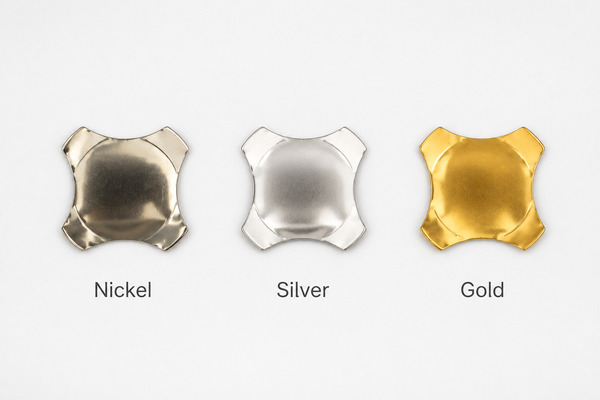
ASTM B689, B700 and B488 cover engineering nickel, silver and gold coatings respectively. They reinforce an important point: coating identity is only one control. Thickness, adhesion, appearance, defects and integrity also require definition and verification.
When Should You Choose Nickel-Plated Metal Domes?
Nickel-plated domes are a practical starting point for general keypads and control interfaces when the electrical signal is robust, the contact area remains clean and the environment is not unusually corrosive. Nickel is hard and wear-resistant, and it offers useful corrosion protection at a lower cost than precious-metal finishes.
Nickel should not be selected only because it looks bright. Confirm the initial and post-life contact resistance under the real pad finish and contact force. For very low-level signals or long idle periods, the stability of surface films may become more important than nickel’s mechanical durability.
When Should You Choose Silver-Plated Metal Domes?
Silver plating is appropriate when high electrical conductivity and low contact resistance are important, provided the atmosphere is compatible with silver. It can be a useful middle option when nickel does not meet the electrical target and gold is unnecessary.
Silver is not automatically the best finish for every low-resistance contact. Sulfur-containing gases can form tarnish, and contamination can change the interface. If silver is selected for industrial, automotive or outdoor equipment, environmental exposure and post-conditioning resistance should be part of validation.
When Should You Choose Gold-Plated Metal Domes?
Gold plating is preferred when a low-current or low-voltage signal needs a contact surface that resists oxidation and tarnish. It is especially useful when a switch may remain unused for long periods, because the circuit cannot rely on high electrical energy to disrupt a surface film at the next actuation.
Gold does not remove the need for engineering controls. A porous or excessively thin coating can expose the underlying layer, while an unsuitable deposit can wear or crack during forming and cycling. Use gold where its surface stability solves a defined problem, then verify thickness, coverage, adhesion and life rather than treating the finish name as the acceptance criterion.
Does Plating Affect Actuation Force or Tactile Feel?
Plating usually has less influence on tactile feel than dome geometry, stainless steel temper, material thickness, free height, dimple design and actuator position. Changing a finish should not be used as the primary method for changing trip force or click ratio.
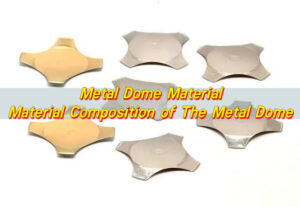
Finish options can be applied to different mechanical families, including circle metal domes, four-leg metal domes and triangle metal domes. Select the family from pad geometry, available space and force curve; select the plating from the electrical and environmental requirements. The combined part should still be approved by force-displacement and life testing.
How Do Signal Level and Contact Resistance Affect Plating Choice?
Low-level circuits are more sensitive to films and resistance variation because they have limited voltage and current available at closure. Gold is often favored for these dry-circuit conditions. Silver can provide excellent conductivity, while nickel can be satisfactory when the signal and contact force are sufficient and the environment is controlled.
Do not compare bulk metal conductivity alone. A metal dome contact is a small, dynamic interface. Real resistance includes surface films, contact area, force, pad finish, contamination, bounce and measurement method. Set an initial limit and a post-environment or post-life limit using the same test fixture.
How Do Humidity, Sulfur and Contamination Affect Plating?
Humidity can accelerate corrosion where pores or damage expose a less noble underlying layer. Sulfur-containing atmospheres are particularly important for silver because silver sulfide tarnish can raise interface resistance. Oils, dust, adhesive residue and cleaning-agent films can affect any finish by separating the dome from the PCB contact.
Gold offers strong resistance to normal oxidation and tarnish, but porosity and edge coverage still matter. Environmental validation should reproduce the expected contaminants and temperature/humidity conditions, then measure contact resistance after conditioning and actuation rather than relying on visual appearance alone.
Why Do Plating Thickness, Coverage and Adhesion Matter?
Plating must be thick enough and continuous enough for the intended process and service life, while remaining well bonded through forming and repeated flexing. Thin spots, pores or weak adhesion can expose the base or underlayer and create local corrosion, wear-through or resistance drift.
A drawing should avoid a generic note such as “gold color.” Specify the finish system, the controlled surface, whether one or both sides are plated, and the applicable thickness and inspection method when these are critical. The exact thickness should come from the approved product specification and validation plan, not from a universal number copied from another contact design.
How Should Metal Dome Plating Be Tested?
Testing should connect coating quality to actual switch performance. A useful plan checks deposit construction before cycling, electrical behavior at the contact interface and stability after mechanical or environmental stress.
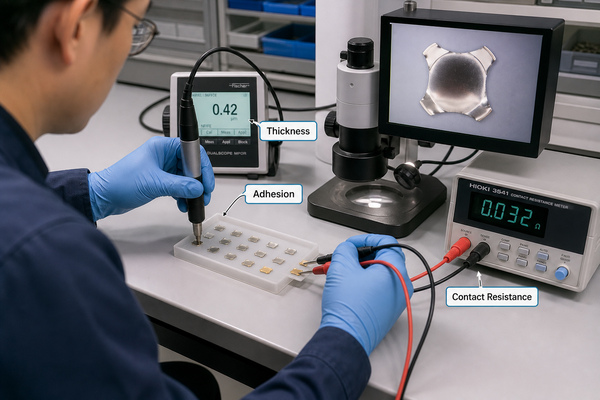
- Confirm finish identity, coverage and visual condition under magnification.
- Measure coating thickness with a method suitable for the material and geometry.
- Evaluate adhesion using an agreed method that does not confuse base-metal deformation with coating failure.
- Measure initial contact resistance on the specified PCB pad and fixture.
- Repeat resistance and force measurements after life cycling and relevant environmental conditioning.
- Inspect worn contact points for cracking, peeling, porosity, contamination and exposed substrate.
EBest Circuit(Best Technology) has manufactured metal domes and metal dome arrays since 2006 and publishes trip-force, rebound-force, life-cycle and electrical test capabilities. Acceptance limits remain subject to the selected dome series, finish, PCB surface, fixture and application conditions.
What Plating Defects Cause Contact Failure?
Common risks include insufficient coverage, pinholes, blisters, peeling, cracks, embedded contamination, uneven deposits and mechanical damage. These defects can expose the underlying metal, concentrate corrosion or reduce the effective contact area. A finish may pass a color check and still fail electrically.
Resistance drift can also come from outside the coating. Misaligned actuation, low contact force, trapped particles, adhesive flow or contaminated PCB pads may produce the same symptom. Failure analysis should inspect the dome, pad and actuator stack together before assigning the cause to plating.
How Should the PCB Contact Finish Match the Dome Plating?
The metal dome and PCB pad form one contact pair. Pad flatness, finish, mask clearance, cleanliness and wear pattern affect closure resistance. A stable dome coating cannot correct an oxidized, contaminated or geometrically incorrect pad.
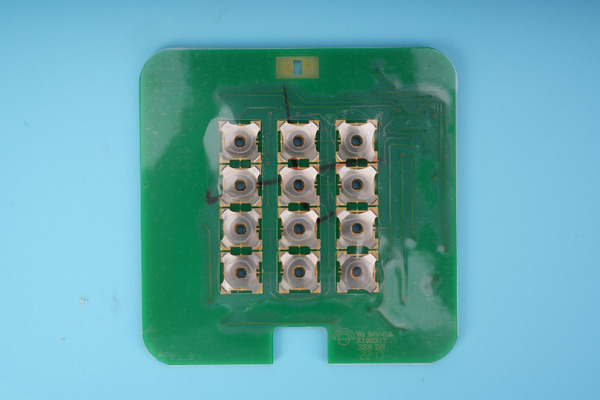
Verify the actual combination rather than approving the dome and board separately. Use the intended PCB surface finish, dome orientation, actuator and support condition. Keep the center contact electrically isolated from the outer contact area, and prevent solder mask edges, vias or debris from holding the dome above the pad.
How Do You Select Metal Dome Plating Without Overspecifying?
Start with four controlled questions: how small the switched signal is, how stable contact resistance must remain, what atmosphere reaches the contact and what lifecycle must be demonstrated. Use nickel when general-purpose durability and cost dominate, silver when conductivity is central and tarnish is controlled, and gold when low-level contact stability and corrosion resistance justify the added cost.
Then specify only the coating controls needed to prove performance: finish system, plated side, thickness where critical, coverage, adhesion, initial resistance, post-life resistance and environmental condition. This prevents both under-specification and an expensive precious-metal finish that does not solve the real failure mechanism.
FAQ About Metal Dome Plating
Is Gold Plating Always Better Than Silver?
No. Silver has higher bulk electrical conductivity, while gold is more resistant to oxidation and tarnish and therefore often provides more stable low-level contact over time. The better choice depends on signal level, atmosphere, contact force and qualification results.
Can a Metal Dome Be Plated on Both Sides?
Yes, one-side and double-side plating can be specified when the product and process support it. The controlled side or sides should be shown on the drawing because the electrical contact surface and the actuator-facing surface have different functions.
Can Plating Prevent Every Corrosion Problem?
No. Pores, damage, contaminants, incompatible environments and exposed edges can still create corrosion paths. Sealing, cleanliness, PCB finish and environmental validation remain part of the complete design.
Should Plating Be Chosen by Color?
No. Color is not a reliable measure of thickness, adhesion, porosity, purity or contact resistance. Use controlled process records and agreed inspection methods.
Does Gold Plating Guarantee a Longer Mechanical Life?
No. Mechanical life is strongly influenced by the stainless steel, dome geometry, actuation alignment, over-travel and assembly support. Gold can improve contact-surface stability, but the complete dome still requires lifecycle testing.
Conclusion
A useful metal dome plating guide must separate three decisions: the stainless steel and geometry that create tactile action, the nickel/silver/gold surface that controls contact behavior, and the inspection plan that proves the coating remains functional. Nickel is a practical general finish, silver provides very high conductivity, and gold is strongest where stable low-level contact and tarnish resistance matter.
For material and finish confirmation, contact EBest Circuit(Best Technology) at sales@metal-domes.com. Final recommendations are based on the selected dome series, signal, PCB pad, environment and validation conditions.