
Metal domes may look simple at first glance, but their material science is anything but basic. Behind every tactile click lies a carefully engineered balance of elasticity, conductivity, fatigue resistance, and environmental stability. Whether used in industrial control panels, medical devices, or consumer electronics, the choice of metal dome material directly determines performance, lifespan, and user experience.

What is the main metal dome material for industrial switches?
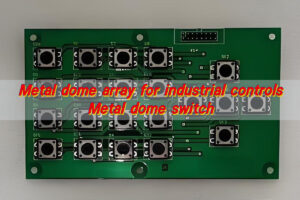
In industrial applications, reliability is non-negotiable. Metal domes must endure repeated actuation cycles, fluctuating temperatures, and sometimes harsh environmental exposure. The most widely used base material is stainless steel, specifically precision-grade variants designed for spring performance.
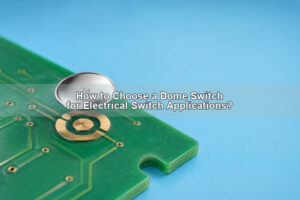
Stainless steel offers a unique combination of mechanical strength and corrosion resistance. It can flex millions of times without permanent deformation, which makes it ideal for tactile switch applications. In industrial switches, domes are typically manufactured using austenitic stainless steel, such as SUS301 or SUS304, with SUS301 being the more common choice due to its superior spring properties.
The reason stainless steel dominates is its ability to maintain consistent tactile feedback. When a user presses a metal dome button, the dome collapses and rebounds instantly. This action depends heavily on the material’s elastic modulus and fatigue strength. Lower-grade metals simply cannot deliver the same crisp and repeatable response.
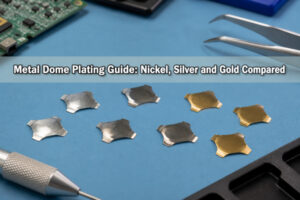
In addition to stainless steel, surface treatments are often applied to enhance conductivity and durability. Nickel plating, gold plating, or silver plating can be used depending on the application requirements. These coatings reduce contact resistance and improve signal reliability, especially in low-voltage circuits.
From a manufacturing perspective, companies like EBest Circuit (Best Technology) optimize material selection based on end-use scenarios. For example, industrial control panels may prioritize durability and temperature resistance, while handheld devices may require thinner domes with lighter actuation force.
How to make a metal dome?
The production of a metal dome is a precise and multi-stage process. It is not simply stamped metal—it is engineered through controlled forming, heat treatment, and finishing processes to achieve the desired tactile characteristics.
The typical manufacturing process includes:
- Material selection and preparation
High-quality stainless steel sheets are selected based on thickness, hardness, and grain structure. The sheet must be uniform to ensure consistent dome performance. - Stamping and forming
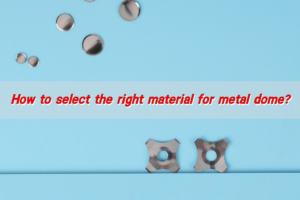
Using high-precision dies, the metal sheet is stamped into dome shapes. The geometry—whether four-leg, triangle, or round—affects actuation force and tactile ratio. - Heat treatment
After forming, domes undergo heat treatment to enhance elasticity and relieve internal stress. This step is critical for ensuring long-term durability. - Surface plating
Conductive coatings such as nickel or gold are applied. This improves electrical performance and protects against oxidation. - Cleaning and inspection
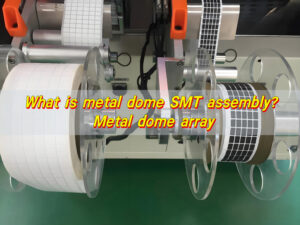
Each dome is cleaned to remove contaminants and inspected for dimensional accuracy and surface quality. - Packaging (bulk or tape & reel)
Advanced manufacturers, including EBest Circuit (Best Technology), offer tape & reel packaging for automated SMT placement. This method significantly improves assembly efficiency and alignment precision.
The entire process demands tight tolerances. Even a slight variation in thickness or curvature can change the actuation force and tactile feel. That’s why experienced manufacturers invest heavily in tooling precision and quality control systems.

What is the complete material composition of the metal dome?
A metal dome is more than just a piece of stainless steel. Its full composition includes multiple layers and supporting materials that work together to deliver reliable performance.
At its core, the composition typically includes:
- Base metal (stainless steel)
This forms the structural body of the dome. It provides elasticity, strength, and fatigue resistance. - Surface plating layer
Conductive coatings such as nickel, gold, or silver are applied to improve electrical conductivity and reduce oxidation. - Adhesive carrier (for arrays)
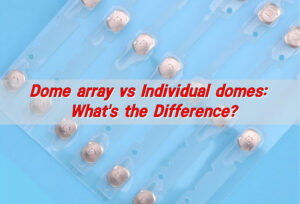
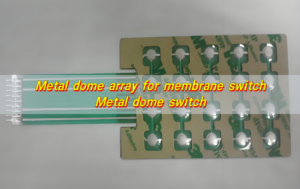
In metal dome arrays, domes are mounted on PET (polyester) films with pressure-sensitive adhesive. This layer ensures accurate positioning and simplifies assembly. - Spacer layer (optional)
In some designs, a spacer is used to maintain a consistent gap between the dome and the PCB. - Protective film
A top protective layer may be added to prevent contamination and mechanical damage during handling and assembly.
These components form a complete system rather than a standalone part. The interaction between layers determines the final performance. For example, the adhesive layer must be strong enough to hold the dome in place but flexible enough not to interfere with its movement.
EBest Circuit (Best Technology) integrates these materials into customized solutions, ensuring that each layer is optimized for the specific application. Our ability to control material composition at a micro level is one of the reasons their products achieve high reliability across industries.
Is stainless steel the most common metal dome base material?
Yes, stainless steel is by far the most common base material for metal domes, and for good reason. Its mechanical and chemical properties align perfectly with the requirements of tactile switching.
To better understand why stainless steel stands out, here is a comparison with other potential materials:
| Property | Stainless Steel (SUS301) | Phosphor Bronze | Beryllium Copper |
|---|---|---|---|
| Elasticity | Excellent | Good | Excellent |
| Fatigue Resistance | Very high | Moderate | Very high |
| Corrosion Resistance | Excellent | Moderate | Good |
| Cost | Moderate | Moderate | High |
| Conductivity | Moderate | Good | Excellent |
| Manufacturability | High | Moderate | Complex |
While materials like beryllium copper offer superior conductivity, they come with higher costs and stricter handling requirements. Phosphor bronze is easier to work with but lacks the long-term fatigue resistance needed for high-cycle applications.
Stainless steel strikes the right balance. It is cost-effective, durable, and easy to process at scale. That’s why it remains the preferred choice for most metal dome manufacturers.
Which raw material improves the durability of metal dome switch?
Durability in a metal dome switch is primarily influenced by the base metal and its treatment process. Among all options, SUS301 stainless steel with proper heat treatment delivers the best durability.
However, durability is not just about the base material. It is a combination of several factors:
- Material hardness and thickness
Thicker domes generally last longer but require higher actuation force. - Heat treatment quality
Proper heat treatment enhances fatigue life and prevents deformation. - Surface coating
Gold or nickel plating reduces wear and oxidation, extending lifespan. - Design geometry
Dome shape affects stress distribution during actuation.
High-end manufacturers like EBest Circuit (Best Technology) optimize all these factors together. Our domes can exceed one million actuations, making them suitable for demanding applications such as medical devices and industrial controls.

What material options are available for custom metal dome button?
Customization is a key advantage in modern electronics manufacturing. Different applications require different tactile responses, environmental resistance, and electrical properties. As a result, several material options are available for custom metal dome buttons.
Common options include:
- Stainless steel (SUS301, SUS304)
The standard choice for most applications. - Gold-plated domes
Ideal for low-current circuits requiring stable conductivity. - Nickel-plated domes
Cost-effective and suitable for general-purpose use. - Silver-plated domes
Offers good conductivity with moderate cost. - PET carrier films
Used in dome arrays for precise positioning and insulation. - Adhesive types
Different adhesives are available depending on temperature and humidity requirements.
Customization also extends to dome thickness, diameter, and actuation force. EBest Circuit (Best Technology) provides OEM and ODM services, allowing clients to tailor every aspect of the dome design to their product needs.
Does different metal dome material change service lifespan?
Material selection has a direct impact on service lifespan. Even small differences in composition or treatment can significantly affect how long a dome performs reliably. For example, a dome made from untreated stainless steel may lose its elasticity after repeated use. In contrast, a properly heat-treated SUS301 dome can maintain performance for over one million cycles.
Surface coatings also play a role. Gold-plated domes resist oxidation better than uncoated ones, which is especially important in humid environments. Similarly, thicker domes tend to last longer but may not be suitable for applications requiring a light touch.
In real-world applications, lifespan is influenced by:
- Actuation frequency
- Environmental conditions (temperature, humidity, dust)
- Electrical load
- Mechanical design
By carefully selecting the right material and design, manufacturers can significantly extend the service life of a metal dome switch.
How to choose suitable metal dome material for long-term use?
Choosing the right material is a strategic decision that balances performance, cost, and application requirements. There is no one-size-fits-all solution, but a structured approach can simplify the process.
Start by considering the application environment. Industrial settings may require higher corrosion resistance and durability, while consumer electronics may prioritize tactile feel and compact size.
Next, evaluate performance requirements:
- Required lifespan (number of cycles)
- Actuation force and tactile ratio
- Electrical conductivity needs
- Operating temperature range
Material selection should align with these requirements. For example, SUS301 stainless steel with gold plating is ideal for high-reliability, low-current applications.
It is also important to work with an experienced manufacturer. EBest Circuit (Best Technology), with over 20 years of expertise, offers technical guidance and rapid response support. Our ability to deliver customized solutions with tight tolerances ensures consistent performance in long-term use.
Finally, consider manufacturing efficiency. Tape & reel packaging, for instance, can improve assembly speed and reduce labor costs. This is particularly valuable for high-volume production.

Summary:
Metal domes are small components with a significant impact on product performance. Their effectiveness depends heavily on material selection, manufacturing precision, and design optimization. Stainless steel remains the dominant base material due to its excellent balance of elasticity, durability, and cost-effectiveness. However, surface coatings, adhesive layers, and customization options all contribute to the final performance.
For professional support and customized solutions, you can reach out to EBest Circuit (Best Technology) at sales@metal-domes.com. Our team provides expert guidance, fast sampling, and high-quality manufacturing tailored to your application needs.