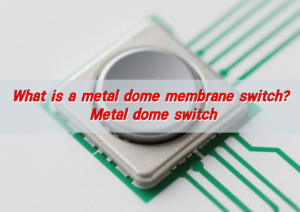

A waterproof dome switch is a tactile switch structure designed to keep moisture away from the electrical contact area. It is commonly used in control panels, handheld devices, outdoor equipment, medical keypads, industrial instruments, and other products where the user still needs a crisp click feel in a humid, washable, or splash-prone environment.
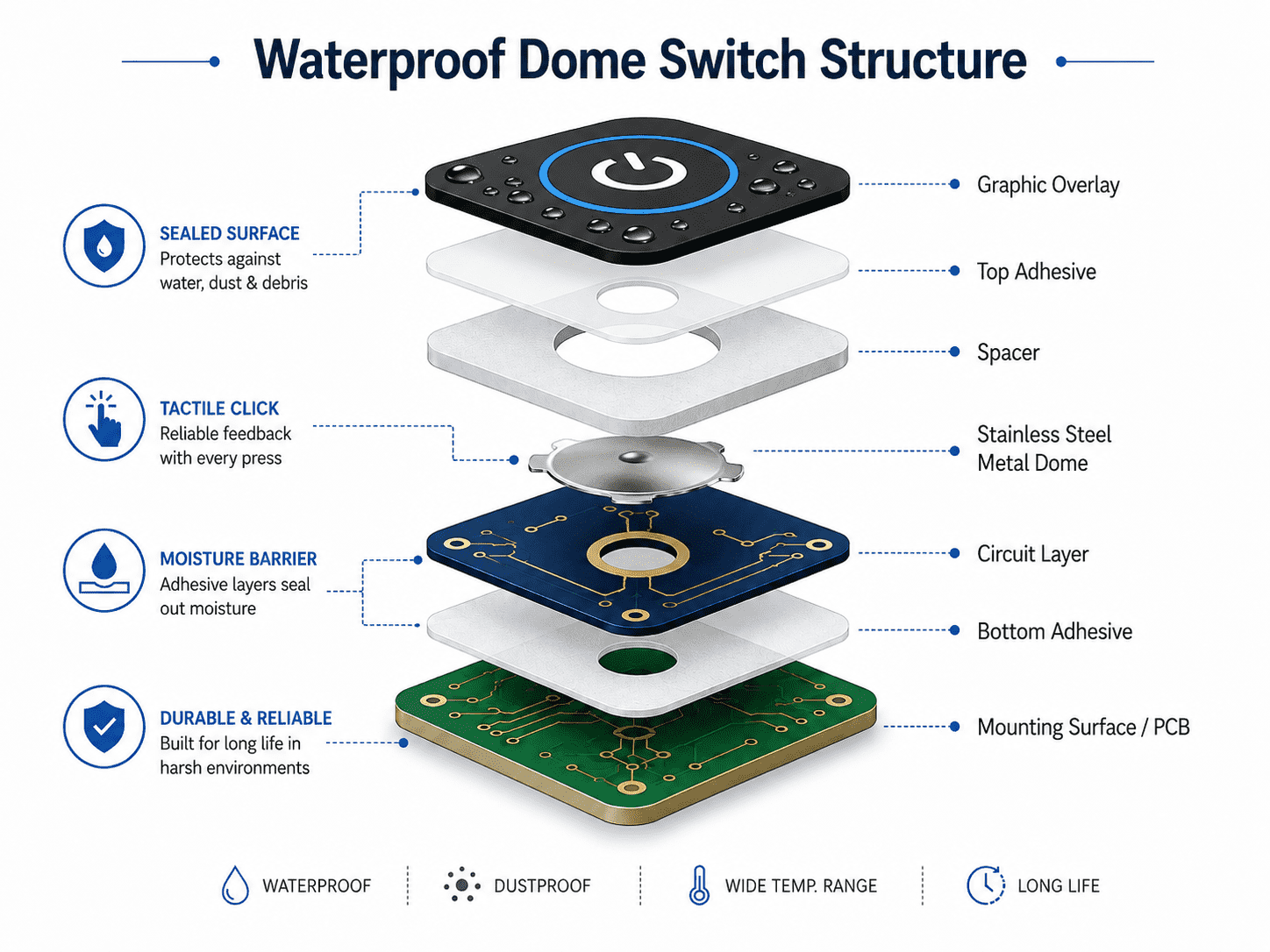
The key point is simple: a dome switch is not waterproof only because it uses a metal dome. Waterproof performance comes from the full switch stack-up, including the overlay, adhesive, spacer, circuit layer, dome design, tail exit, enclosure fit, and final sealing method. In real projects, customers should define the use environment first, then decide whether a waterproof dome switch is necessary, how much sealing is required, and which material combination makes sense.
What is a waterproof dome switch?
A waterproof dome switch is a sealed tactile switch that uses a dome-shaped actuator, usually a metal dome or rubber dome, to create electrical contact when pressed. The waterproof function is achieved by isolating the circuit and contact area from water, sweat, cleaning liquid, dust, and moisture.
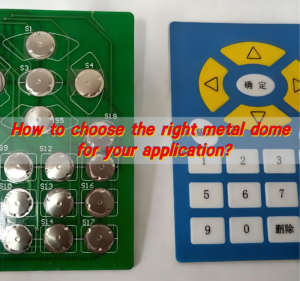
In a typical metal dome switch, the dome sits above conductive pads on a PCB, FPC, or PET circuit. When the user presses the button area, the dome collapses and touches the center contact. When the force is removed, the dome returns to its original shape. This creates the familiar tactile “snap.”
A waterproof design normally includes:
- A sealed graphic overlay or silicone/rubber keypad surface
- Pressure-sensitive adhesive around the active area
- A spacer layer that positions the dome correctly
- A sealed circuit layer, often PET, FPC, or PCB
- A protected tail exit or connector area
- Optional gasket, venting, shielding, or enclosure compression
For customer evaluation, the most important question is not only “Is it waterproof?” A better question is: What liquid exposure must the switch survive, and for how long?
For example, a kitchen appliance keypad may need resistance to water drops, grease, and wiping. An outdoor controller may need rain exposure and UV-resistant overlay material. A medical keypad may need compatibility with cleaning agents. These are different design conditions.
Ingress protection should be verified against a defined rating or test method. IP testing is used to validate how well an enclosure or product resists dust and water ingress, especially in harsh environments.
How to make a switch waterproof?
A switch becomes waterproof when every possible ingress path is controlled. In dome switch products, leakage usually happens at the edge seal, tail exit, connector area, dome cavity, screw holes, LED windows, or poorly bonded overlay edges.
The design logic is direct: seal the surface, seal the perimeter, protect the circuit, and control the exit path.
| Waterproof design area | Practical function | Engineering note |
|---|---|---|
| Overlay surface | Blocks water from the top side | Polyester, polycarbonate, silicone, or rubber may be used depending on wear, UV, and chemical exposure |
| Perimeter adhesive | Creates the main seal around the switch | Adhesive must be continuous, with enough width and compression |
| Spacer layer | Keeps dome movement stable | Poor spacer thickness can affect tactile force and sealing |
| Tail exit | Prevents liquid from entering along the circuit tail | Tail filler, potting, or mechanical sealing may be needed |
| Enclosure gasket | Seals the switch to the housing | Important for outdoor, medical, and industrial panels |
| Connector area | Protects electrical interface | Often the weakest point if left open |
| Testing | Confirms sealing performance | IP target, spray test, immersion test, wipe test, or customer-specific test may be used |
A continuous adhesive perimeter is especially important. In membrane switch construction, moisture protection often depends on a full perimeter seal, and the tail exit may need a filler or shim to prevent a gap in the adhesive path.
Customers should avoid choosing “maximum waterproofing” automatically. A higher sealing level may increase cost, thickness, stiffness, tooling requirements, and assembly tolerance control. For indoor equipment with occasional wiping, a simple sealed overlay may be enough. For outdoor instruments, an IP-rated structure with tested enclosure integration is more appropriate.
For quotation, it is useful to provide the target environment clearly: indoor or outdoor use, expected liquid type, cleaning method, working temperature, storage condition, required lifetime, and whether the unit will be exposed to immersion or only splashes.
What is a rubber dome switch?
A rubber dome switch uses a molded elastomer dome, usually silicone rubber, to provide both actuation force and environmental protection. When pressed, the rubber dome collapses and pushes a conductive pill, carbon contact, or actuator feature onto the circuit below.
Rubber dome switches are common in remote controls, industrial panels, medical equipment, automotive keypads, and consumer products. They are useful when the design needs a soft touch, larger key travel, molded key shapes, backlighting features, or integrated sealing.
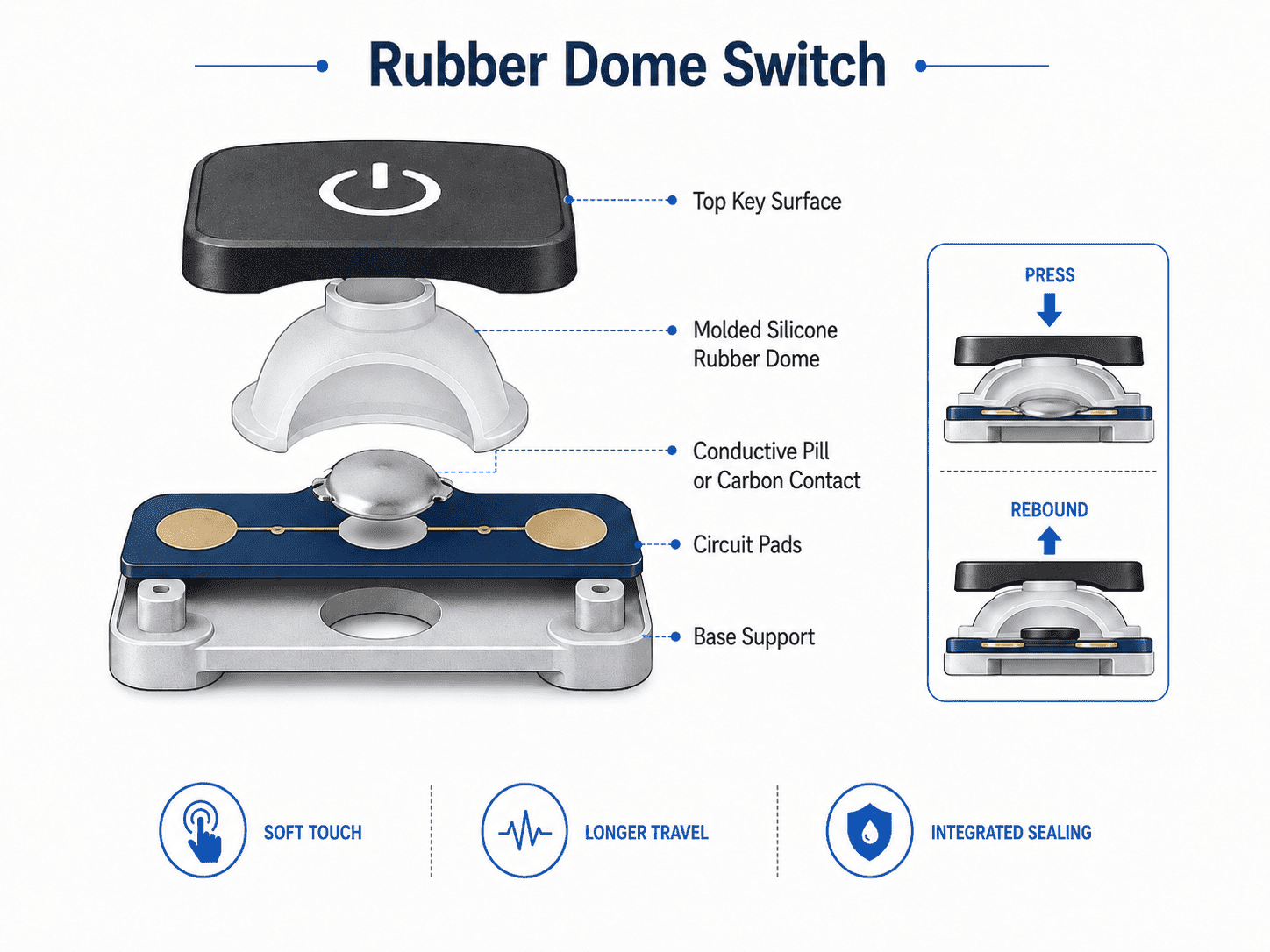
Rubber dome and metal dome switches are not direct replacements. The selection depends on feel, travel, sealing, lifetime, height, tooling cost, and appearance.
| Item | Rubber dome switch | Metal dome switch |
| Tactile feel | Softer, longer travel | Crisp, sharp snap |
| Typical sealing | Good when molded as a keypad or gasket | Depends on overlay, adhesive, spacer, and housing seal |
| Height | Usually taller | Very low profile |
| Tooling | Mold tooling usually required | Lower tooling for dome arrays and membrane structures |
| Visual design | Can form raised buttons | Usually flat overlay or printed key area |
| Force control | Adjusted by rubber geometry | Adjusted by dome diameter, shape, thickness, and material |
| Common use | Remote controls, sealed keypads, appliance controls | Thin panels, medical devices, industrial controls, handheld electronics |
A rubber dome switch is often preferred when the product needs a washable surface, soft key travel, and molded button geometry. A metal dome switch is usually better when the customer wants a thin structure, fast actuation, and a clear tactile response.
What materials are used for waterproof switches?
Waterproof switches use different materials depending on the switch type, operating environment, cost target, and assembly method. A switch used in an outdoor charging device does not need the same material stack as a keypad inside a laboratory instrument.
Common waterproof switch materials include:
- Polyester overlay: Good flex life, stable printing performance, suitable for membrane switches and dome switch overlays.
- Polycarbonate overlay: Easy to print and form, but may be less suitable for repeated flexing or chemical exposure.
- Silicone rubber: Suitable for molded keypads, soft touch, sealing lips, and gasket structures.
- Acrylic adhesive: Common in membrane switch bonding and overlay attachment.
- PET circuit layer: Used in flexible membrane circuits and dome arrays.
- FPC: Suitable when fine routing, bending, or compact installation is required.
- FR4 PCB: Used when the switch is part of a larger rigid control board or PCBA.
- Stainless steel dome: Provides crisp tactile feedback and good mechanical resilience.
- Nickel-plated or gold-plated contacts: Used when lower contact resistance, corrosion resistance, or signal stability is required.
- Foam or rubber gasket: Used between the switch and enclosure.
- Epoxy or silicone potting: Used for connector, tail, or edge protection when required.
Material choice should follow the product environment. For outdoor applications, UV resistance and adhesive aging matter. For medical devices, cleaning-agent resistance matters. For industrial products, oil, dust, vibration, and glove operation may matter more than appearance.
EBest Circuit usually recommends reviewing the full stack-up before prototype tooling. A small change in overlay thickness, spacer height, adhesive type, or dome force can change both waterproof performance and tactile feel.
Is the metal dome switch waterproof?
A metal dome switch is not automatically waterproof. The metal dome itself is only the tactile contact element. Waterproofing comes from the layers around it.
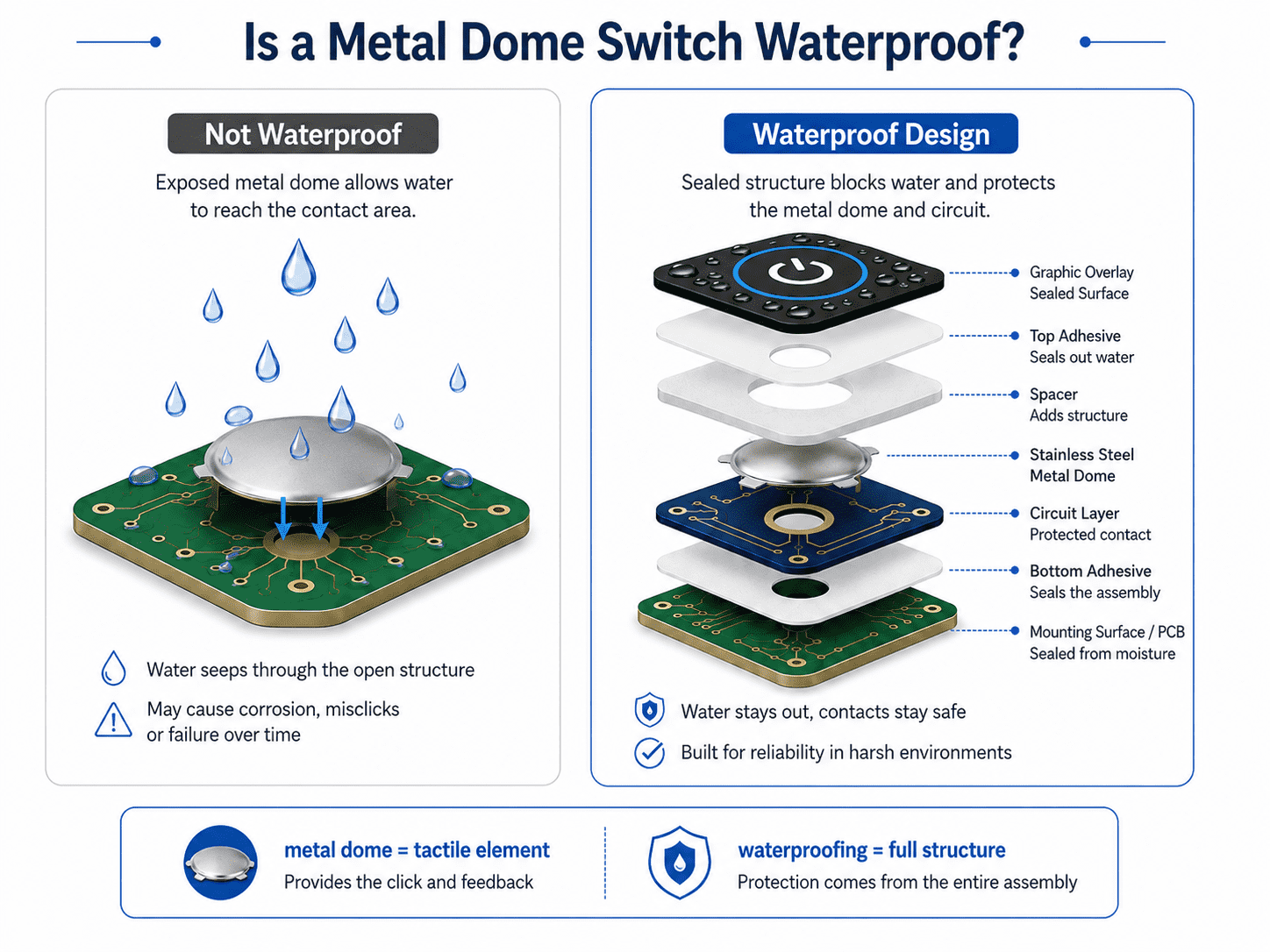
A metal dome can be used inside a waterproof switch structure when the dome is protected by a sealed overlay, membrane, adhesive frame, or enclosure. Keyelco notes that dome switches can be pressed through a thin flexible membrane that may be sealed against the product chassis to protect the circuitry from cleaning fluids, dust, or weather.
This distinction is important for purchasing. If a supplier says “metal dome switch,” the customer should ask whether they mean:
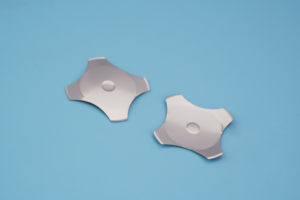
- Loose metal domes
- Metal dome array with adhesive sheet
- Metal dome on PCB
- Metal dome membrane switch
- Waterproof metal dome switch assembly
- Complete keypad with enclosure sealing
Only the last few options may offer meaningful water resistance. Loose domes and open PCB-mounted domes are usually not waterproof unless the final product enclosure provides protection.
For practical selection, customers should define:
- Required actuation force, such as 160 gf, 250 gf, 350 gf, or custom force
- Dome diameter and travel
- Circuit type: PCB, FPC, or PET
- Expected operating cycles
- Contact plating requirement
- Required waterproof level or test condition
- Overlay material and printing requirement
- Tail length, connector type, and assembly direction
For EBest Circuit, this information helps engineers check whether the dome feel, sealing path, circuit layout, and assembly process are aligned before production.
Do metal domes rust?
Most metal domes are made from stainless steel, but stainless steel does not mean “rust-proof under every condition.” It resists corrosion because of a passive chromium oxide layer on the surface. Under harsh conditions, such as salt mist, trapped moisture, chemical residue, damaged plating, or poor storage, corrosion can still occur. A metal dome manufacturer also explains that stainless steel domes resist visible rust through the formation of a chromium oxide surface layer.
In normal indoor electronics, stainless steel domes are reliable and widely used. For humid, outdoor, marine, medical, or industrial environments, additional protection may be needed.
| Condition | Risk level | Better design choice |
| Dry indoor control panel | Low | Standard stainless steel dome |
| Handheld device exposed to sweat | Medium | Stainless steel dome with sealed overlay |
| Outdoor keypad | Medium to high | Sealed structure, gasket, corrosion-resistant contacts |
| Medical cleaning environment | Medium to high | Chemical-resistant overlay and sealed tail/edge |
| Marine or salt-spray exposure | High | Enhanced sealing, suitable plating, validated corrosion testing |
| Open PCB with exposed dome | High | Avoid if moisture is expected |
Gold plating may improve contact stability in low-current signal applications, but it does not replace sealing. Nickel plating may help wear and corrosion resistance in some designs, but the complete switch structure still determines field reliability.
Storage also matters. Domes should be stored in dry conditions before assembly. Fingerprints, flux residue, ionic contamination, or trapped moisture can reduce long-term reliability. During PCBA design, the dome contact area should be kept clean and compatible with the selected surface finish.
What Materials Are Used in Waterproof Dome Switches?
A waterproof dome switch is a layered structure. Each layer has a job. The wrong material in one layer can create failures even when the rest of the design looks correct.
| Layer or component | Common material | Main function | Selection concern |
| Graphic overlay | PET, PC, silicone rubber | User interface, printing, top-side protection | Abrasion, UV, chemical resistance, embossing |
| Top adhesive | Acrylic PSA | Bonds overlay to spacer or circuit | Bond strength, water resistance, temperature range |
| Spacer | PET, adhesive spacer, die-cut film | Creates dome cavity and key travel | Thickness, compression, dome clearance |
| Metal dome | Stainless steel, plated stainless steel | Tactile response and electrical actuation | Force, diameter, lifetime, corrosion resistance |
| Circuit layer | PET, FPC, FR4 PCB | Carries switch signal | Routing density, bending, contact finish |
| Contact surface | Carbon, silver, ENIG, nickel/gold | Electrical contact area | Contact resistance, wear, oxidation |
| Back adhesive | Acrylic PSA, foam adhesive | Mounts switch to housing | Surface energy, roughness, compression |
| Gasket/seal | Silicone, rubber, foam | Blocks liquid at housing interface | Compression set, tolerance, aging |
| Tail protection | Tail filler, epoxy, silicone, boot | Seals the cable or tail exit | Often critical for IP-rated designs |
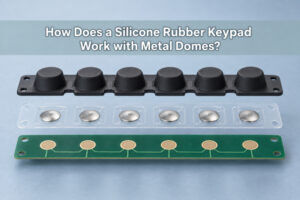
For thin waterproof dome switches, PET overlay and PET spacer are common. For more complex products, FPC or PCB may be used under the dome. For rugged applications, a molded silicone keypad can sit above the metal dome array or PCB.
A practical purchasing decision should consider both performance and manufacturability. A very thin switch may feel better and look cleaner, but it leaves less room for adhesive width and gasket compression. A very thick seal may improve water resistance, but it can reduce tactile sharpness. The best design balances sealing, touch feel, panel thickness, assembly tolerance, and cost.
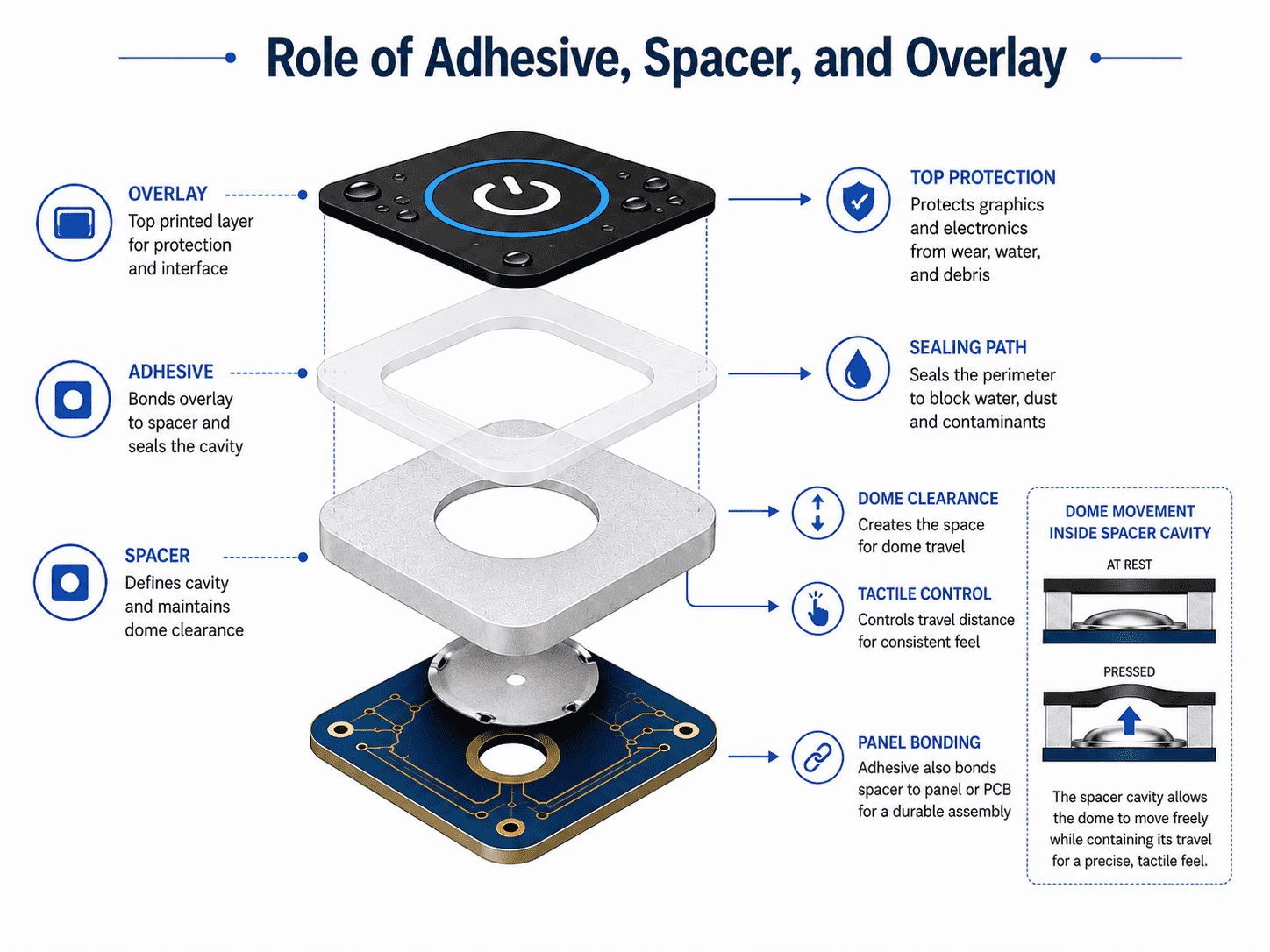
What Is the Role of Adhesive, Spacer, and Overlay Layers?
The adhesive, spacer, and overlay layers are the core of a waterproof dome switch. They determine whether the switch feels good, bonds reliably, and blocks water in real use.
Adhesive layer
The adhesive layer bonds the switch stack together and forms the sealing path. For waterproof designs, adhesive should not be treated as a simple mounting tape. It must be wide enough, continuous enough, and compatible with the overlay, spacer, circuit layer, and enclosure surface.
Important adhesive checks include:
- Bonding surface: metal, plastic, painted housing, rubber, glass, or coated panel
- Surface roughness and cleanliness
- Operating temperature range
- Exposure to water, detergent, oil, sweat, or disinfectant
- Required adhesive thickness
- Edge-seal width
- Long-term aging and compression
A narrow adhesive frame may save space, but it can create leakage risk. For compact devices, engineers should review the minimum sealing width early, not after the mechanical housing is finished.
Spacer layer
The spacer creates the cavity where the dome moves. It controls dome clearance, key travel, and tactile response. If the spacer is too thin, the dome may preload or lose snap feel. If it is too thick, the user may feel delayed actuation or unstable response.
For waterproof structures, the spacer also helps manage liquid path control. Die-cut accuracy matters because open channels, sharp corners, or incomplete adhesive contact can weaken the seal.
Overlay layer
The overlay is the visible and touchable surface. It protects the switch from the top side and carries the printed graphics. PET is widely used for membrane switch overlays because it offers good flex durability. PC can provide good print quality and appearance, but the final choice should consider flexing, chemicals, and expected wear.
Overlay design also affects customer experience. Embossed keys can improve finger location. Matte texture can reduce glare. Transparent windows may support LEDs, but they introduce design details around light diffusion, adhesive appearance, and sealing edges.
For quotation, customers should provide:
- Product drawing or switch outline
- Key quantity, size, and layout
- Required actuation force and tactile feel
- Waterproof target or test condition
- Overlay material, color, texture, and printing file
- Circuit type: PET, FPC, or PCB
- Tail length, connector type, and pinout
- Expected operating environment
- Annual quantity and prototype quantity
- Any cleaning, chemical, UV, or outdoor exposure requirement
These details help avoid unnecessary redesign after sampling. They also help the manufacturer decide whether a simple dome array, sealed membrane dome switch, rubber keypad plus PCB, or full waterproof control panel is the most practical option.
Conclusion
A waterproof dome switch is not defined by one part alone. The metal dome provides tactile feedback, but the waterproof performance comes from the complete structure: overlay, adhesive, spacer, circuit layer, tail exit, gasket, enclosure fit, and testing method.
For indoor devices, a sealed overlay and stable adhesive structure may be enough. For outdoor, medical, industrial, or washable products, the design should be reviewed as a full assembly. Customers should define the liquid exposure, target protection level, operating environment, material preferences, tactile force, and quotation files before ordering.
EBest Circuit can support waterproof dome switch projects from material review and prototype evaluation to PCB, FPC, dome array, membrane switch, and PCBA integration. For drawings, samples, or quotation support, please contact sales@metal-domes.com.