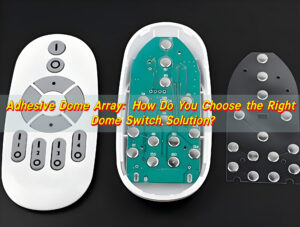

High-quality adhesive metal dome array with reliable pressure-sensitive adhesive, suitable for fast SMT and manual assembly in various electronic devices.
What is an adhesive metal dome array?
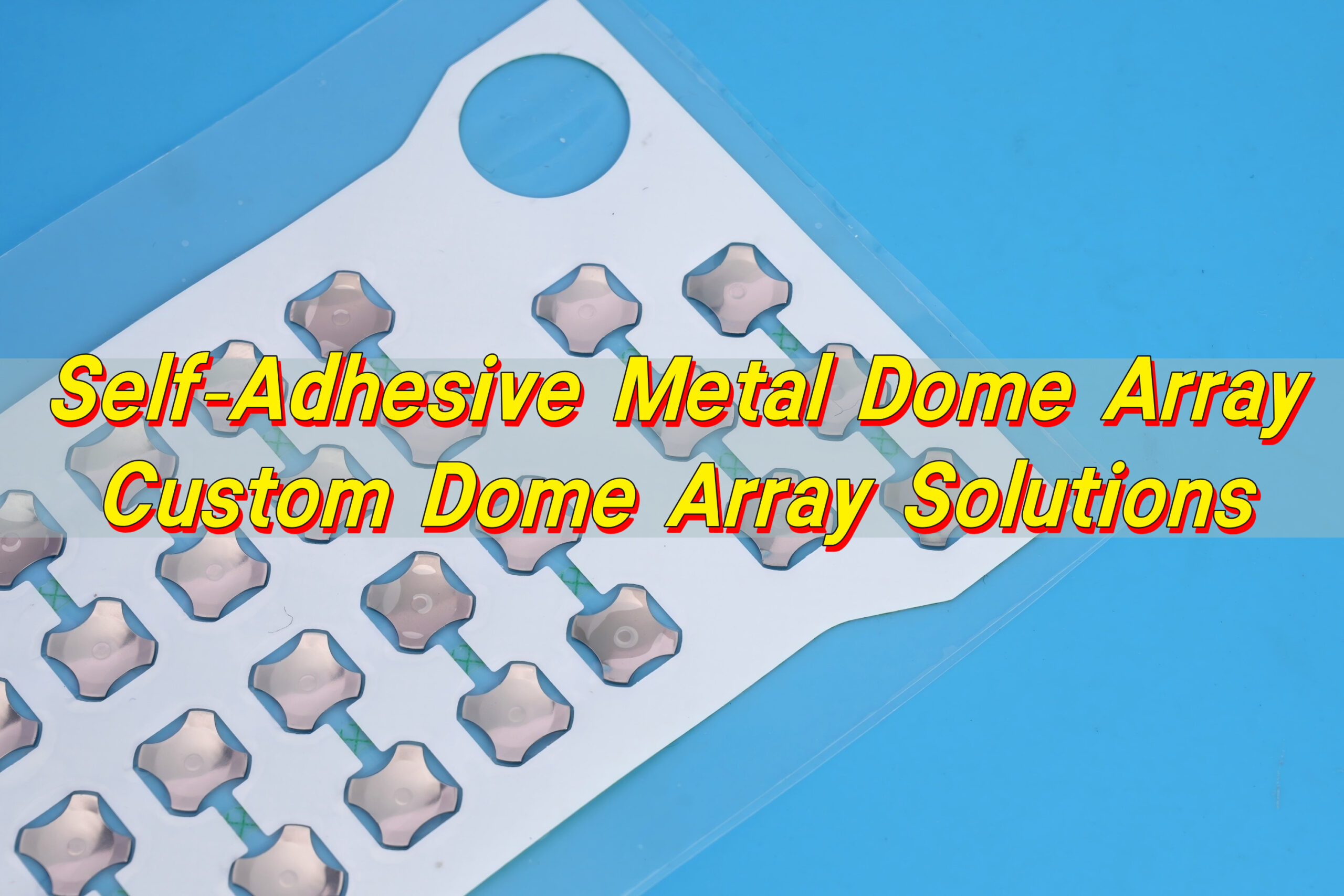
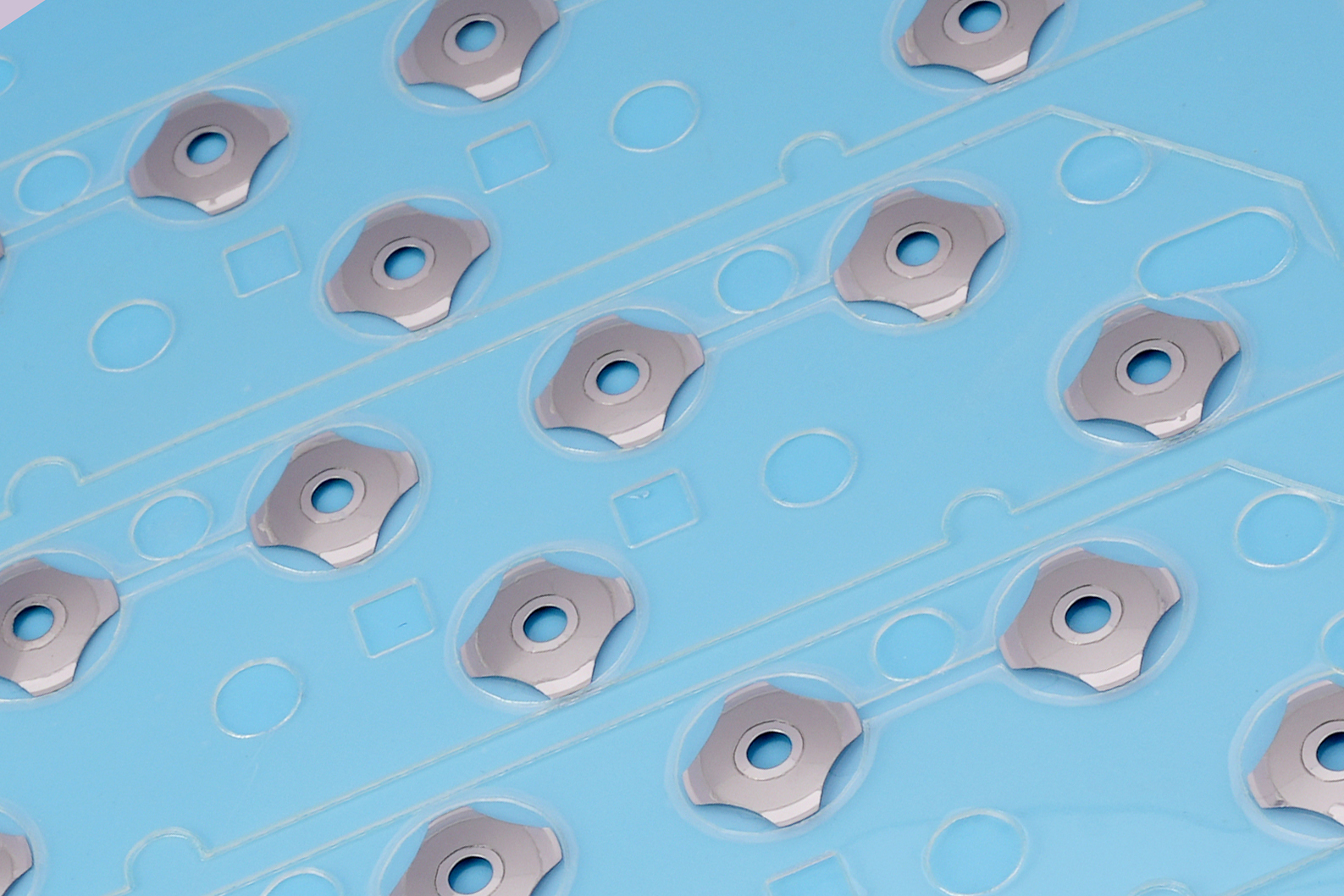
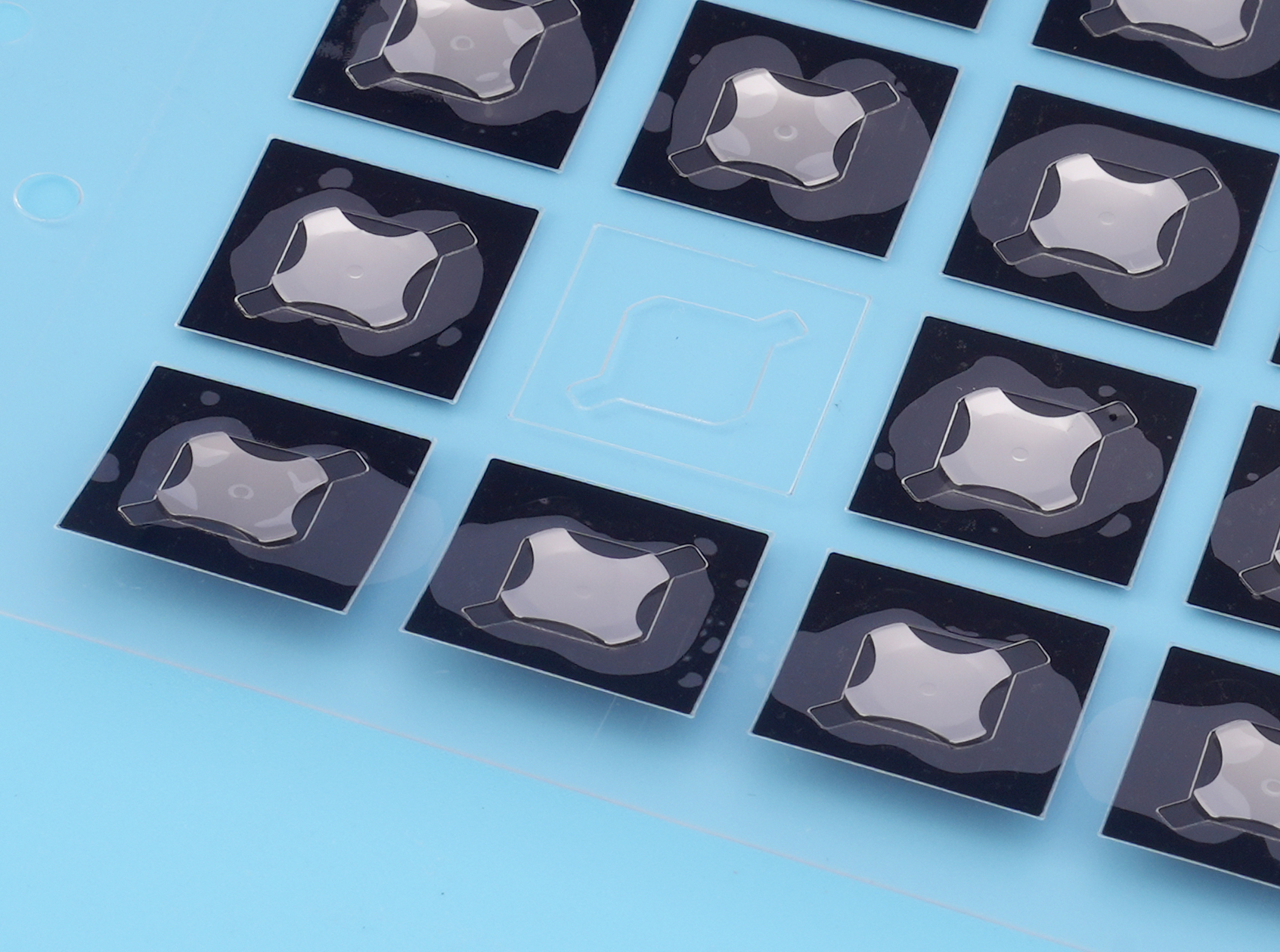
An adhesive metal dome array is a thin component used in electronic switch structures. It holds several metal domes in fixed positions using an adhesive layer. Each dome acts as a tactile switch that creates electrical contact when pressed. The adhesive backing allows the array to stay firmly aligned on a circuit board or switch contact pattern.
In many electronic devices, metal domes must sit exactly over contact pads. If their position shifts even slightly, the switch may fail or produce unstable signals. An adhesive dome array solves this challenge by keeping every dome securely placed during assembly and operation.
Most arrays use a thin PET film as the carrier layer. Metal domes are positioned in accurate locations and covered by protective layers. On the back side, an adhesive layer attaches the structure to the PCB or membrane switch circuit. Because the domes are pre-arranged, installation becomes faster and more reliable.
The structure usually contains several layers working together:
- PET carrier film that holds the domes in place
- Metal domes that provide tactile feedback and electrical contact
- Adhesive backing that secures the array to the circuit surface
- Release liner that protects the adhesive until installation
This simple but effective design helps manufacturers reduce assembly time while maintaining precise dome alignment. In high-volume production, that consistency is extremely valuable. Compared with placing loose domes individually, a pre-aligned array improves efficiency and accuracy. Assemblers do not need to manually adjust each dome. Instead, they place the entire array in a single step.
Self-adhesive arrays are widely used in compact electronic products. Examples include remote controls, handheld instruments, medical devices, industrial control panels, and consumer electronics. These products require reliable tactile switches with stable electrical contact. A well-designed array also improves product durability. The adhesive layer stabilizes the dome position during repeated pressing. When the switch is pressed, the dome collapses and rebounds thousands or even millions of times. The adhesive layer prevents lateral movement and keeps the contact consistent.
Manufacturers often customize these arrays based on the device design. Dome size, actuation force, spacing, and adhesive type can all be tailored. This flexibility allows the switch system to match the performance and feel required by the product. For example, some products require a soft and responsive touch. Others require a stronger tactile response to avoid accidental activation. By adjusting the dome structure and adhesive configuration, engineers can achieve the desired switch behavior.
Companies like EBest Circuit (Best Technology) specialize in manufacturing customized dome arrays for global electronics brands. With precise tooling and quality inspection, We ensure the dome placement accuracy and long-term reliability required in modern electronic products.
In short, an adhesive metal dome array is a practical and efficient solution for tactile switch design. It combines precise dome positioning, fast assembly, and reliable switching performance in one compact component.
What are the benefits of adhesive metal dome arrays?
Adhesive metal dome arrays offer several advantages in electronic switch assembly. Their design simplifies installation, improves alignment accuracy, and enhances overall product reliability. Manufacturers prefer these arrays because they streamline the production process while maintaining stable performance.
One of the biggest advantages is precise positioning. Each dome sits exactly over the contact pads, which helps maintain consistent electrical signals. Since the domes are pre-aligned on a carrier film, the risk of misplacement during assembly becomes very low.
Another benefit is faster production speed. Instead of installing domes individually, technicians place the entire array at once. This reduces labor time and improves assembly efficiency, especially in large-scale manufacturing environments.
Adhesive arrays also help maintain stable switch performance over time. The adhesive layer holds the array firmly in position, preventing movement during repeated pressing cycles.
Key benefits include:
- Accurate dome alignment during assembly
- Reduced installation time compared with loose domes
- Improved switch reliability and electrical stability
- Cleaner assembly process with fewer handling errors
- Better protection for delicate metal domes
Another major advantage is improved product durability. The adhesive layer helps absorb mechanical stress that occurs during pressing. This support protects the domes and maintains consistent tactile feedback.
From a design perspective, adhesive arrays allow engineers to build thinner and more compact switch structures. Many modern devices demand slim profiles and lightweight construction. The thin PET film used in these arrays fits well within these requirements.
Adhesive arrays also contribute to a better user experience. When domes are positioned correctly, the tactile feedback remains uniform across all keys. This consistency is important for devices that rely on frequent button interactions.
Manufacturers also benefit from simplified quality control. Because the domes are arranged in a controlled process during production, the final assembly becomes more predictable. This reduces the chance of switch failures later in the product life cycle.
In addition, adhesive dome arrays can be customized easily. Dome force, size, spacing, and film thickness can be adjusted to suit different applications.
For example, an industrial control panel may require strong tactile feedback, while a medical handheld device may require a softer touch. Custom dome arrays make these adjustments possible.
With advanced manufacturing capabilities, companies like EBest Circuit (Best Technology) provide tailored solutions that match the performance requirements of various electronic products. Their arrays are produced under strict quality standards to ensure consistent tactile response and long operational life.
Overall, adhesive metal dome arrays provide a powerful combination of efficiency, precision, and durability. These advantages make them a preferred choice for many modern electronic switch designs.
How to install an adhesive metal dome array correctly?
Correct installation plays a key role in achieving stable switch performance. Even though adhesive arrays simplify assembly, proper handling ensures the domes function smoothly and maintain their tactile response.
Before installation, the circuit surface should be clean and free from dust or oil. Contaminants can reduce adhesive bonding and affect electrical contact. Many manufacturers clean the PCB surface using alcohol or approved cleaning solutions before applying the array.
Proper alignment is also important. The dome array must match the contact pattern on the circuit board. Since the domes are pre-positioned on the carrier film, careful placement ensures that each dome sits exactly over the corresponding contact pad.
The installation process generally follows several simple steps:
- Prepare the PCB surface by removing dust and residue.
- Peel off the release liner that protects the adhesive layer.
- Align the dome array with the contact pads on the circuit.
- Gently place the array onto the PCB without shifting the domes.
- Apply light pressure to secure the adhesive evenly.
During installation, excessive pressure should be avoided. Strong force may deform the domes or affect their tactile performance. A smooth and even press is usually enough to bond the adhesive layer.
Temperature and humidity can also influence the bonding quality. Controlled assembly environments often produce the most reliable results. Many electronics manufacturers install dome arrays in clean production areas to maintain consistency.
Another useful practice is visual inspection after installation. Checking the alignment ensures every dome is positioned correctly. Any misalignment can be corrected before the next assembly stage.
For automated production lines, alignment fixtures or placement tools are often used. These tools improve positioning accuracy and speed up the installation process.
In high-volume electronics manufacturing, adhesive dome arrays are frequently integrated with membrane switch structures. In these cases, the array sits between the circuit layer and the top overlay. Accurate installation ensures the switch responds smoothly when pressed.
Experienced manufacturers such as EBest Circuit (Best Technology) provide dome arrays designed for easy placement and strong adhesive bonding. Their precise array layouts help engineers integrate the switch system smoothly into the product design.
When installed properly, an adhesive dome array delivers stable switching performance, reliable tactile feedback, and long operational life.
What adhesive is used in metal dome arrays?
The adhesive layer plays a critical role in the performance of a dome array. It secures the array to the circuit surface while maintaining flexibility during repeated switch operations.
Most dome arrays use pressure-sensitive adhesives designed for electronics assembly. These adhesives provide strong bonding without requiring heat or chemical activation. Once pressed onto the circuit surface, they create a stable connection.
One of the most widely used adhesive types is 3M industrial adhesive. This adhesive family offers excellent bonding strength, temperature resistance, and long-term stability. Many electronics manufacturers prefer it for its consistent performance.
Common adhesive materials include:
- Acrylic pressure-sensitive adhesive
- 3M double-sided adhesive films
- High-temperature resistant adhesives
- Electronics-grade bonding films
Each adhesive type has different performance characteristics. Some provide stronger bonding strength, while others focus on temperature resistance or flexibility.
For example, devices operating in high-temperature environments require adhesives that maintain their bonding strength under thermal stress. In contrast, handheld devices often prioritize flexibility and long-term durability.
The PET carrier film used in dome arrays works well with these adhesives. PET provides excellent dimensional stability and resists deformation under normal operating conditions.
The adhesive layer must also maintain stable performance during repeated pressing cycles. When the dome collapses and rebounds, the adhesive should remain secure and prevent the array from shifting.
Different adhesives can be compared more clearly in the following table:
| Adhesive Type | Key Features | Typical Applications |
|---|---|---|
| Acrylic adhesive | Strong bonding and long life | Consumer electronics |
| 3M industrial adhesive | High reliability and temperature stability | Medical and industrial devices |
| High-temperature adhesive | Withstands elevated temperatures | Automotive electronics |
| Flexible bonding film | Maintains elasticity during repeated pressing | Handheld electronics |
Selecting the right adhesive depends on the product design, operating environment, and expected service life.
Reliable manufacturers often test adhesive performance through environmental and durability testing. These tests simulate real operating conditions to ensure the adhesive remains stable over time.
At EBest Circuit (Best Technology), dome arrays can be produced with several adhesive options to match different applications. Engineers evaluate the device structure and recommend a suitable adhesive configuration to support long-term performance.
With the right adhesive system, the dome array maintains stable positioning, smooth tactile feedback, and consistent electrical contact throughout the product lifecycle.
Can adhesive metal dome arrays be reused?
In most situations, adhesive dome arrays are designed for single-use installation. Once the array attaches to a circuit surface, the adhesive forms a stable bond that supports the switch structure.
Removing the array after installation can weaken the adhesive layer. This may reduce bonding strength if the array is applied again. Because of this, reuse is generally not recommended in final production environments.
However, during product development or prototype testing, engineers sometimes remove and reposition dome arrays for evaluation. In these early design stages, reuse may be possible if the adhesive surface remains clean and undamaged.
Even in testing scenarios, careful handling is important. The metal domes are thin and sensitive to mechanical stress. Improper removal could deform the domes or affect their tactile response.
Several factors influence whether reuse might still be possible:
- The condition of the adhesive layer
- The cleanliness of the circuit surface
- Whether the domes remain structurally intact
- The number of previous installation attempts
If the adhesive loses its bonding strength, the array may shift during operation. This can affect switch reliability and create inconsistent contact signals.
Because stable positioning is essential for switch performance, production environments almost always use new dome arrays for each assembly cycle.
Using a new array ensures strong adhesive bonding and correct dome alignment. It also prevents potential switch failures caused by weakened adhesives or damaged domes.
Professional manufacturers design dome arrays with durability in mind. For instance, EBest Circuit (Best Technology) produces arrays tested for long operational life and stable tactile feedback. When installed once in the final product, the array performs reliably throughout its service life.
While limited reuse may occur during development testing, the best practice for production assembly is to use a fresh adhesive dome array. This approach ensures optimal switch reliability and consistent product quality.
How to customize an adhesive metal dome array?
Customization is one of the strongest advantages of metal dome array technology. Electronic devices vary widely in size, function, and switch design. A customized array ensures the dome structure fits perfectly within the product layout.
Several design elements can be tailored during the customization process.
The metal dome type is one of the first decisions. Domes come in different shapes such as round, four-leg, and triangle structures. Each shape provides a slightly different tactile response and actuation force.
Dome size also influences the switch performance. Larger domes typically produce stronger tactile feedback, while smaller domes create a softer response suitable for compact devices.
Important customization parameters include:
- Dome shape and diameter
- Actuation force
- Dome spacing and layout
- PET carrier thickness
- Adhesive type and thickness
The layout design determines how the domes align with the circuit contacts. Precise spacing is required to ensure accurate switching performance. Advanced manufacturing processes can achieve very tight placement tolerances.
Another key factor is tactile force. Different applications require different levels of pressing force. Engineers select the appropriate dome force to balance comfort and responsiveness.
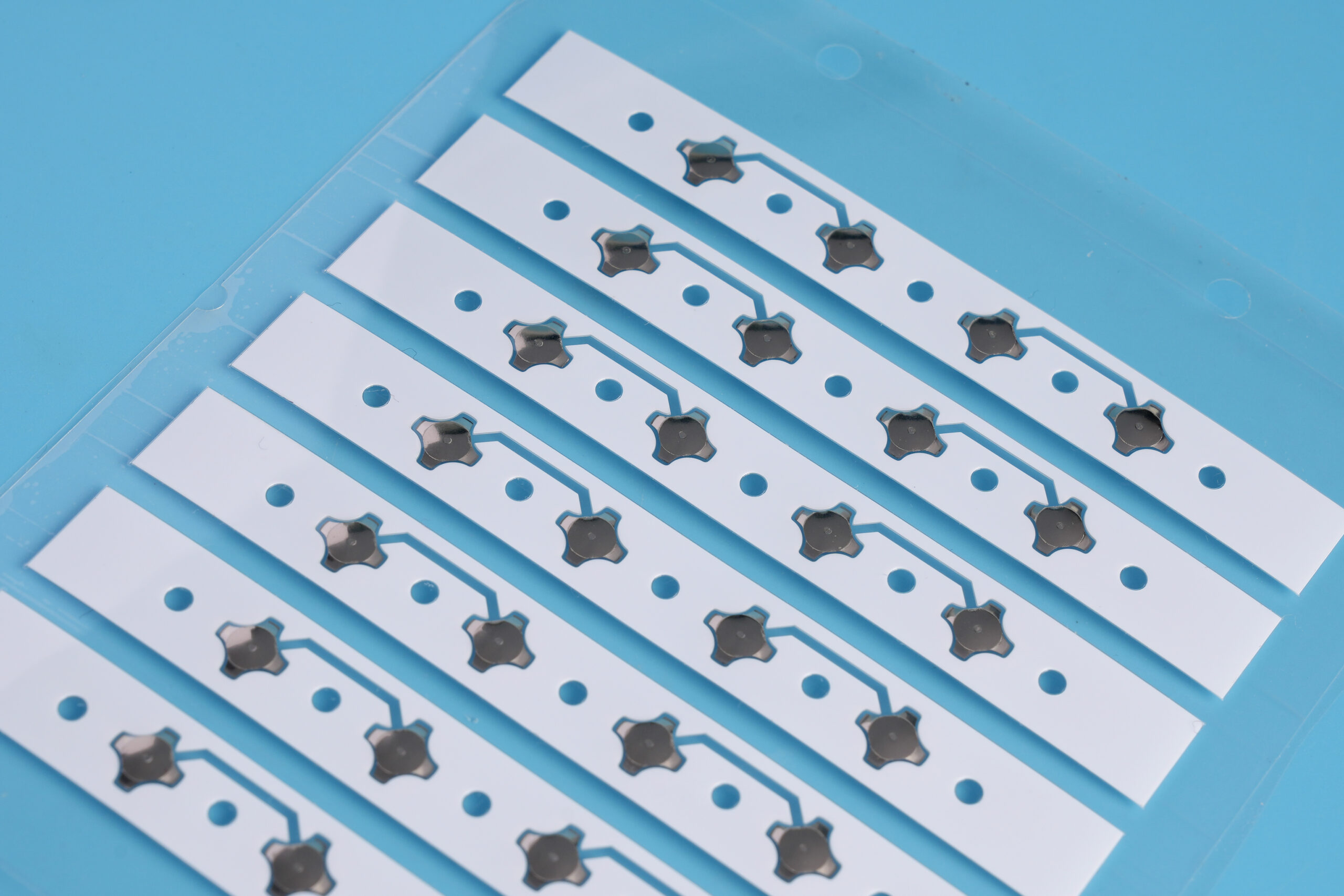
Customization may also include protective layers or additional structural features. Some arrays integrate alignment holes or positioning marks to help with assembly accuracy.
Manufacturers typically collaborate with customers during the design phase. Engineers review the device layout, switching requirements, and environmental conditions before recommending a suitable dome configuration.
Companies like EBest Circuit (Best Technology) provide full customization services for dome arrays. Their engineering team works closely with product designers to optimize dome force, layout accuracy, and adhesive performance.
With careful customization, an adhesive dome array becomes a highly optimized component within the switch system. The final design delivers reliable tactile feedback, stable electrical contact, and efficient assembly performance.
What is the difference between adhesive and non-adhesive dome arrays?
Metal dome arrays can be produced in two main forms: adhesive arrays and non-adhesive arrays. Both types perform the same switching function, but their installation methods and structural features differ.
Adhesive arrays include a bonding layer that attaches the array directly to the circuit surface. Non-adhesive arrays rely on mechanical alignment or other assembly structures to stay in position.
Each approach offers unique advantages depending on the product design and assembly process.
A quick overview of the main differences is shown below:
| Feature | Adhesive Dome Array | Non-Adhesive Dome Array |
|---|---|---|
| Installation method | Bonded to surface using adhesive | Positioned using mechanical alignment |
| Assembly speed | Faster installation | Slower manual alignment |
| Stability during operation | Strong positional stability | May rely on structural support |
| Repositioning ability | Limited after bonding | Easier during assembly |
| Typical applications | Consumer electronics and membrane switches | Specialized industrial assemblies |
Adhesive arrays are widely used in high-volume manufacturing because they simplify installation. The adhesive layer keeps the domes aligned and prevents movement during repeated pressing.
Non-adhesive arrays may be chosen for designs that require removable components or specialized assembly methods. Some engineers prefer them when the switch structure already includes strong mechanical support.
However, many modern electronic products favor adhesive arrays because of their simplicity and reliability. The adhesive layer ensures consistent dome placement, which directly supports stable switch performance.
Manufacturers such as EBest Circuit (Best Technology) produce both types of arrays, allowing engineers to choose the structure that best fits their product design.
What applications use adhesive metal dome arrays?
Adhesive dome arrays appear in many electronic devices that require reliable tactile switches. Their thin profile, accurate alignment, and fast assembly make them suitable for a wide range of industries.
Consumer electronics represent one of the largest application areas. Many handheld devices require compact switches that deliver clear tactile feedback.
Common applications include:
- Remote controls
- Portable medical instruments
- Industrial control panels
- Automotive electronics
- Communication equipment
- Smart home devices
These products often rely on membrane switch technology. The dome array sits between the circuit layer and the top overlay. When the user presses the button, the dome collapses and creates electrical contact with the circuit pads.
Industrial control equipment also benefits from adhesive dome arrays. Operators often interact with control panels repeatedly throughout the day. Reliable tactile feedback ensures accurate input and reduces user fatigue.
Medical devices represent another important field. In healthcare equipment, switch reliability is essential for safe operation. Adhesive arrays provide stable performance while maintaining a compact structure.
Automotive electronics use dome arrays in dashboard controls, steering wheel buttons, and infotainment systems. These environments require components that can withstand temperature variation and frequent operation.
Adhesive dome arrays also appear in specialized electronic instruments used in laboratories and measurement equipment. Engineers value their precise tactile response and long operating life.
With continued innovation in electronics design, the demand for compact and reliable switch solutions continues to grow. Adhesive dome arrays remain a practical and efficient option for achieving stable tactile input.
Manufacturers like EBest Circuit (Best Technology) support these industries by delivering high-quality dome arrays tailored to specific applications. Their experience in metal dome production allows them to provide reliable solutions for a wide range of electronic products.
Summary:
Adhesive metal dome arrays play an important role in modern electronic switch design. They combine precise dome alignment, efficient installation, and reliable tactile feedback in a compact structure. The adhesive backing keeps the array securely attached to the circuit surface, ensuring stable electrical contact during repeated operation.
These arrays simplify assembly, improve manufacturing efficiency, and support consistent switch performance across many applications. From consumer electronics to industrial control systems, adhesive dome arrays provide dependable tactile switching solutions.
Customization options allow engineers to adjust dome shape, force, layout, and adhesive type to match specific product requirements. With proper design and installation, the dome array can deliver millions of reliable switch cycles.
Manufacturers such as EBest Circuit (Best Technology) provide professional customization services and high-precision production for metal dome arrays used worldwide. Their expertise helps ensure that every dome array meets the performance standards required in modern electronics.
For product inquiries or technical support, please contact: sales@metal-domes.com